Category: HEALTHY CHURCH

  • Prophetic Planning

    This article was originally posted on Transforming Leader on December 6, 2010. Enjoy!

    John Wesley Preaching

    It’s Saturday afternoon and the pastor arrives home from the office, sermon in hand. He just spent the last two days poring over the Scriptures, praying, and writing a message he really believes in. His wife sees him walk through the door and asks, “So are you ready for tomorrow’s message?” He looks down at the manila envelope in his hand, lifting it up as he says, “Ready as I can ever be. I think this will be really good stuff. This series is perfect for what our people are going through right now.”

    Fast forward 24 hours. The service is over and the pastor and his wife are driving home from church. “So what did you think of the service?” she asks.  After a very brief moment to gather a deep breath, allowing greater sustenance in his passionate reply, the pastor says, “Amazing! God really showed up! Did you see the people at the alter? Did you notice how powerful the ministry time was? What is overwhelming to me is that I changed the whole order of the service AND my message during worship. It was all very spontaneous and Spirit led. I would love it if that happened every week!”

    I’m going to open a can of worms, just for fun.

    What happened here? When did the Lord show up? On Sunday morning only? Was He not present on Friday and Saturday? Was this pastor meant to spend hours seeking God for a Spirit-led message only to throw it out so God can do what He really had planned the next day? Is it possible the pastor just wasn’t in tune with God until Sunday morning?  Was he just wasting his time in preservice planning and God decided to bail him out?

    Let me stop for just a brief moment and ease your mind (in case I just read your mail from this weekend’s service); been there and done that. There have been several occasions over the years when I set my message aside to follow through with something that I felt led to do during the service. Often the service ended powerfully. Sometimes the message was so anointed I had to backtrack and just marvel in the wisdom and discernment it represented – which obviously did not originate from me.

    Actually, I don’t think we can answer the question. The Bible is full of all sorts of events where man was surprised by a spontaneous move of God. Of course, we know none of it really was spontaneous on God’s part – at least not humanly speaking. He knew what was going on long before we ever found out.

    It leads me to another question though.

    When do we really believe God shows up?
    I think as pastors and leaders we often fall into the trap of thinking that the Sunday service is where God shows up and our weekly planning and preparation is our measly attempt to throw a dart at a moving target and hope we at least get close to the bullseye. Of course, we won’t know where we “hit” until Sunday morning.

    We get excited when we experience God’s sovereign Presence and power on a Sunday morning. It’s so obvious that God was there with us. Rarely do we experience that same excitement mid-week when we’re in the middle of our preparations. We almost never stop and marvel at God’s sovereign Presence while we make phone call after phone call recruiting volunteers to usher or be on the worship team. It’s like those moments don’t really count. God’s off in the back room getting ready for His Sunday appearance and we’re just pulling everything together in hopes that we get everything right.

    What If?
    What if God was actually just as present, perhaps more if that’s possible, all week long with you? What if He was the one that led you to the people you talked to on the phone, the random Scripture passage that ended up being your key verse, and that song you decided to close the service with? What if God places a spiritual mantle on every pastor and leader throughout the week that is prophetic in nature? What if He speaks to you in advance of the Sunday service about what He is planning later in the week or even month?

    We always think of the prophetic as being a person standing up and making a timely, relevant, and powerful message for a group of people or singular person. It’s often spontaneous. The prophet hears from God “right there”. She speaks it out. Everyone lets out a holy ‘gasp’ of appreciation (hopefully). Wow. That was God!

    May I submit that many pastors and leaders function in the same role, but perhaps on an even higher level of influence and relevance? Is it not true that the message you speak on Sunday is also meant to be timely, relevant and powerful? It’s not spontaneous. It’s planned. It’s not ‘heard’ and ‘delivered’ on the spot. It’s discussed, contemplated, prayed through, and developed; then it’s delivered.

    You may not receive the holy ‘gasp’ of appreciation. But you know what? Wow. That was God!
  • Thursday Quote: What Drives Your Church?

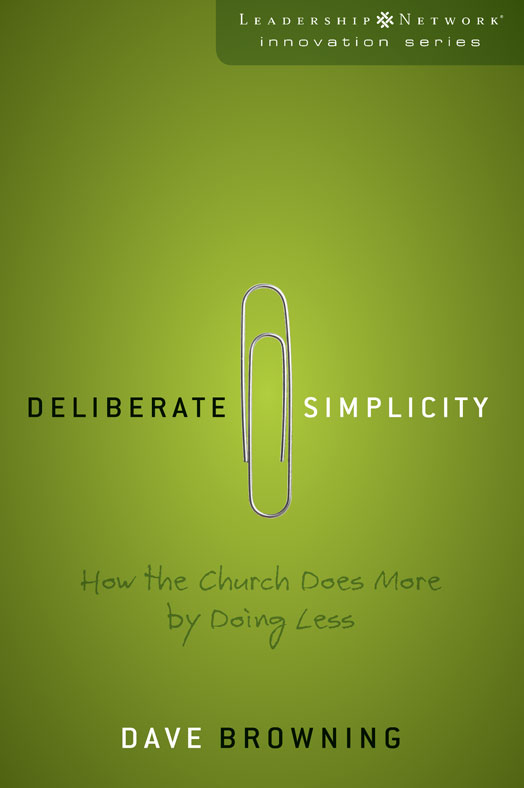
    I’m reading a great book by Dave Browning called Deliberate Simplicity. In one section of the book, Dave challenges us to ask the question, ‘What Drives Our Local Church?” Here’s what he says:

    You cannot do work that matters until you define what matters. A leaders’s job is to clarify and simplify so everyone understands what’s truly important….

    President Calvin Coolidge believed that ‘no enterprise can exist for itself alone. It ministers to some great need, it performs some great service, not for itself, but for others; or failing therein it ceases to be profitable and ceases to exist.’ Perhaps that statement summarizes the reason why many churches are sick and dying….

    Some of the organizing principles that churches adopt (maybe unknowingly) include:


    • Tradition. A church driven by tradition finds itself looking to the past for guidance for the future….
    • Personality. A church driven by personality finds itself directed by a key figure or figures….
    • Finances. A church driven by finances finds itself looking at the budget for direction. If it’s in the budget, we can do it. If it’s not, we can’t….
    • Programs. A church driven by programs defines itself by the programs it offers….
    • Buildings. A church driven by buildings finds itself in constant pursuit of bigger and better facilities….
    • Events. A church driven by events finds itself regularly gearing up for its next concert or pageant or bazaar. While events can be an effective part of any church’s strategy, left unchecked, events can grow to be the ministry….
    • Seekers. A church driven by seekers finds itself trying to get into the mind of ‘the customer.’ Surveys are taken. The results are evaluated. The church’s ministry is driven by polling data. The energy of the body goes into being culturally relevant and seeker friendly….
    • Purpose. A church driven by purpose finds itself evaluating what it does in relation to its sense of purpose. It has a philosophy of ministry that begins with the question, what is the church supposed to do? The church’s goals and objectives become the ruler by which efforts are measured.

    What is the driving force behind your church?

     
    Disclosure of Material Connection: Some of the links in the post above are “affiliate links.” This means if you click on the link and purchase the item, I will receive an affiliate commission. Regardless, I only recommend products or services I use personally and believe will add value to my readers. I am disclosing this in accordance with the Federal Trade Commission’s 16 CFR, Part 255: “Guides Concerning the Use of Endorsements and Testimonials in Advertising.”
  • Kindness Boomerang by Life Vest Inside

    Adam McCain spoke at our church this Sunday and showed this awesome 5 minute clip during his message about the power of doing small acts of kindness for those around us. What a great illustration to remind us of Christ’s command to “Love your neighbor as yourself.”  If we all did this every day, imagine how our world and community would be different! (Note: the construction worker at the beginning of the video is the same one at the end.) Enjoy.

    [youtube http://youtu.be/nwAYpLVyeFU]

    If you can’t see this video, try clicking this link.

    You Might Also Like These Videos:

  • The Internet is a Mission Field

    I ran across this great little video today (90 seconds) that challenges us to include social media and the internet in our creative outreach strategies. How about your church? How’s your website look to guests and those in your community? If you’d like some genuine, unbiased feedback, send me an email. I’ll look it over and give you some thoughts to consider.

    You also might want to check out this article by the good people over at Willowcreek entitled, “Your Digital Front Door“.

    Internet: A Mission Field from Resolute Creative on Vimeo.


  • Great Guest Friendly Posts

    guest-friendly-greeting

    Following are some great posts I’ve discovered in my blog reading that relates to the issue of Guest Friendliness and Customer Service in the Local Church. Forward them on to your ushers, greeters and leadership teams! Enjoy.

    Guest Friendly Series by Wayne Hedlund
    When I did a Google search on “Guest Friendly Church” I was so proud to see several of my very own posts on the first page of results, so it seemed OK to me to include them with everyone elses. If you haven’t read through this series of posts, I invite you to do so. Read More.


    First Impressions Are Virtual by Evan Courtney
    Last summer my family went on vacation with my in-laws to Branson, Mo. When Sunday rolled around it was defaulted to me, being the pastor in the family, to pick a church to attend. I didn’t know anything about churches in the area so I resorted to Googling “Branson church.” Read More.


    8 Points On Great Customer Service by Brad Lomenick
    I’ve worked on some great teams over the past several years, and seen great customer service in action. One of the places I learned the most about great customer service was Lost Valley Ranch, an incredible 4 diamond guest ranch in Colorado. Read More.


    What Do Our Guests Want From Us? by NorthPoint Guest Services
    Every Sunday, every guest who comes into our church wants something from us. If we’re lucky, they will walk up to us and ask for it. Most Sundays, though, they don’t even give us a hint. We just have to guess. Guest Services volunteers are on the front line of giving each guest what they want. What a privilege! And what a responsibility! Read More.


    How To Create A Great First Impression by NorthPoint Guest Services
    “First impressions can greatly impact the emotion consumers feel for a brand. What are first impressions like for your customers?” – The Disney Institute via Twitter What a great question for churches to ask! Every Sunday you create a first impression. When guests first experience your church, they feel something towards your church. Read More.


    My VIP Experience at Elevation Church: First Impressions Matter by Tim Schraeder
    First impressions matter. Oftentimes in the programming and planning of church services we can quickly neglect an important aspect of our worship gatherings: how we welcome first-time visitors. Read More.


  • 19 Tips on Preaching

    I received this email from the team over at preachingrocket.com yesterday and thought it was so helpful I should share it with you. These people know what they’re talking about. You may recognize them from the webinar they hosted and I wrote about entitled,Preach Better Sermons Online Conference. I recommend their webinars and services to pastors at large! Enjoy.

    logo_preaching

    We wanted to share some tips with you that you could apply to your message this week. Don’t try to use all nineteen this weekend just chose one or two to incorporate into your message this Sunday.

    • Get feedback on your message BEFORE you preach it.
      Feedback after the fact is great, but if you seek input before you preach, you can make your message better. This could be as simple as sending it to another pastor, another staff member, or a volunteer or two in your church. Chances are, there are people in your congregation who would review your message seriously and be a great help to you. Ernest Hemingway said the first draft of anything is #$&*@, so make sure you never preach your first draft.
    • Finish on time.
      Whether you use a countdown clock or a watch, it’s a good idea to stick to the allotted time. The Gettysburg Address has 300 words. Nobody remembers the other guy who spoke that day (who spoke for a couple of hours). Besides, nobody ever got mad at the preacher for finishing a few minutes early.
    • Don’t hide in the greenroom.
      Connecting with real people before your message is one of the most powerful things you can do. Last minute study is a sign of poor preparation and while some last minute prayers are always appropriate, that doesn’t mean you can’t speak a few words to people in the congregation. Leave the green room mentality and shake hands with people.
    • Pick a point.
      Most sermons try to cover too much information, so pick a point and stick to it. One 30-minute message isn’t going to be the final word on any topic. If you want to learn how to make that point memorable and sticky, here’s a free webinar that might help.
    • Be interesting.
      Helpful content that doesn’t engage the audience won’t have the desired effect. In other words, be interesting. Boring presentations, lifeless information, and passionless points will sail right over the head of the congregation. And over the head misses the heart every time. It’s absolutely imperative that you have accurate, Biblical content. But it’s equally important to present it in a way that connects.
    • Stories say it best.
      You’ve listened to speakers too, and, chances are, when the speaker told a personal story, your interest level increased. There’s something about stories that cause people to lean in. So make sure you tell a story every ten minutes or so. “Stories are the most powerful delivery tool for information, more powerful and enduring than any other art form,” writes Nancy Duarte.
    • Know your material.
      Before you preach your message to anyone else, you should preach it to yourself. Be familiar with your content so you can preach from your heart. A reliance on notes could be a sign that you don’t know your material. That’s why we teach members how to finish early in the week so the message can sit in a crockpot.
    • Get better as a preacher, don’t just work on your next message.
      Watching yourself on video is a great way to improve. Joining a community of people committed to improvement might also be right for you. For most churches, the sermon is the most visible thing you do and a key component in the discipleship process. So don’t get stuck in a rut, get better.
    • Speak to everyone.
      Those football stories you tell are awesome, and about 30% of the audience really relates to them. Referencing 2 Peter commandment on the fly is cool, but unchurched people think you’re talking about a race. You’ve got a diverse audience – that calls for diverse application and varied illustrations. Make sure your message is sensitive to your audiences (yep, you have more than one).
    • You’re not preaching in the first century.
      From time to time, I meet people who say, “Jesus didn’t need PowerPoint.” That’s true. (He would have used Keynote or ProPresenter anyway.) But Jesus was preaching in a first century context that didn’t have electricity. You didn’t ride on a donkey to church or ask the congregation to bring grain to the alter. It’s okay to use modern methods to communicate a timeless message.
    • Preach to who is NOT there.
      If you want guests, address guests. If you want to reach men, talk to men. If you want to reach the educated, add a little more intellect. Preach to who is NOT in the room, not just who IS in the room.
    • Summarize your sermon for twitter.
      Your sermon needs a central theme or a big idea. J.H. Howett was right when he wrote, “I have a conviction that no sermon is ready for preaching not ready for writing out, until we can express its theme in a short, pregnant sentence as clear as crystal.” We’ve got a
      free webinar that will help you craft these simple statements.
    • Find common ground.
      People don’t think preachers have real lives, real marriages or real struggles, so the fact that you’re a preacher is NOT instant credibility. Make sure you find common ground with your audience to let them know that you share some of their struggles, doubts and feelings.
    • Talk about your failures, not just your successes.
      John Maxwell said if you want to impress people, talk about your success, but if you want to impact them, talk about your failures. When you appropriately share your struggles, mistakes and failures, and communicate from a place of humble brokenness, you’ll make a far greater impact on your congregation.
    • Make people laugh.
      Everybody wants to laugh, and you don’t need to disrespect God’s Word or be a comedian to make people smile in church. Proverbs 17:22 says a joyful heart is good medicine. So let’s not talk about a boring God with lifeless sermons and give people the impression that God has no personality. God created laughter…it’s okay for it to happen in church.
    • Present Jesus as the hero.
      Not the audience, not you, not even the church. No matter your topic, you can find a way to point to Jesus. By the way, that’s exactly what Jesus did when he opened up the Old Testament scriptures and connected the dots for people.
    • Preach to inspire action, not just to inform.
      What do you want people to DO as the result of hearing this message? When Peter finished preaching in Acts 2, he told the people exactly what they should do (repent and be baptized). Make sure you’re not just presenting information but calling people to action.
    • Add some visuals.
      Whether it’s a graphic, or a slide, a prop or an object lesson, look for ways to make your words visual. Study after study shows this is the key to rememberability. If this doesn’t come natural to you, fight through the hard work…it’s worth it.

    One of the most significant things you can do as a communicator is work ON your skill and develop your calling. This is very different from working on your next message. It’s why we created the Core Coaching Program.

    Thanks for letting us serve you today!

    Michael

    CEO of The Rocket Company

    P.S. Here is a summary of the FREE stuff in this email:

    • Preaching With A Point Webinar: How to craft a memorable bottom line statement each week that your church attenders will be repeating on Wednesday at Starbucks.
  • Free Stuff For Churches: NewSpring Church


    The great people over at NewSpring Church, with Pastor Perry Noble, recently released their new Church Resources website. Pastors and church leaders are invited to sign up and download any of the many resources they have developed, free of charge!

    Available For Download:

    • Sermon Series Images and Video Files.
      You’ll have to make sure you have the right programs to update these files for your church. If you do, there are more than 50 series available. To the left is an example of one of a series graphics.
    • Student Resources.
      These student resources may work great in Sunday services too.
    • And More!
      Check out their website to see what else NewSpring Church has available to help your church reach your community!


  • Thursday Quote: Who – The A Method for Hiring

    This is a guest post by Pastor Doug Cowburn II. Pastor Doug serves as the Executive Pastor at Elim Gospel Church in Lima, NY. Recently, while sharing lunch together, Doug told me about this book and readily agreed to writing this Thursday Quote about it for your benefit. Enjoy.


    Recently, two different people I know recommended that I read, Who: The A Method to Hiring. I found that this book was not only a great resource for when you need to hire someone, but also a great way to look at writing your own job description. If you’re like me, you want to know when you are being successful at your job. The problem is that many who are in ministry are either working without a job description or the one they have is all activity based. Activity based job descriptions say things like:
    • Connects with volunteers
    • Teaches on a regular basis
    • Leads the deacon team

    Someone could follow an activity based job description for years and never actually move the needle on the church’s mission. I want to be an “A Player” who delivers his best and contributes toward the church’s vision and mission. In order to do this I need a job description, or as this book suggests, I need a scorecard that gives me some targets to hit.

    Here are some of my favorite quotes from the book:

    “We define an ‘A Player’ this way: a candidate who has at least a 90 percent chance of achieving a set of outcomes that only the top 10 percent of possible candidates could achieve.”

    “The scorecard is composed of three parts: the job’s mission, outcomes and competencies. Together, these three pieces describe ‘A’ performance in the role—what a person must accomplish and how. They provide a clear linkage between the people you hire and your strategy.”

    “While typical job descriptions break down because they focus on activities, or a list of things a person will be doing (calling on customers, selling), scorecards succeed because they focus on outcomes, or what a person must get done (grow revenue from $25 million to $50 million by the end of year three). Do you see the distinction?”

    “Scorecards: • Set expectations with new hires • Monitor employee progress over time • Objectify your annual review system • Allow you to rate your team annually as part of a talent review process.”

    As you can see, this book was written primarily for the business world, but it has huge implications for ministry related job descriptions as well.  What would your scorecard look like?

  • Thursday Quote: Enchantment – Enchanting Volunteers

    I recently heard about a gentleman who left his church (after many years) because he had nothing important to do there. While he was telling his story, he included the fact that the church he was currently involved in almost immediately got him involved in ministry and he is active, excited, and doing a lot more than he ever imagined he would. He’s also considering full time ministry as a result.

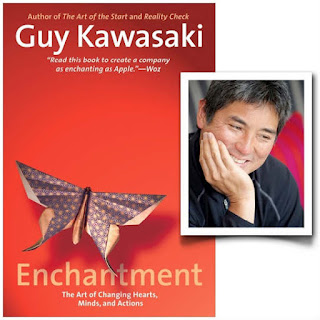
    It can be very difficult to recruit church-goers into ministry roles. Some shy away from it altogether; and many who do recruit people for ministry often do so apologetically. In today’s Thursday Quote I’d like to share an awesome excerpt from the book Enchantment: The Art of Changing Hearts, Minds and Actions by Guy Kawasaki. Although the author makes no claims to Christianity, I’ve found many of the ideas and principles in this book apply directly to Christian Leadership.

    How to Enchant Volunteers
    Volunteers help organizations all over the world, and they are essential for the welfare and success of educational, environmental, social, religious, and other philanthropic causes. While the techniques already discussed in this chapter also pertain to volunteers, these folks deserve their own rules for enchantment: 
    • Set ambitious goals. Volunteers want to know that what they are doing is important and that they are making a difference. Your obligation is to set challenging goals and not waste their time. If there’s anything worse than overusing volunteers, it’s underusing them.
    • Manage them well. When people believe, they want to help, and it’s your responsibility to enable them to help as much as they can This includes planning and organizing how you’ll utilize their activities. You may not be paying them, but their time is still valuable.
    • Enable them to fulfill their needs. Why do people join a nonprofit organization? There are three principal reasons: duty (“I should help my kid’s school”), belonging (“I like doing things with people”), and mastery (“Learning a new skill is more important than money”). Fulfill these needs, and you’re on the way to enchanting your volunteers.
    • Ensure that the paid staff appreciates them. You and your employees must believe in the value of volunteers – if you lack this belief, maybe you should not recruit them. Volunteers often give their heart and soul to an organization, so it’s important that your paid staff appreciates their efforts.
    • Give feedback. People want to know how well they are doing. With volunteers, this is doubly important because you can’t use compensation as a feedback mechanism. So after you set your ambitious goals, provide feedback, and they’ll love you for helping them learn how they are progressing.
    • Provide recognition. Recognition comes in small forms for volunteers: business cards, an e-mail address, a workspace (even if it’s shared), attendance at conferences and public and private expressions of gratitude. See anything that’s expensive on this list? Good, because there isn’t.
    • Invite them in. At least once a year, invite your volunteers into your headquarters. This enables people to meet face-to-face instead of only virtually. Remember the value of proximity to achieving likability? The same concept applies to volunteers.
    • Provide free stuff. “Stuff” means food and drink at working sessions as well as T-shirts and other forms of tchotchkes. Unfortunately, these kinds of goodies are often the first thing an organization cuts when going gets tough, but, dollar for dollar, they are among the most cost-effective forms of compensation that you can offer.
     
    Disclosure of Material Connection: Some of the links in the post above are “affiliate links.” This means if you click on the link and purchase the item, I will receive an affiliate commission. Regardless, I only recommend products or services I use personally and believe will add value to my readers. I am disclosing this in accordance with the Federal Trade Commission’s 16 CFR, Part 255: “Guides Concerning the Use of Endorsements and Testimonials in Advertising.”
  • Unlocking the Secrets of Church Sound


    This is a guest post by Josh Cummings. For many years Josh served as the Technical Director at Elim Gospel Church in Lima, NY. Josh is passionate about all things audio & visual. His world includes wires, cables, buttons, knobs, computers, software, lights, speakers and a million other odd and weird knick-knacks. He is, by far, the coolest tech-dude I know.

    You might also enjoy reading my other posts in this series entitled ‘Turn the Volume UP!‘ and ‘Turn the Volume DOWN!‘.


    Poor sound can be extremely distracting. We’ve probably all been there: the worship leaders mic gives annoying feedback during the service, the preacher sounds like he’s underwater, or you can’t hear the lead vocals over the band during worship. Though it is often a thankless role, the church sound tech has the power to enhance or detract from the communication of the gospel in our church services. With that much depending upon one person, I thought I would give you a few tips on how to improve in this article on the art of mixing.

    • Preparation will save you time and stress.
      Before I tell you anything else, I want to give you the number one rule of using technology in church: Test everything. Trust people, not equipment. You’ve probably tried to play a video at some point during a church service and experienced the awkward embarrassing silence that follows when the video doesn’t work. With a little preparation, you can make sure that it doesn’t happen again (or nearly as much). Don’t blame the “demons in the sound system” when you could have prevented the problem with proper preparation. Take the service plan and go over every detail and press every button just like you would in a service. Years ago, we made a decision to rehearse our entire Sunday morning service, minus the preaching. We catch problems every single week and I know that it was one of the best things we have ever done to increase the quality of our services.
    • Mic that kick drum!
      Most local churches do not mic the drum set. If I were to only mic one drum, it would be the kick drum. This will add punch and rhythm to your mix and give your worship more overall energy. If your room is large enough, I recommend mic-ing the entire drum set, but mic-ing the kick drum is the place to start.
    • Set gain levels first.
      Gain is the master volume for each channel on your mixer, which affects the monitors, house mix (“house” mix is what comes out of the main speakers in your sanctuary), and more. Set the house volume fader to 0, and turn up the gain until the level is approximately where it should be in the house or slightly above. This gives you a good basic level for each channel. Do not mix with the gain knobs. Set them to the right levels and then adjust the house mix using the house volume faders.
    • Set monitor levels.
      If you’re not using in-ear monitors, I recommend putting as little as possible in the monitors while still supporting the worship team properly so that they can hear themselves. This will keep your stage noise to a minimum and give you a more intelligible house mix. A good method for setting monitor levels is this: do a basic mix for each monitor mix, have the band run a song, then adjust one channel at a time while band members give you a thumbs up or down to let you know how much they need in their monitors.
    • Shape the tone with EQ.Please, please, use the equalization (EQ) controls on your mixer. EQ takes a specific frequency or frequency range and turns it up or down. You are a sculptor of sound and the worship team has given you a lump of clay to mold into a masterpiece. If you don’t use the EQ to improve the tone of your mix, your museum will be showing an ugly lump of clay on Sunday morning. This is a huge subject to delve into, and can immensely improve your mix if used properly. For example, your bass guitar will sound nasty if you don’t turn down 300Hz, the violin doesn’t need any bass in it, and you can reduce feedback by cutting the frequency that is feeding back. Just turn up the EQ gain, sweep the frequency knob, find the nastiest sound you can, and then turn it down accordingly to its nastiness. If you want to learn more, here is a helpful blog post on EQ.
    • Regulate your levels with compression
      Compression will cut down on all of those sudden loud noises from your vocals and instruments. When you cut down those spikes in volume, you can have a more consistent and less dynamic sound from that channel. If you use it on one thing, use it on the lead vocal mic.
    • Enhance your vocals with reverbA tasteful amount of reverb can make a good vocal sound fantastic, but it unfortunately won’t make a terrible vocalist sound like Pavarotti!
    • Highlight the lead vocals!In any context, the lead vocals should be the most prominent sound, but even more so in church, where the congregation needs to know the melody to sing along in worship to God. Don’t let anything overpower the lead vocals in your mix. Spend the most time getting the lead vocals just right compared to other channels in your mix.
    • Mentally listen to one instrument at a time.
      To create your mix, listen to each instrument one at a time. Mentally block out all of the other instruments, listen, then decide if that instrument needs to be louder or softer in the mix.
    • Budget your mix.Just like your values will drive how you spend your money, you need to decide what instruments have the most value in your mix and budget your levels accordingly. For example, I will mix foundational instruments like piano and acoustic guitar a bit softer, and more interesting lead instruments like electric guitar or violin a bit louder. Those interesting lead parts have more value to me, so I make them more prominent in the mix. There are no exact rules for mixing, only guidelines. This is where mixing becomes an art.
    • Mix around the same overall deciBel level every week.It’s amazing how easy it is to upset people with the volume levels of your church sound system. Make a team decision as to how loud it should be, and keep it the same every week. I would recommend purchasing a decibel meter if you can to ensure the consistency of your levels.
    • Refine your ear by listening to high quality music.It is entirely possible that you or the sound techs at your church haven’t experienced high quality sound very much, or at least haven’t listened with an analytical ear. If you want to get better, listen to high quality recordings and concerts, and try to imitate the way they do things.
    • Clear up your house mix by reducing stage noise.Stage noise often causes all sorts of problems with your house mix. I can’t go into all of the details in this post, but anything you can do to reduce your stage volume will create a clearer mix in the house. You could use a shield or an enclosure for your drum set, or you could use in-ear monitors for your worship team.
    • Take yourself to school.Never stop learning. There is always more to learn about live sound. Connect with other church sound techs and learn what you can from them. Use Google to discover helpful websites like www.prosoundweb.com, www.churchsoundguy.com or www.churchtechtoday.com. Attend a How-To Sound Workshop. Keep seeking out more knowledge, and you will keep increasing in your skills as an audio engineer and your ability to serve the local church in this way.