Category: LEADERSHIP

Leadership Articles prior to 2016

  • The Four C’s


    In my last two blog entries I have been talking about the importance of getting the right people on your bus and also making sure you have the right people in the right seats.

    In particular, it is very important that every team member is aligned with you in four different areas. At Elim Gospel Church, we simply call these “The Four C’s”. Three of these “C’s” Bill Hybels talks about in his Leadership Book, “Axiom: Powerful Leadership Proverbs”. Whether you are looking for someone for your Strategic Team, for your board of directors, for the director of your men’s ministry or for your newest secretarial hire, these four criteria should be evaluated as part of the recruitment process.

    Character: It goes without saying that character is critical when recruiting someone to an influential position. What is often NOT said, or thought about, is just what “character” traits you are looking for. We tend to see people as “good” and have a hard time labeling them as someone lacking in character.

    You should identify your own list, but here are a few things we deem very important:

    • Team Player
    • Teachable
    • Honest
    • Attends Regularly
    • Serves Regularly
    • Gives Regularly
    • Submitted to Leadership
    • Growing Christian
    • Positive Example in Life

    Competency: The business world has this one figured out. They’ve got resume’s, job applications, and interviews down pat. The Christian world? Not so good. Again, it seems like we somehow think it’s “unchristian-like” to evaluate whether someone actually has the right skills for the job. Classic example: the lady who played the organ when growing up in church during my teen years. Was I the only one that noticed she didn’t have any rhythm and constantly got the wrong notes? Oh yeah, and she couldn’t really sing either.

    When recruiting, for anything, figure out in advance what competencies are required for that role; then you can begin the process of deciding who best meets those criteria (along with the other 3 “C’s”.)

    Chemistry: Again, this area is one many leaders are afraid to discuss or consider. This is the arena where you determine if the person in question is going to be a good fit in your culture as well as with you as their leader. Chemistry is not to be confused with character. It is strictly about whether this person carries the key aspects of your ministry DNA or not. This is why nearly every great leader in both the marketplace and ministry will tell you that it’s much better to hire from within – because those people will be much more likely to be DNA carriers and score high in chemistry with you as their leader.

    Here is what I have discovered about how chemistry impacts your team and ministry. When you have a team player that is high in chemistry with you and your organization, you will very likely have little relational conflict. Conversely, when chemistry is low, conflict will likely abound. I’m not talking about the constructive conflict that should be in every relationship and team. I’m talking about the conflict that continually rises up because two different worlds/mindsets/standards keep colliding. This is also why it is becoming more and more popular for organizations to hire competent but young and less experienced people as opposed to those who have a ton of experience. The more experienced professionals also tend to have a lot of opinions and mindsets on what should be done and how to do it.

    Calling: The final “C” we look for when hiring or recruiting is also critical to us. We actually walk all new hires through these four C’s and end with this one. This is our reminder that God has an interest in this decision. Jesus told us to “Seek first the kingdom of God and His righteousness…” God told Jeremiah, “I know the plans I have for you…” So we remind the candidate to seek God for His purposes for them and we do the same. It is quite possible that the person would be a great match in every other way, but that God is directing them towards something else in your organization or in the world.


    We take these criteria very seriously. If even just one of them doesn’t seem to be lining up, we slow everything down and re-evaluate. Better to struggle through a leadership void for a season of time than to get the wrong person on the bus and find out 6 or 9 months down the line that they aren’t going to work out.

    Disclosure of Material Connection: Some of the links in the post above are “affiliate links.” This means if you click on the link and purchase the item, I will receive an affiliate commission. Regardless, I only recommend products or services I use personally and believe will add value to my readers. I am disclosing this in accordance with the Federal Trade Commission’s 16 CFR, Part 255: “Guides Concerning the Use of Endorsements and Testimonials in Advertising.”

  • What’s the Big Deal About a Wrong Seat?

    OK. So we have acknowledged that there are different kinds of seats on the bus. Why is this so important? Would it really be that big of a deal if team members picked their seats? What if someone who sits in the middle of the bus decides they would really like to hang out in the back of the bus? Shouldn’t we let them?

    Do you remember where you sat on the bus when you were a grade-schooler or teenager? It’s pretty likely that, although you perhaps thought you would enjoy sitting somewhere else, if you did you would have felt really out of place. Or perhaps your parents made you sit in the front and you couldn’t wait for the ride to get over?

    The point is, team members should be placed on the RIGHT team for their OWN benefit as well as the benefit of your organization. This is especially true when it comes to identifying who should be on your strategic team. It’s not for everyone to sit in the back of the bus. The conversations taking place in healthy strategy meetings will include honest and open assessments of current ministry, big picture brainstorming, and plans to make both small and large shifts and changes in your organization. Some of those conversations are enough to send your average “tactically-minded” team member to counselling for weeks.

    Here are some signs you may have the wrong person in the wrong seat in Strategic Meetings:

    • He rarely speaks during the meeting.
    • She often fidgets or is disengaged from the conversations.
    • When he does share, his comments seem to reflect a misunderstanding of the general direction of the discussion.
    • She seems distressed during the meeting most of the time.
    • He constantly brings up reasons why ideas won’t work.
    • She regularly resents or defends ministry evaluations.
    • He is emotionally exhausted after each of the meetings.
    • She gets overwhelmed and excessively emotional during or after the meeting.
    • He keeps turning the conversation towards the details – “Who is going to do that?”, “Where will we get the money?”, “How will we ever be able to recruit people to get involved?”, etc.
    Do your ministry a favor. Be careful in who you choose to be on your Strategic Team. Over the next few entries I will share more ideas on how to pick the right people for your Strategic Team.
  • The Chicken or the Egg?

    Philosophical Dilemma: Which came first, the chicken or the egg?

    Evidently the age-old question has finally been solved. Ironically, the solution British scientists have come up with supports creation pretty well! If you are into poultry philosophy, fell free to check out the article here.

    Leadership Dilemma: Which came first, the strategic plan or the strategic team?

    Most of the business and ministry world would likely have answered this question with, ‘the strategic plan’. After all, doesn’t it make sense that we determine where we want to go, what our vision is, and THEN pull together a team of people to implement that vision? I would have thought so myself until I read the book, “Good to Great” by Jim Collins (I recommend this book!). Listen to what Jim had to say about great leaders:

    “We expected that good-to-great leaders would begin by setting a new vision and strategy. We found instead that they first got the right people on the bus, the wrong people off the bus, and the right people in the right seats – and then they figured out where to drive it. The old adage, ‘People are your most important asset’ turns out to be wrong. People are not your most important asset. The right people are.”


    Disclosure of Material Connection: Some of the links in the post above are “affiliate links.” This means if you click on the link and purchase the item, I will receive an affiliate commission. Regardless, I only recommend products or services I use personally and believe will add value to my readers. I am disclosing this in accordance with the Federal Trade Commission’s 16 CFR, Part 255: “Guides Concerning the Use of Endorsements and Testimonials in Advertising.”

  • Being Spiritual

    George Washington’s Prayer at Valley Forge

    I spent the last month focusing almost solely on “Being Strategic”.

    What about “Being Spiritual?” Where does God fit into the mix? Important question. The answer to that question will ultimately determine “the path” you take in all of your plans. God has always been very clear that His purposes and His will are what we should be seeking, not ours.

    “Many are the plans in a person’s heart, but it is the LORD’s purposes that prevails.” Proverbs 19:21

    “Unless the LORD builds the house, the builders labor in vain. Unless the LORD watches over the city the guards stand watch in vain.” Psalm 127:1

    “Commit to the LORD whatever you do, and he will establish your plans.” Proverbs 16:3

    Job gives us a great reminder that we should always remember to submit our plans, ideas, and dreams to the Lord. It’s vital that every step we take is God inspired and God ordained.

    “Then the LORD spoke to Job out of the storm. He said: Who is this that obscures my plans with words without knowledge? Brace yourself like a man; I will question you, and you shall answer me.” Job 38:1-3

    Here’s my challenge for you . . . . Pray. . . . Seek God. . . . Dedicate yourself to listening to His voice. . . . Fast.

    Recently my pastor was speaking to our leadership team about prayer. We are gearing up right now for our second annual 21 day fast beginning in January. We’re calling it “Fast Forward 2011”. Check out some of these quotes from Pastor Josh’s message to us:

    • “Prayer is the single most resisted activity by the enemy.”
    • “Prayer is one of the highest forms of spiritual stewardship.”
    • “Jesus said, ‘Without me you can do nothing.’”
    • “Prayerlessness is not because of busy-ness, it’s because of pride.”
    • “Prayer is the ultimate surrender.”
  • Being Strategic

    The last couple of weeks I’ve walked through a blog series called “A Guest Experience.” If you followed along at all you discovered that I was using a unique strategic process to solve a problem in the context of the church environment. I’ve said many times to my colleagues and friends that I wish I had this book available to me many years ago.

    That said, I’d like to give credit where it is rightfully due.

    Erika Andersen is a business thinker and the author of the book “Being Strategic“. Nearly all of the ideas and methods I have introduced in my most recent blog series are directly from that book. There is a lot more in the book I haven’t talked about. Being strategic with groups, building a culture of strategic thinking and the art of facilitating meetings are a few.

    I highly recommend this book to you. You can pick up a copy right here at Amazon.com.

    You may also go to Erika Andersen’s website to learn more about her at erikaandersen.com or visit her blog at Forbes.com.

    Disclosure of Material Connection: Some of the links in the post above are “affiliate links.” This means if you click on the link and purchase the item, I will receive an affiliate commission. Regardless, I only recommend products or services I use personally and believe will add value to my readers. I am disclosing this in accordance with the Federal Trade Commission’s 16 CFR, Part 255: “Guides Concerning the Use of Endorsements and Testimonials in Advertising.”

  • The Big Road Block


    Road-ClosedI’ve heard it said that there are two seasons in Upstate New York: Winter and Construction. We’re feeling it right now in the small suburban town that I live in. Every day several handfuls of construction workers magically appear to repave our roads and rebuild the local bridges.

    The bridge construction, in particular, has been quite frustrating. An entire section of road will be shut down for 3 weeks to a couple of months. Ugh. The first local bridge they worked on required a long, convoluted detour. I even discovered that the construction crew went on some sort of strike for a couple of weeks. I don’t know the details, I just remember thinking, “This is really ridiculous! We have a well traveled road that can get me to my destination in great time that is not being fixed and has been road-blocked indefinitely!”

    That said, here’s what I discovered: I GOT USED TO IT. It was a mild annoyance, but eventually I adjusted my expectations and plans and just used the detour all the time. I had no idea when the road would reopen so it became pretty irrelevant as I adjusted to the new pathway. A new pathway that was long, tedious, and not very productive.

    I’ve discovered that many of us have a road block like this that needs to be overcome before we see any meaningful changes in our ministry and at our church. It’s a road block that we don’t think about very much. We just bypass it, deal with it, live with it, adjust to it, even forget about it. We’ve gotten used to doing ministry the long, tedious, and not so productive way. This road block can be a major key to launching change. You get this particular road opened and you may discover a brand new path to effective and powerful ministry.

    The road block is YOU. Think about it. If you are the primary or even secondary influencer in your church or ministry, who is really stopping you from fulfilling the calling of God for your church and on your life? It’s so easy to blame the conditions around you, to describe all the reasons or excuses that stand in the way, to determine that the solution is beyond your control and external. In fact, it’s easy because it means you don’t have to take responsibility. You just convince yourself that there are good reasons why certain things can’t happen, and you just have to live with them.

    But what if the real problem was a wrong mindset that you believe? What if the road block is your way of viewing your ministry and situation? Perhaps the bridge is out and you’ve gone on strike…indefinitely. While on strike you’ve adjusted how things work so that the ministry continues – but it’s entirely ineffective. What if your predecessor is the one who created the detoured path you are on because his thinking was on strike and you’re now following the same path?

    I’m not saying that there aren’t limitations and natural barriers to the fulfillment of your God-ordained vision. I’m just saying that ONE of those barriers may very well be your perceptions and internal dialog about how you can reach that vision.

    I’d like to propose that it IS possible to see God’s purposes and vision fulfilled. After all, if it’s a God-ordained vision, then He’s interested in seeing it fulfilled even more than you are! It’s not your responsibility to MAKE that vision happen, it’s your responsibility to fulfill your part of that vision and let the Holy Spirit breathe life, prosperity, and blessing into it.

    Maybe I’m missing all the ingredients, but it seems to me that at least three primary ones would be:

    1. FAITH. You need to believe it’s from God and live and act like it will happen. I think it’s OK to have doubts. We see plenty of that in the Bible. What’s not OK is forgetting that God is the overseer of your ministry, not you.
    2. A PLAN. We would all love it if God would just step in and make it all happen. Alas and alack, he wants us to do the planning part, with His leading, instead. Nehemiah made plans to build a wall. David made plans to conquer a nation. Joseph made plans to overcome a God-revealed famine. The disciples made plans about where they would go, when they would leave, and often what they would do while they were there. And of course, Jesus lived out a God-sized strategic plan for the salvation of the world.
    3. COMMITMENT. That means you are willing to press through the dips, the valleys, the rough times. It means you’re willing to work hard, to read a lot, to ask for help, and to make changes that will require a level of self-sacrifice that will be uncomfortable. It means you’ll take risks and fail sometimes and then get up and try again. It means you won’t give up.

    HOW DO YOU KNOW IF YOU’RE IN THE WAY? How about starting by asking three questions:

    1. Do I have faith that God can and will lead me to where I believe this ministry is supposed to go?
    2. Do I have a plan to get there?
    3. Am I willing to make sacrifices on the way?
  • Bill Hybels & Humility in Leadership

    It is becoming increasingly clear to me as time goes on how important the attribute of Humility is for leaders in organizations. Not just THE leader, but all of the leaders in your church or ministry. This year at the Willow Leadership Summit, Jim Collins, author of the book, “How The Mighty Fall” and “Good to Great” said:

    “The single greatest leadership signature we found in organizations that moved from good to great and who stood the test of time for decades was this: Personal Humility.”

    After listening, as well, to one of the greatest leaders in this generation, Bill Hybels, I was reminded again of how true this is. Bill has made a huge, exponential impact on God’s church that may never stop until the Lord’s return. And yet, he stands before hundreds of thousands of people and says, “Sometimes I am just not sure if I’ve got the right stuff to lead.” He then told the story of how critical it is that he leans and rely’s on God.

    The man has tremendous humility.

    How about you. Do you see yourself as a person with humility before God and man? Or as someone who’s ‘got the stuff’ and entitled to the place you now serve? How about your leadership team?

    Disclosure of Material Connection: Some of the links in the post above are “affiliate links.” This means if you click on the link and purchase the item, I will receive an affiliate commission. Regardless, I only recommend products or services I use personally and believe will add value to my readers. I am disclosing this in accordance with the Federal Trade Commission’s 16 CFR, Part 255: “Guides Concerning the Use of Endorsements and Testimonials in Advertising.”

  • Overcoming Barriers to Church Growth

    Several years ago we read a book as a team that really started us on the path of strategic planning at Elim Gospel Church. It was called, “Leadership Transitions for Growth” by Michael Fletcher. The book has now been re-released by the title, “Overcoming Barriers to Church Growth“. It’s a short and easy read, and played a big role in helping us to change our mindset as a leadership team for growth.

    Among other things, the book discusses how to build a leadership structure for the NEXT stage of growth you are believing God for in your church/ministry. He said it best on page 43:

    “To cross over into a new stage, leaders must understand what lies ahead and make the necessary realignments before they expect to move to a new level of growth.”

    He explores three questions for small size churches (under 200), medium size churches (200-700), and large churches (over 800):

    1. How do the Elders relate to ministry?
    2. Who does the ministry?
    3. How are decisions made?
    If you have been struggling getting your footing in church growth, I would recommend this book as a resource, especially in the area of how your church leadership is currently structured.

    Disclosure of Material Connection: Some of the links in the post above are “affiliate links.” This means if you click on the link and purchase the item, I will receive an affiliate commission. Regardless, I only recommend products or services I use personally and believe will add value to my readers. I am disclosing this in accordance with the Federal Trade Commission’s 16 CFR, Part 255: “Guides Concerning the Use of Endorsements and Testimonials in Advertising.”
  • Attributes of a Church in Decline

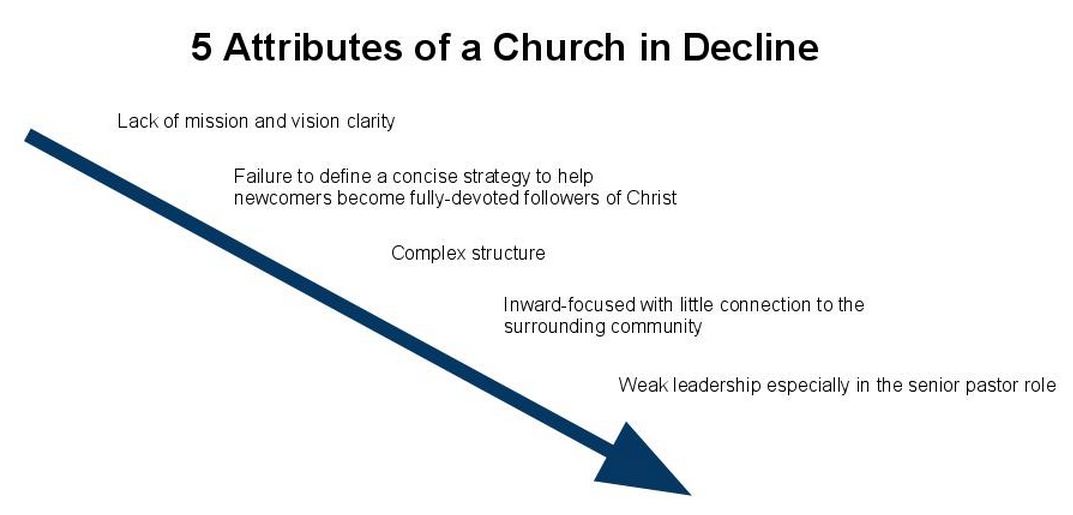
    Tony Morgan grabbed my attention again this week in his blog entitled, “5 Attributes of a Church in Decline”. He shared what he and a fellow blogger felt could be five key attributes of a church in decline. What strikes me as so interesting is simply that all five attributes are indicative of a church that isn’t led by someone who thinks strategically for the future. For instance, as I’ll share in a future entry, a clear mission and vision is a very basic and key first step in strategic planning. What do you think?

    In case you have a difficult time reading this chart, the five attributes are:

    • Lack of mission and vision clarity.
    • Failure to define a concise strategy to help newcomers become fully-devoted followers of Christ.
    • Complex structure.
    • Inward-focused with little connection to the surrounding community.
    • Weak leadership especially in the senior pastor role.