Category: Volunteers

  • Seats on the Bus

    Seats on the Bus

    In his book, Good to Great, Jim Collins says, “We expected that good-to-great leaders would begin by setting a new vision and strategy. We found instead that they first got the right people on the bus, the wrong people off the bus, and the right people in the right seats – and then they figured out where to drive it. The old adage, ‘People are your most important asset’ turns out to be wrong. People are not your most important asset. The right people are.”

    He hit the nail on the head. Ministry is not just all about having people around doing things; it’s also about paying attention to what they are doing as well. Unfortunately, I think this ideas sort of locks many of us up. We think, “How am I supposed to find the exact right seat for everyone?” Ugh. Some of us can hardly figure out where WE fit in, much less trying to figure out which seats on the bus everyone else is supposed to fit.

    MY RECOMMENDATION: START WITH SECTIONS.

    What if we just started by getting people in the right section of the bus instead? Generally, we have three kinds of people in our church: Creatives, Doers & Leaders. Yes, I know. Sometimes people can be a mixture of one or more of those. But generally speaking, if we know what kind of people we’re dealing with, we can seat them where they fit best and worry about finding their exact seat as time goes on.

    The back of the bus – Creatives

    Everyone knows that the troublemakers like to sit in the back. If you’re sitting back there, you probably want to be far away from what’s really going on. You aren’t interested in where the bus is going right now. You just want to utilize your creativity to dream, talk, and get into just enough trouble that the bus driver doesn’t notice. 

    This is where strategic thinkers and creatives sit. They are big-picture people. They like to try new things. They are sometimes critical thinkers (I didn’t say critical people!) They are the ones you want in the room when you’re dreaming about the future, evaluating how things are going and discussing creative, new things to do or ways to do them. 

    These people don’t need a lot of authority to make choices, they just need a platform for their thoughts and ideas to be heard. Great leaders will gather them together to hear them out and learn from them. They also tend to be early adopters, ready to jump in with both feet when it’s time for change.

    The front of the bus – Leaders

    If you’re sitting at the front of the bus it’s likely because you want to be close to the action. You want to see who’s coming in and out the door. You want to talk to the bus driver. You want to see where the bus is going next and you want to play a part in how you will get there.

    This is where the the leaders sit; the ones who make decisions. These are the people in your organization who will actually decide the future and direction of the church. Sometimes the Creatives & the Leaders are the same people. However, often it’s wise to have them sit in a separate section of the bus. Of course, if you’re driving a small bus (a small church/ministry) you don’t always have that luxury. 

    In a perfect world, the Creatives come up with some great ideas, feedback and insights and the Leaders can then determine which one’s will work best for the bus based on it’s mission and where it’s going.

    The middle of the bus – Doers

    If you’re sitting in the middle of the bus you are likely in your own world. You’ve got your iPod in or your just hanging with everyone else in that section. Sometimes you like to listen in on the talk in the back of the bus and sometimes you like to sit near the front to get a feel for the action, without having to be involved. You aren’t cut out for the intensity of the back of the bus and you aren’t really super interested in where the bus is going. You just like being IN the bus.

    This is where the doers sit. These are the people who will do whatever is necessary to keep the bus moving and support the vision of the leaders. They are the ones who will dig their heels in and grind out the plans you have made. Your doers don’t make a lot of decisions, and they don’t want to. They do the work based on the decisions that have already been made, and they do it well.

    About Your Bus

    Here are a few closing observations about how these sections work (or don’t work) in different ‘buses’ or ministries.

    • In my experience, the middle of the bus (Doers) is where the vast majority of people sit, like 90%. There are usually only a few seats in the front and a few seats in the back dedicated to Creatives and Leaders.
    • If a bus has too FEW Doers, it end up coming up with a lot of ideas/plans that never get done. Innovative ideas & new paths don’t get built. The bus doesn’t stop when it should to take on new passengers. It sometimes doesn’t get cleaned properly and needs a fresh coat of paint. You get the idea.
    • If a bus has too FEW Leaders, the bus tends to take loopy circles and gets distracted going places it doesn’t need to go. It also runs inefficiently and needs to spend a lot of time in the shop with repairs. Often, the bus looks great but is going nowhere important.
    • If a bus has too FEW Creatives it takes the path it’s always known, even when there are better paths to take. The bus stays old and eventually becomes uninteresting to prospective new passengers. 
    • The smaller the church, the more Creatives and Leaders have to double up and also be Doers. There is less of a clear demarcation between the different seats.
  • where there are no oxen . . .

    This article was originally posted on Transforming Leader the winter of 2010. Enjoy!


    there-is-no-oxen

    I remember talking to a pastor once at a conference about the challenges he was facing at his church. He jokingly said, “Church work would be a lot easier if it weren’t for the people.” I understood that he was just dumping on me and that he really did love the ministry and his people; but I remember the remark because I’ve heard it many times over the years (and probably have said it a couple times too).

    We all know that people are often difficult to be with, work with, and lead. They can be self-centered, egotistical, critical, needy, stupid, hurtful and so much more (just like you and me). Sometimes it can be so discouraging watching them stumble through life choices despite godly input and advice.

    It’s no wonder that we pastors and leaders are often reticent or even scared to get others involved in leadership with us. The potential for conflict, discord, and crisis just doesn’t seem worth it. The idea of inviting other people with all of their internal garbage to join in building the kingdom dream God has given us seems really risky.

    Is it possible that it just might BE too risky for you? Jesus cautions us to carefully count the cost before we commit to a cause for Him in Luke 14:28-30.

    “Suppose one of you wants to build a tower. Won’t you first sit down and estimate the cost to see if you have enough money to complete it? For if you lay the foundation and are not able to finish it, everyone who sees it will ridicule you, saying, ‘This person began to build and wasn’t able to finish.’ Or suppose a king is about to go to war against another king. Won’t he first sit down and consider whether he is able with ten thousand men to oppose the one coming against him with twenty thousand? If he is not able, he will send a delegation while the other is still a long way off and will ask for terms of peace. In the same way, those of you who do not give up everything you have cannot be my disciples.”

    People Risk Taking
    Perhaps you don’t really need to hear it, but I am feeling prompted to press the point. If you want to see your ministry grow you must be willing to make some people risks. That means ministry will get more challenging; but it also means your ministry has room for God inspired momentum.

    We’ve all heard the verse in proverbs, “Where there are no oxen, the manger is empty, but from the strength of an ox come abundant harvests.” Proverbs 14:4.

    Clean and empty sounds good, orderly, and predictable; but clean won’t plow the fields. Clean won’t sow the seeds. And clean won’t bring in the harvest. The oxen were critical to the success of the local farmers. Without the oxen and the mess that came with them there would be no farm.

    The same is true for your ministry. Without a team of people and growing leaders around you the work of the Lord will not grow and prosper.

    You know what those farmers spent a lot of time doing? Cleaning up after the oxen. They didn’t go home and complain to their wives, “Those stupid beasts! Why don’t they just quit crapping all over the place? What’s the deal with them anyway? Farming would be a lot easier without them!”

    Hey, if you’ve actually got messes to clean up, thank the Lord, roll up your sleeves, grab a shovel, and dig in. You are pointing in a direction that may well lead towards an abundant harvest.

    photo credit: caese via photopin cc

  • zombies, athletes and superheros

    This article was originally posted on Transforming Leader the winter of 2010. Enjoy!


    In a past post I attempted to convince you that you shouldn’t be strategizing, planning, and goal-setting alone. God never intended or planned for you to be the ‘Jack of all Trades’ pastor. Not convinced? Read 1 Corinthians 12 again – you probably preached on that passage or referred to it sometime this year. It applies to you too! I don’t know which part of the body you represent in your local church – but I do know that you need the other parts for the work of God to be a success through you.

    One of my favorite people is my spiritual and ministry mentor, Pastor Mike Cavanaugh. He serves as President of Elim Bible Institute and Vice President of the ministerial association I serve with, Elim Fellowship. He has been a great example of someone who is not afraid to find his niche and then let others serve with and around him in theirs. I’ll never forget one instance many years ago when he was serving as the Lead Pastor of Elim Gospel Church.  He asked me to lead all of our church strategic meetings, with him sitting as one of the team members! He wasn’t afraid to relinquish control in order to see the church grow. He didn’t feel the need to do everything himself. He was open to allowing others to try, fail, and eventually grow to become all or more than he could become himself in various areas.

    There are three kinds of leadership teams:

    • Solo leaders drive a bus-load of zombies. Everyone just goes where they say and nobody thinks to get much involved.
    • Good leaders drive a bus-load of athletes. They carry committed people who will go out of their way to serve, help, and grow under their leaders tutelage and coaching.
    • Great leaders drive a bus-load of superhero’s. These leaders have the self confidence to allow other leaders to serve alongside them; they love to release the team around them to excel beyond them.


    One Question Survey

    Where do you stand when it comes to gathering, equipping, and releasing others to serve with you in the calling God has for the ministry you lead?

    On a scale of 1 – 5…

    1 = “I don’t have a team of people around me. I pretty much do everything myself. I either don’t trust others to get involved or I don’t believe there are others around me capable of doing what needs done in this church/ministry.”

    2 = somewhere between 1 and 3.

    3 = “I have a team of people around me. They are committed to the ministry and to me. They are expanding what I am capable of doing because my time, effort, energy, and ideas are amplified with their presence. However, none of them are offering something to the team that I couldn’t offer myself. Some have leadership gifts, but most don’t have much of an opportunity to be totally released in them.

    4 = somewhere between 3 and 5.

    5 = “I have a team of committed leaders surrounding me. They are my dream team. Many if not all of them provide leadership and strengths to this ministry that I could not provide myself if I were in their shoes. They have surpassed me in many areas or are well on their way to surpassing me.”


  • Push that Bus!

    This article was originally posted on Transforming Leader the winter of 2010. Enjoy!


    Have you ever tried to push a stalled car down a road by yourself? I have. Many years ago (when I was young and stupid) my car ran out of gas right in the middle of the road. I was also only a block away from the gas station. I jumped out and attempted to push the car to the gas station. My nemesis turned out to be a red light. After excruciating effort (and several cars waiting for me) I finally got enough momentum to get across the road and to the gas station. Ugh. Besides being embarrassing, it was very hard; but I made it.

    Rewind about 4 years prior to that when I was in college. I was part of the Roberts Wesleyan College Chorale and we were in downtown New York City on a Greyhound bus. The women were dressed in black dresses and the men were wearing tuxedo’s. We were late for our next concert. The BUS died in the middle of the road, at a red light! (Did you catch we were in a bus?) All the men (and a few of the ladies) got out of the bus and pushed it down the road. Eventually, the bus driver was able to pop the clutch and get it started again. I wish I had a picture!  It was awesome, fun, and memorable . . . but most importantly, it wasn’t that hard.

    That’s the difference a team makes.

    My point. Strategic planning is NOT a solo activity. As the leader of your ministry you were not meant to plan and strategize about the future alone. It is critical that other leaders and trusted members in your church or ministry be part of the process.

    Here are a few very good reasons why you need a team of people while you plan for the future ministry and life of your church:

    • Your team will sharpen the results of strategic plans.
      You can spend hours in prayer, in the Word and in planning alone and still miss out on all of God’s purposes for your ministry’s future. God is into teams. Jesus recruited a team of disciples. Moses was commanded to pick a team of others to carry the future of the nation with him. Paul worked with a team of other disciples and leaders as he served in ministry on earth. You can only accomplish so much creatively by yourself. Your ideas are finite. Your experience is limited. Your knowledge isn’t enough. When you have a team of people dreaming together about the future, the resulting vision will be sharper, clearer, and bigger than anything you could have dreamed up alone.
    • Your team will add perspective to strategic plans.
      Have you ever had an idea in the middle of the night and thought “That’s a great idea! Why didn’t I think of that before?” and then wake up in the morning, remember the conversation you had with yourself (and the idea) and think, “I must have been brain-dead, that is totally unrealistic and inappropriate!
      Your team provides that kind of perspective when you get tunnel vision. They will allow good ideas to germinate and grow and will help to kill unrealistic, narrow, or faithless ideas before they get started.
    • Your team will provide confirmation for strategic plans.
      A couple of years ago I wrote the script for my church’s Christmas production. When I finished writing the script I immediately brought it before our creative team for input. After a few minor changes, they were able to give me a thumbs up – expressing that they believed in the script and liked it. That confirmation from trusted leaders and friends gave me the confidence to run with our Christmas Eve production without worry that it would be a dismal failure. I promoted the event like it would be one of the best productions ever – which it was in my not so humble opinion. 
    • Your team will save you time and energy.
      Hours and hours of time and energy are saved when a team of people brainstorm and strategize together. Sometimes I would stand in awe of what we accomplished as a team, and how quickly and easily we did it.
    • Your team will become key stakeholders in implementing change.
      This is perhaps one of the greatest benefits of a team. When people have a chance to walk through the strategic process with you, they will also become stakeholders in it’s success. You won’t have to cast the vision to these people, trying to convince them of why it’s so important to the ministry. Buy-in will happen automatically as they dream, strategize and troubleshoot problems with you.
    • Your team will provide momentum for change.
      Not only will this team have buy-in, they will often end up being the champions for it’s success. They will talk the vision up with their spouses, family, friends, and the rest of the church for you. They will convince others what a great idea you have. And they will find ways to get involved in it’s success. 
    Perhaps some area in your ministry has stalled out. There’s a car, bus, van, maybe even a train that needs to get rolling. God has shown you that change needs to happen, and it needs to happen soon.
     

    So the real question is, are you going to push that problem down the road alone or are you going to have others who will push with you? Better spend time and energy right now getting the right people to push that bus than to kill yourself trying to get it rolling on your own.

    photo credit: lairdscott via photopin cc

  • Thursday Quote: Who – The A Method for Hiring

    This is a guest post by Pastor Doug Cowburn II. Pastor Doug serves as the Executive Pastor at Elim Gospel Church in Lima, NY. Recently, while sharing lunch together, Doug told me about this book and readily agreed to writing this Thursday Quote about it for your benefit. Enjoy.


    Recently, two different people I know recommended that I read, Who: The A Method to Hiring. I found that this book was not only a great resource for when you need to hire someone, but also a great way to look at writing your own job description. If you’re like me, you want to know when you are being successful at your job. The problem is that many who are in ministry are either working without a job description or the one they have is all activity based. Activity based job descriptions say things like:
    • Connects with volunteers
    • Teaches on a regular basis
    • Leads the deacon team

    Someone could follow an activity based job description for years and never actually move the needle on the church’s mission. I want to be an “A Player” who delivers his best and contributes toward the church’s vision and mission. In order to do this I need a job description, or as this book suggests, I need a scorecard that gives me some targets to hit.

    Here are some of my favorite quotes from the book:

    “We define an ‘A Player’ this way: a candidate who has at least a 90 percent chance of achieving a set of outcomes that only the top 10 percent of possible candidates could achieve.”

    “The scorecard is composed of three parts: the job’s mission, outcomes and competencies. Together, these three pieces describe ‘A’ performance in the role—what a person must accomplish and how. They provide a clear linkage between the people you hire and your strategy.”

    “While typical job descriptions break down because they focus on activities, or a list of things a person will be doing (calling on customers, selling), scorecards succeed because they focus on outcomes, or what a person must get done (grow revenue from $25 million to $50 million by the end of year three). Do you see the distinction?”

    “Scorecards: • Set expectations with new hires • Monitor employee progress over time • Objectify your annual review system • Allow you to rate your team annually as part of a talent review process.”

    As you can see, this book was written primarily for the business world, but it has huge implications for ministry related job descriptions as well.  What would your scorecard look like?

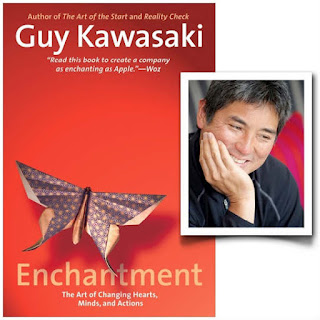
  • Thursday Quote: Enchantment – Enchanting Volunteers

    I recently heard about a gentleman who left his church (after many years) because he had nothing important to do there. While he was telling his story, he included the fact that the church he was currently involved in almost immediately got him involved in ministry and he is active, excited, and doing a lot more than he ever imagined he would. He’s also considering full time ministry as a result.

    It can be very difficult to recruit church-goers into ministry roles. Some shy away from it altogether; and many who do recruit people for ministry often do so apologetically. In today’s Thursday Quote I’d like to share an awesome excerpt from the book Enchantment: The Art of Changing Hearts, Minds and Actions by Guy Kawasaki. Although the author makes no claims to Christianity, I’ve found many of the ideas and principles in this book apply directly to Christian Leadership.

    How to Enchant Volunteers
    Volunteers help organizations all over the world, and they are essential for the welfare and success of educational, environmental, social, religious, and other philanthropic causes. While the techniques already discussed in this chapter also pertain to volunteers, these folks deserve their own rules for enchantment: 
    • Set ambitious goals. Volunteers want to know that what they are doing is important and that they are making a difference. Your obligation is to set challenging goals and not waste their time. If there’s anything worse than overusing volunteers, it’s underusing them.
    • Manage them well. When people believe, they want to help, and it’s your responsibility to enable them to help as much as they can This includes planning and organizing how you’ll utilize their activities. You may not be paying them, but their time is still valuable.
    • Enable them to fulfill their needs. Why do people join a nonprofit organization? There are three principal reasons: duty (“I should help my kid’s school”), belonging (“I like doing things with people”), and mastery (“Learning a new skill is more important than money”). Fulfill these needs, and you’re on the way to enchanting your volunteers.
    • Ensure that the paid staff appreciates them. You and your employees must believe in the value of volunteers – if you lack this belief, maybe you should not recruit them. Volunteers often give their heart and soul to an organization, so it’s important that your paid staff appreciates their efforts.
    • Give feedback. People want to know how well they are doing. With volunteers, this is doubly important because you can’t use compensation as a feedback mechanism. So after you set your ambitious goals, provide feedback, and they’ll love you for helping them learn how they are progressing.
    • Provide recognition. Recognition comes in small forms for volunteers: business cards, an e-mail address, a workspace (even if it’s shared), attendance at conferences and public and private expressions of gratitude. See anything that’s expensive on this list? Good, because there isn’t.
    • Invite them in. At least once a year, invite your volunteers into your headquarters. This enables people to meet face-to-face instead of only virtually. Remember the value of proximity to achieving likability? The same concept applies to volunteers.
    • Provide free stuff. “Stuff” means food and drink at working sessions as well as T-shirts and other forms of tchotchkes. Unfortunately, these kinds of goodies are often the first thing an organization cuts when going gets tough, but, dollar for dollar, they are among the most cost-effective forms of compensation that you can offer.
     
    Disclosure of Material Connection: Some of the links in the post above are “affiliate links.” This means if you click on the link and purchase the item, I will receive an affiliate commission. Regardless, I only recommend products or services I use personally and believe will add value to my readers. I am disclosing this in accordance with the Federal Trade Commission’s 16 CFR, Part 255: “Guides Concerning the Use of Endorsements and Testimonials in Advertising.”
  • Letting Young Eagles Fly

    Hypothetical Question. If you HAD to pick between the following two candidates to serve as the primary leader for all adult ministries in your church (Sunday services, small groups, care, special events, etc.) who would you be most likely to choose: The Young Inexperienced Eagle or The Old Seasoned Eagle?

    Your answer to that question may one day (or presently) dictate whether your church survives this decade! Last week I posted a Thursday Quote entitled, “Sticky Teams & Guarding the Gates“. Larry Osborne reminds us that finding and releasing young eagles into meaningful positions of authority and responsibility is critical to our church’s ongoing growth and success.

    Unfortunately, most of us who’ve been around for a while would prefer the safety of the known, the experienced, the tried and true. Earlier this month I was talking to a church leader who told me he wanted young people to serve in his church, but that he didn’t think they should be in charge. I reminded him that HE WAS YOUNG when he was given positions of authority. I’ve seen and heard of this happening over and over.

    So for today’s post I would like to direct my readers to another blog. I have recently become a fan of the leader of the Catalyst Conferences, Brad Lomenick. Among other things, he firmly believes that young people can and do make a difference.

    Following is a link to his massive list of what he calls, Young Influencers. These men and women are doing great things. They are young eagles that are soaring to new and greater heights. They are attempting things that us older folk never considered when we were their age . . . and they are succeeding. For me, I’m going for the Young Eagles. How about you?

    Image compliments of Tina Phillips on freedigitalphotos.net

  • Thursday Quote: Sticking Teams and Young Eagles

    “Ironically, most churches are started by young eagles. But soon after getting their nest built, nicely appointed, and fully furnished, they start to marginalize the next batch of young eagles, asking them to sit at the kids’ table and wait for their turn at middle-aged leadership.”

    I don’t think Larry Osborne could have presented a major problem in the local church better . . . and it’s becoming a major roadblock in the ongoing growth and development of the church at large. Leaders just have a real hard time releasing young leaders into meaningful and influential leadership. In his book, Sticky Teams, Larry Osborne talks about this difficulty in the chapter entitled, “Making Room at the Top”. Here’s a little more from that chapter.

    When a church grows old, gray, and culturally out of touch – far more interested in protecting the past than in creating the future – it starts to wonder, ‘What happened to all the young people that used to hang around here?’ That’s a sure sign that the young eagles have been shut out for a long time.

    I’d be a liar if I said that protecting and promoting young eagles is a pain-free venture. It’s far easier in theory than in practice. I don’t like giving up my personal power, prestige, or preferences any more than the next guy does. It’s kind of a drag.

    But young eagles are born to fly. It’s their nature. It’s how God made them. If they can’t fly high in our church, they’ll bolt and fly elsewhere. And sadly, if and when they do, they’ll take most of the life, vitality, and the future of the church with them.

    So, honestly now, how are you and your church responding to young eagles? Are they written off, tolerated, or celebrated? Are they encourage to fly or asked to clip their wings?

    I guarantee you, your answer will determine your church’s future.

    When working with leadership teams to determine their ability and openness to fully utilize and keep young eagles, I ask three questions.

    1. Are young eagles empowered and platformed?
    2. Are young eagles in the loop or in the meeting?
    3. Who gets to ride shotgun? 
     
    Disclosure of Material Connection: Some of the links in the post above are “affiliate links.” This means if you click on the link and purchase the item, I will receive an affiliate commission. Regardless, I only recommend products or services I use personally and believe will add value to my readers. I am disclosing this in accordance with the Federal Trade Commission’s 16 CFR, Part 255: “Guides Concerning the Use of Endorsements and Testimonials in Advertising.”
  • Thursday Quote: Unleashing The Power of Rubber Bands

     
    One of the qualities I believe a true leader must possess is courage. I’ll be honest, sometimes I think I’m quite the wimp, but I know I’m growing and I’ve faced enough difficult choices over the years to understand that doing the right thing can be really, really hard. In particular, it takes courage to confront someone who doesn’t fit. 
     
    In this week’s Thursday Quote I thought I’d share a little excerpt from Nancy Ortberg’s book, Unleashing the Power of Rubber Bands: Lessons in Non-Linear Leadership. This very easy to read book is a great addition to the leaders library and offers many great reminders and lessons on leadership; but what makes the book real outstanding is some of the great stories and examples in nearly every chapter. I recommend it. Check this out:

    There is a big difference between a bad fit and a bad person. Leadership is about having the courage to make that distinction. Too often, we hide behind the belief that someone is a bad person, when the reality is, he or she is simply a bad fit. Many organizations and certainly many churches have allowed people to remain in positions (paid or volunteer) for which they are poorly suited. Everyone suffers when that happens.

    The organization suffers. When someone is in the wrong position; vision, strategy, and results usually suffer. The church or the ministry department or the business fails to live up to it’s God-given potential. The organization is crippled in its efforts to be all that it could be. That is not God’s design for a church or an organization.

    Individuals suffer. When a person is not well suited to his or her role, the people who work with and for that person inevitably languish in some regard. They either fail to get the support, recognition, or resources they need to do their jobs, or they are neglected in areas of discipleship and growth.

    It is one of the fundamental jobs of a leader to make sure that the right people are in the right positions in an organization. Leaders who take action and initiative to make sure this is the case engender trust. Those who don’t, cultivate cynicism and mistrust.

    Disclosure of Material Connection: Some of the links in the post above are “affiliate links.” This means if you click on the link and purchase the item, I will receive an affiliate commission. Regardless, I only recommend products or services I use personally and believe will add value to my readers. I am disclosing this in accordance with the Federal Trade Commission’s 16 CFR, Part 255: “Guides Concerning the Use of Endorsements and Testimonials in Advertising.”
  • Ten Church Strategies: The Ministry Partner Strategy (Volunteers)


    Check out this quote from Bill Hybels from his book, ‘Volunteer Revolution‘:

    “It’s as if God has work gloves on. And he calls us to roll up our sleeves and join him with our talents, our money, our time, and our passion. He wants his mission to become ours. ‘If you’re chasing the wind,’ he tells us, ‘you can keep right on doing that. Or you can hook up with me, and together we’ll transform this hurting planet.’”

    The Ministry Partner System is the local church’s answer to God’s call for everyone to ‘roll up their sleeves’ and partner with Him. The problem is that individuals often view the local church as an organization meant to serve him or herself instead of seeing themselves as being a vital part of a body of believers. Ephesians 4 clearly defines a key role of the pastor (among others): “…to prepare God’s people for works of service, so that the body of Christ may be built up…” In this installment of ‘The Ten Church Systems‘ I will outline how the church can identify, equip, and release people to ‘partner’ together in fulfilling your church’s mission. If you haven’t already, I recommend you first read my ‘Getting Started Thoughts and Disclaimers’, written in three parts: Part 1Part 2Part 3.

    Key Sub-Systems of The Ministry Partner System (Volunteers)
    Following are the key sub-systems needed to develop and sustain this system. Please note that the term “Ministry Partner” and “Volunteer” are interchangeable throughout this article.

    • Ministry Identification System
      It can be very frustrating to potential volunteers when they actually want to serve somewhere in the church, but have no information about what volunteer positions are available and what the commitment is for each one. This system will identify every ministry position in the church as well as clarify each one’s basic job description, ministry expectations and requirements. 
    • Ministry On-Ramp System
      It seems the traditional method for filling volunteer positions in the church is through direct recruitment. Although this method can be very effective if done properly, it can become grossly inadequate, plus it means potential volunteers won’t find a place to serve until they get that phone call or email. The ‘Ministry On-Ramp System’ will develop simple ways for church attendees to get plugged into each person’s best possible position. On ramps may include web based solutions, signup tables, ministry fairs, ministry partner classes, sermon series and more. Depending on your church’s Ministry Partner strategy, it may also include a volunteer apprenticeship program.
    • Ministry Partner Resource System
      As the Systems/People Matrix so aptly illustrates, putting great people into bad systems leads to frustration, resentment, and often a high turnover of some of your best people. This system is a critical part to your church’s health and growth. It will include volunteer training (helping them understand how to do the job as well as allowing them to develop and grow in it), resourcing (making sure they have everything they need to be a success), and encouragement (providing meaningful and regular feedback).
    • Ministry Partner Communication System
      Although communication could really fall within the above mentioned ‘Ministry Partner Resource System’, it deserves it’s own mention since it is so critical to a healthy volunteer system. The fact is, good communication breeds loyalty, trust, and commitment while bad communication develops the exact opposite. This system will ensure your volunteers are on the same page with you regarding schedules, expectations and potential problems.
    • Ministry Partner Celebration System
      It’s OK that we have volunteers who serve ‘behind the scenes’. It’s not OK that they are so incognito that weeks, months, even years go by without a ‘thanks’, ‘we are so proud to have you on this team’ and ‘your contribution makes a difference’! This system will ensure everyone is honored and cared for during their tenure as volunteers (instead of just at the end of their tenure!) This system may include simple ‘thank you cards‘, emails, phone calls, and perhaps even an event like a ‘Volunteer Appreciation Banquet’. It is recommended that the celebration system also utilizes the occasional gift certificate and acknowledges milestones (5, 10, 15+ years of service).
     

    Note: Inspiration for the Ten Church Systems comes from Nelson Searcy and the Eight Systems of the Local Church he proposed in his free e-book entitled, ‘Healthy Systems, Healthy Church‘.

    Photo from mangostock on istockphoto.com

    Disclosure of Material Connection: Some of the links in the post above are “affiliate links.” This means if you click on the link and purchase the item, I will receive an affiliate commission. Regardless, I only recommend products or services I use personally and believe will add value to my readers. I am disclosing this in accordance with the Federal Trade Commission’s 16 CFR, Part 255: “Guides Concerning the Use of Endorsements and Testimonials in Advertising.”