Category: HEALTHY CHURCH

  • Ten Church Strategies: The Care Strategy

    Very strictly speaking, the local church is a service organization. That’s way over-simplifying, but it’s still mostly true. The local church serves the Lord, the body of Christ, communities, and the world. One of the ‘services’ everyone hopes and prays the church never stops offering is care. When people are hurting, needy, lost, or simply confused we want them to know they can turn to the local church.

    In this installment of ‘The Ten Church Systems‘ I’ll talk about creating an outstanding response system that will ensure the church does what the church should do better than anyone else – show the love of Christ to those in need. If you haven’t already, I recommend you first read my ‘Getting Started Thoughts and Disclaimers’, written in three parts: Part 1Part 2Part 3.

    Key Sub-Systems of The Care System:
    Following are five key sub-systems that support The Care System. As with all systems, care will be most effective when it is distributed throughout the congregation, rather than centralized with the pastoral team.

    • Attendee Response System
      This system clarifies what will happen when a church attendee is facing a major life transition or crisis. This will include events like a new baby, a family moving, major illness, stays in the hospital, death of a loved one, a lost job, and more. The Attendee Response System will engage the congregation in providing care for one another.
    • Special Services System
      This set of sub-systems will clarify how the church will respond when a special service is necessary to accommodate an attendee’s life transition. Special services will most often include funerals and weddings.
    • Counselling System
      Church attendees will occasionally need professional help to resolve a personal crisis, like addictions, marital difficulties, and other forms of relational conflict. The counselling system clarifies how the pastoral leadership will respond when those needs present themselves. Trusted professional counselors and services in the area will be a critical part of this system. Pastors should not assume that ongoing counselling should fall within the scope of their weekly responsibilities.
    • Benevolence System
      This system enables the pastoral leadership to financially assist attendees and the community during times of need and crisis. It will include annual benevolence budgeting and policies regarding how benevolences are determined and distributed as well as procedures regarding transients who pass through looking for money.
    • Member Care System
      Your church members are a critical part of church life. This system will administratively keep track of membership as well as deal with needed conflict resolution necessary to maintain unity in the church. Finally, this system will ensure members with specialized and ongoing care concerns are taken care of; like the elderly and shut-ins. 

    Note: Inspiration for the Ten Church Systems comes from Nelson Searcy and the Eight Systems of the Local Church he proposed in his free e-book entitled, ‘Healthy Systems, Healthy Church‘.

  • Ten Church Strategies: The Assimilation Strategy


    Just an FYI – I didn’t make up that word: assimilation. It sounds very, well, official and businesslike (or Star Trekish – I notice we all leave the Borg’s tagline off: ‘Resistance is futile’. Wise.). That word does represent what we hope will happen to our guests. Dictionary.com defines the word ‘assimilate’ as follows: ‘to take in and incorporate as one’s own; absorb.’ This is what most church leaders desire regarding the guests who darken their door each week. We hope they will start coming to church, like it, and stay – eventually becoming members and leaders themselves.

    In this installment of the ‘Ten Church Strategies‘ series I’ll talk about creating your Assimilation Strategy, or what I prefer to call your Guest Friendly Strategy. Check out more posts on Guest Friendly right here

    Key Sub-Systems of The Assimilation Strategy:
    Following are SIX key subsystems necessary for guest friendly assimilation at your church. These systems will intersect with many of the other ten systems, but most notably The Weekend Service Strategy, The Small Group Strategy, The Discipleship Strategy, and The Marketing Strategy.

    • Guest Friendly Campus System (Facilities & Grounds)
      First impressions matter. No matter how big or small your building and grounds, it’s critical that each area is built and maintained to serve both attendees and guests. This system will include outdoor signs, the cleanliness of the grounds, the parking lot and parking spaces for guests, your entry areas, interior signs, restrooms, sanctuary, and much more. (Check out ‘Guest Friendly Parking‘, ‘Guest Friendly Signage‘.)
    • Guest Friendly Host Services System
      I’ve heard it said that ‘people’s perception is their reality’. We create guest’s reality, whether it is true or not, by how well we host them. Unlike our regular attendees, who know what to do, where to go, and who to talk to, guests are mostly clueless. This system includes the development of all the people who will welcome and take care of guests, like ushers, greeters, and various kinds of hosts (cafe, parking, etc.). This system should also include all preparations surrounding the materials guests will receive when they arrive at church for the first time (welcome packet, gifts, new info. cards). (Check out ‘Guest Friendly Welcome‘.)
    • Guest Friendly Service System
      Next up is the guest friendly church service. This system actually fits almost entirely within The Weekend Service System, but is worth noting here for a few reasons. This system will focus primarily on the few small things that can be done in a service to ensure guests feel comfortable participating in the service. It may include things like reserved seats near the back, but more notably the language being used during the worship, announcements, offering, and message. Additionally, this system will help keep ‘insider‘ activities that would alienate or confuse a guest to a minimum. (Check out ‘Guest Friendly Perspective‘).
    • Guest Friendly Follow Up
      A successful Assimilation System should always include relevant and timely follow up. This may come in the form of phone calls, personal visits, letters, emails, Facebook or any number of other means. This system will help guests know they were noticed during the service and will welcome and encourage them to return again someday. (Check out ‘Guest Friendly Follow-Up’, ‘Guest Friendly Website‘.)
    • Guest Friendly Next Steps
      Probably one of the most important pieces of The Assimilation System will be the ‘Next Steps’ you create as a church to help move people from ‘guests’ to ‘regular attendees’ and eventually members. These systems will communicate next steps to your guests and will facilitate all of the follow up activities that you will ask guests to attend, view, or listen to. For many churches, the final assimilation ‘next step’ would be a membership class.
     

    Note: Inspiration for the Ten Church Systems comes from Nelson Searcy and the Eight Systems of the Local Church he proposed in his free e-book entitled, ‘Healthy Systems, Healthy Church

    Photo compliments of wragg on istockphoto.com

  • Ten Church Strategies: The Weekend Service Strategy


    What is your Sunday Morning or Weekend Service strategy? What are you trying to accomplish and how are you planning on doing so? This is the Weekend Service Strategy.

    In this installment of the “Ten Church Strategies” series, I will outline some of the Systems that should be clarified, developed and regularly evaluated for effective Sunday services. Since Weekend Services are usually the primary focus of most church’s weekly schedule, it is understandably the most complex of all of the Ten Church Strategies. If you haven’t already, I recommend you first read Ten Church Strategies – Getting Started.

    Key Systems of the Weekend Service:
    Following are the various systems that directly impact the effectiveness of Sunday morning services. You will notice that the vast majority of these systems don’t actually occur on Sunday mornings, but in the days, weeks, and months prior to each Sunday morning experience. Here they are:

    Systems Supporting The Message:
    The message is primarily dependent on the Lead Pastor’s preparations and planning. Developing these systems will expand the message’s influence by allowing others to be better prepared to support what will be said.

    • Message Series Planning System
      This is the system whereby the Lead Pastor and his teaching team create a tentative schedule of message series for the upcoming months. Ideally, message series’ will be planned out for six months or longer. 
    • Message Preparation System
      It’s critical that the Lead Pastor or teacher has a system in place to regularly study, pray, and prepare for the Sunday morning message. Ideally, the requisite hours are etched in stone in his weekly calendar. The best system will accommodate advanced planning for future weekends and extra speaking engagements.
    Systems Supporting Worship
    There are many necessary subsystems to accommodate relevant worship ministry on Sunday morning. A few of the more notable ones include:
    • Song List System
      This system includes developing a ‘Master Song List’, keeping it updated with relevant songs, and determining when new songs are introduced and old songs are removed. This system will also take care of details like CCLI licensing and lyrics administration. 
    • Worship Team System
      This system will recruit, train and develop the various instrumentalists, vocalists, and technicians necessary to support Sunday morning worship.
    • Practice & Rehearsal System
      The best rehearsal system will allow room for worship teams to practice (building unity, communication skills, song dynamics and team-building) and rehearse (specifically preparing for upcoming worship sets). 
    • Worship Leader System
      It’s important the worship leader has systems in place allowing him/her to pray and prepare song lists, transitions, scripts, etc. Ideally, this system will include learning new songs; preparing for future weeks, series, and events; and developing his/her own worship leadership skills.
    Systems Supporting Service Planning
    Service Planning is a necessary part of exceptional weekend services. These subsystems will add creativity and increase excellence each week.
    • Service Planning System
      There are no surprises regarding what’s happening in upcoming weeks with a service planning system. The ministry team will know exactly when upcoming special service elements (water baptism, communion, guest missionary, baby dedication, etc.) will be taking place. Additionally, details concerning what will be announced each week, what handouts will be included in the bulletin, when creative expressions will take place and what prayer needs will be publicly addressed will also be clarified. Finally, this system will ensure each week’s Service Plan is developed, scrutinized and effectively communicated to key players each week. 
    • Creative Expressions System
      Creative Expressions (skits, music specials, video clips, etc.) during a Sunday morning service are most effective when they are planned in advance. With this system, creative brainstorming and planning take place for upcoming services well in advance of when the details surrounding fulfilling them must be made. Tactical assignments, preparations and rehearsals are also included in these systems.
    Systems Supporting Children’s Programming
    Most Weekend Services will offer programming for children during some or all of the adult service. This allows parents to participate in the services uninterrupted and provides child appropriate programming for kids. 
    • Safety System
      It is critical that children are safe and parents have peace of mind leaving their kids each week. Safety systems will include volunteer applications and security checks, enforced children’s ministry policies and procedures and a secure child check-in/check-out system on Sunday mornings.
    • Curriculum System
      This system will include ordering, developing, organizing, and preparing age appropriate curriculum for each age group.
    • Volunteer System
      This system will ideally be fully integrated in the church’s “Ministry Partner System” and includes recruitment, training, support, and appreciation of all kids ministry volunteers.
    • Facility & Resource System
      This system will ensure all kids ministry rooms are stocked with age appropriate toys and supplies. It will also include procedures for regular cleaning and maintenance of the rooms.
    Systems Supporting Service Programming

    The remaining Weekend Service systems will support the various elements and portions of each service.
    • Staging/Tech System
      Stage and technical preparations are vital to a distraction-free experience each week. This system includes developing unique stage designs related to a sermon series as well as the purchasing, maintenance, and care of all technical equipment. 
    • Materials Production System
      Most Sunday services will include materials that attendees receive to enhance and support the Sunday experience and upcoming activities. Preparation and production of the morning bulletin, sermon notes, handouts, offering envelopes, etc. should be systematized and streamlined.
    • Attendee Host Services System
      This includes all systems needed to host and serve attendees before, during, and after the service. Hosts (also referred to as ushers or greeters) will setup for the service, hand out bulletins, help seat attendees, distribute communion elements, etc.
    • Prayer & Care Ministry
      This system will address how leaders facilitate hands-on ministry to attendees each week both during and immediately following the service. This could include the traditional altar call as well as other means of personal ministry during or immediately after the service.
    Note: Inspiration for the Ten Church Systems comes from Nelson Searcy and the Eight Systems of the Local Church he proposed in his free e-book entitled, ‘Healthy Systems, Healthy Church‘.

  • Ten Church Strategies – Getting Started

    If you haven’t already, you may want to first read the summary of this series entitled, The Ten Strategies of the Local Church“. 

    My hope in writing this series is simple: I want to challenge your thinking and equip you for future success. By writing about the ten strategies of the local church I hope you will identify areas where your church and leadership is excelling as well as areas that need growth. I expect you will develop Strategic Plans to develop your weak areas and celebrate your strengths.

    ‘Ten Church Strategies’ – Getting Started
    I’ve discovered that when it comes to strategies and systems, pastors and church leaders can quickly get confused or disheartened. To better prepare you for this “Ten Church Strategies” series I’d like to make 20 observations that may help you along the way.

    • I Owe a Big ‘Thanks’ To Nelson Searcy.
      Nelson Searcy, Lead Pastor of ‘The Journey Church Of The City‘ in New York City,  first introduced the idea of systems for the local church in his free e-book entitled “Healthy Systems, Healthy Church” where he introduced the “8 Systems of the Local Church”. Over time, and after much discussion with others (including Elim Fellowships Vice President, Mike Cavanaugh), I’ve made several tweaks and changes. First, I’ve changed the term from ‘Systems’ to ‘Strategies’ because I believe the big idea behind each subject area represents a strategy that needs developed. The systems come into play in tactically implementing each strategic area.
    • I Am Not Trying To Overwhelm You.
      But it’s possible some of you may get overwhelmed. The Ten Church Strategies series is not for the faint of heart. I’ll be outlining a lot of ideas that you might not be doing, or that you know aren’t going well. That’s OK. The point of this exercise is to get the truth on the table so you can evaluate what you should or could be doing next. The Ten Church Strategies will provide a ministry benchmark that you can use to measure the current ‘health’ of your church and to guide you toward something better.
    • Size Matters. 
      The size of your church does make a difference in church strategy and systems development. The bigger your church is, the more likely that you will need more subsystems to support your systems. For example, it’s going to be more challenging to develop a strategy for tracking guests if you have 800 people attending 3 services each week compared to 60 people attending one service each week. 
    • Size Isn’t An Excuse. 
      The size of your church shouldn’t be used as an excuse to bypass systems development. Being ‘small’ doesn’t mean you don’t need a system – it just means the system you use will be very different than in other church settings. For example, if you don’t have a system for tracking your guests, then you need to develop that system (no matter what your church size is) in order to help attract and keep people at your church.
    • Strategies and Anointing Are Not the Same.
      Since I’m such a big fan of systems, I thought it would be good to clarify – I’m a bigger fan of God’s anointing. They shouldn’t be confused. I believe a smart, caring, and committed business person could build an amazing church that attracts thousands of people and provides amazing activities and services – without God ever showing up. In fact, it sort of reminds me of the Jehovah Witnesses and Mormon churches! Strategies should never replace God’s anointing. If I ever had to choose between the two, there’s no question which I would pick.
    • Systems, Strategies and Anointing Work Together.
      When God’s anointing for ministry meets a well implemented system, exponential potential for ministry is released. I believe that. I believe God is the one who made up systems, not man. He expects us to use every physical resource we can muster together to provide the best possible environments for His anointing to have the greatest impact. God has always operated that way with man. We do the “man” part and He does the “God” part. Elijah on Mt. Carmel is a classic example. 
    • This is Scary.
      For most of us, change (or even thinking about change) is scary. It’s risky. It’s wrought with the potential for failure; for making mistakes. It means trying something that we really don’t know how to do. It forces a new, and often steep, learning curve on us and our leaders. But if we really think the ministry we lead is ‘stuck’, or worse, headed for a cliff, it’s better to try something new and scary than stay on the train where it’s leading us. (Check out “Strategic Quitting“).
    • This is Healthy.
      We all know what it looks like and feels like to live in an unhealthy body. Perhaps you still do. The same is true for the church. We can survive and be unhealthy or we can thrive by making changes that bring health to our church. Ironically, most unhealthy churches are completely clueless how dysfunctional and unhealthy they have become – and anyone who knows is afraid to tell them. (Check out “Healthy Church, Healthy Systems“).
    • This is Uncomfortable.
      There’s something really weird about building a bus that will seat 55 when you only have 25 people to transport. It can seem awkward, not just for you, but for everyone else. However, there’s no way you will accommodate growth in your church until you’ve expanded your borders. (Check out “Ready for the Rain“).
    • You Are Your Worst Enemy.
      The biggest road block to change is hurtling the barriers inside yourself that resists change. Like me, you take pride in what you’ve accomplished and are currently doing for the Lord. Unfortunately, sometimes our pride clouds our judgement and we come to the conclusion that things are doing just fine, when they really aren’t. (Check out “The Big Road Block“).
    • You Can’t Do It Alone.
      I don’t think the sign on your office door says “Pastor Jack OATS” or “Pastor Jack Of All Trades”. Nehemiah didn’t build the walls by himself and he probably didn’t know every trade necessary to do it right. He had a team of people. The Ten Strategies rely on a team of people too. You can’t expect to fulfill every role necessary to run your church. You aren’t analytical, relational, visionary and administrative in equal parts. Building effective church strategies includes developing a leadership and volunteer team who have the skills and resources you don’t. You can’t do it alone. (Check out “Pastor Jack OATs“).
    • You Can Do It.
      If you’ve made it this far then you’ve already taken another step in developing one of the ten key strategies of the local church. It’s called “The Strategic Strategy”. If you glance back through the above points, you’ll discover that most of the battle is fought between our ears, not in the pews. A final step to getting started is in believing that God has called you to this time and this place. (Check out “Pastoral Ministry by Paul“).
    • I Do Not Condone Legalism Through Systems or Strategies
      I think it’s important to make a distinction between strategies/systems that serve the mission of the church and those that everyone ends up serving. It is possible that a strategic plan can turn into a bottleneck, sacred cow, or legalistic activity within the church. This is why it’s so critical that ministries regularly evaluate the various strategies within the church to ensure they are enabling rather than hindering ministry.
    • The Ten Strategies Cannot Be Prioritized
      It is a trap to think of the Ten Strategies as independent strategies that have little to no bearing on one other. What you will discover is that every strategy either feeds or is fed by one or more other strategy. Although you may choose to focus on one strategy or another at different stages in your ministry journey, it’s important that each one receive appropriate attention.
    • Not All Strategies Carry the Same Weight
      Some strategies will require very little time and energy to develop and maintain in comparison with others. For example, The Weekend Service strategy includes more than a dozen subsystems to function effectively while The Stewardship strategy only requires a few.
    • No Strategy or System Works Forever
      Just like your car, your systems will become less and less effective and relevant over time, unless they are strategically and systematically evaluated and adjusted. 
    • Formal Versus Informal Strategies
      You will discover that even though you haven’t specifically thought of some of the things you are doing through the lenses of The Ten Strategies, you already have many in place. Some of these strategies are informal ones that just ‘get done’ each week; others have been well developed and documented. Whether a strategy is informal or not isn’t quite so critical as whether the strategy is accomplishing the goal in the best possible way.
    • I’m Still Learning
      I’m sharing what I have learned and know about the development of these church strategies. That does not mean everything I suggest or say should be written in stone. Feel free to question my thoughts and ideas – just don’t throw them all out because we occasionally disagree. I recommend you read this series with a heart to hear the voice of the Lord whisper to you what He intends you to hear and disregard all else. In other words, ‘chew the meet and spit out the bones’.
    • I Intentionally Do Not Describe HOW
      Every church is led by a unique mix of pastors, elders, and leaders in a unique geographical location and culture. It would be presumptuous and inappropriate for me to tell you HOW you implement the various strategies I propose your church embrace. This series is meant to help you identify what areas you want to develop – not HOW you develop them.
    • I Am Available To Help You Discover HOW
      I can’t create a cookie-cutter strategy that everyone can use, but I am able to make myself available to a few churches and leadership teams individually. I would be very happy to meet with you to determine if we could establish a coaching relationship that would serve to guide and motivate you in future strategic planning.
  • Your Church Needs ‘Less Clutter, Less Noise’

    I would like to recommend the book to you, Less Clutter, Less Noise by Kem Meyer. Less Clutter, Less Noise challenges us in a clear and fresh way to communicate to our congregation with cultural relevance. It’s extremely practical too, with a ton of great ideas. Kem Meyer is the Communication’s Director at one of the most innovative churches in America, Granger Community Church. You might also consider checking out her blog www.kemmeyer.com and in particular THIS POST which summarizes the key points of her book.

    Among other things, Kem explores various ‘myths’ related to church work and communication. Here’s an example:

    From Myth #4: It Worked Before, So It Will Work Again
    “You can ignore the current reality and use old techniques you’re comfortable with, imitate new techniques that discredit you as a fraud, OR take the time to learn what’s effectively gaining credibility with people in today’s culture.”

    Add Less Clutter, Less Noise to your reading list today!

    Disclosure of Material Connection: Some of the links in the post above are “affiliate links.” This means if you click on the link and purchase the item, I will receive an affiliate commission. Regardless, I only recommend products or services I use personally and believe will add value to my readers. I am disclosing this in accordance with the Federal Trade Commission’s 16 CFR, Part 255: “Guides Concerning the Use of Endorsements and Testimonials in Advertising.”

  • ‘Invite’ Series by Andrew Manzano

    Andrew Manzano

    I’d like to introduce you to a friend at Elim Gospel ChurchAndrew Manzano. Andrew owns his own production company at www.thesoundtank.com and makes some AWESOME video’s for the Christian community.

    A while back I encouraged you to consider ‘spicing’ up your Sunday morning services with the occasional Sunday Service Video Clip. Andrew’s clips have given www.sermonspice.com some great traffic – and for good reason. Check out his “Invite” series below and consider purchasing one or more of them this week!

  • Andy Stanley’s Podcast (for the non-tech Christian leader)

    Pastor Andy Stanley

    If you are a pastor or church leader you are probably familiar with Andy Stanley. If you aren’t, then I recommend you get familiar with him right now. Andy Stanley is a very important voice in church leadership, management and personal growth. You can learn more about Andy right here and you can browse and purchase some awesome books right here.

    This post is meant to be a quick and easy way for you to listen to Andy Stanley’s Leadership Podcast without actually subscribing to the podcast (which I recommend you do – subscribe with iTunes/subscribe with feed-burner). If I were you, I would make it a personal goal to listen to every one of these 25 minute audio clips . . . several times. I also recommend you ask your church leaders and friends to listen to them as well.

    If you are unfamiliar with how to listen to podcasts, then I recommend you watch one of these short video tutorials.

    Subscribe to Podcast in iTunes

    Subscribe to Podcast using Google Reader


    Note: Due to copyright issues, I am unable to provide links to each individual Andy Stanley Leadership Podcast in this blog. However, should you choose to subscribe via Google Reader you can easily see past Podcast’s and listen to them whenever you want.

  • An Exceptional Sunday Service Report

    Does your church host Exceptional Sunday Services? Recently, I had the chance to provide some coaching in this area to an area church leader. After our meetings he went back to his team and with great zeal championed several small but key changes in his Sunday morning preparations. Check out this email he sent me a few weeks later . . . .

    Hello Pastor Wayne,

    Here is an update on our improvements on Sunday mornings. After some great discussion, we implemented a few things.

    • Our secretary changed our Service Planning meeting agenda to be more specific and include minutes.
      That alone has made a huge difference. We now better understand how everything breaks down and what needs to be improved. For the first time since I can remember we actually discussed, re-ordered and even trimmed some things in our Sunday Services. That made an immediately and huge difference in our services.
    • We began having a service coordinator for every service.
      We have three people serving in that role, I do it most of the time and the other two serve in that role when I am not around.
    • We also started a service coordinator meeting.
      This is a short 5 minute meeting where we walk through the whole service with all the key players involved in that Sunday morning service. At this meeting we discuss when music plays and lights go on and off. We talk about what microphone everyone is using and who to give it to next. Our transitions have improved quite a bit now that people know when they are to come onstage and know when to be ready. Everyone sees how efficient we are and also feel’s more part of the team! 

    It’s great when we have a guest speaker as well. They see how organized we are and when I go over the details with them about when they should begin and end they actually end on time now. A few weeks ago, a guest speaker who traditionally always ends late (and I mean always) ended on time and his message was actually better than other times.

    The main thing that made me want to write this email is that in the past we have been so uptight with ending on time (and often we wouldn’t end on time) that we would often just be stressed out. We have also always been concerned that if we become more organized we won’t leave room for God to move. Well, last Sunday we had an 8 minute altar call during worship. Not to mention 3 prophetic words. God moved, people were touched, and no one was stressed about time because we knew we had it all under control. The service still ended on time.

    By becoming more organized and efficient we are not taking God out of the service. In fact we are giving God MORE room to move. If we couldn’t end on time with our previous schedule imagine how uptight we would get when God moved during those services? But now we end early a lot and when God moves we are free to enjoy it because time is no longer an issue like it once was. There is no doubt that all our hard work developing the services has definitely given way to a greater presence of God in our services!

    Thank You Pastor Wayne for the help and coaching!

    I am so inspired and encouraged when I hear stories like this from church leaders. I am also confident that this church will continue to experience God’s Presence in their Sunday morning services as they continue to grow in their preparations  and communications. Their ‘partnership’ with God just took a major leap forward.

    If you’re interested in hearing more from me about hosting exceptional services then I invite you to download and listen to the “Hosting Exceptional Sunday Services Workshop I presented earlier this year at the Elim Fellowship Leadership Conference. I have included a copy of the workshop notes and several other resources as well. Click on this link to purchase it today.

  • Thursday Quote: Good to Great Volunteers (Jim Collins)

    Have you ever felt like someone in leadership was just in the wrong place? Perhaps they seemed like they should be accomplishing much more than they are; or maybe you feel like they have more responsibility than they can practically handle. Welcome to the club. One of the greatest challenges we face as leaders is in getting the right people on the right seats on the bus.
     

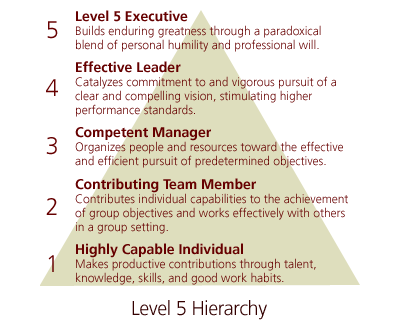
    Today’s Thursday Quote comes from Jim Collins’ bestselling book, “Good to Great: Why Some Companies Make the Leap and Others Don’t“. Check out this chart found on page 20 in the book (which my book falls naturally open to from repeated references.)


    Ironically, I would like to make a couple of practical inferences from this chart that are not really found in the book. Jim’s primary focus in this section of the book was related to the character and qualities of the leader(s) in the organization – specifically, the Level 5 Leader at the top (Two men I highly regard as emulating the Level 5 Qualities include Bill Hybels and Robert Morris. Click their names here to read more.)

    That said, let me unpack this for you two insights I’ve gained from this very meaningful chart.

    • First, nearly every committed member/participant in your church should fall in one of these various levels of contribution. I think it will be very helpful if you can discern which level your leaders and volunteers fall on this scale. For many of my leaders I can determine that they are on a level 2 or 3, and help motivate and resource them to grow into the next level of leadership.


    • However, what I have also discovered is that many people have a natural “lid” in the level of contribution that they can attain – and I need to be sensitive to that lid. My natural inclination is to try to move someone who is accomplishing great things for our church to the next level of leadership. However, it’s possible that, by doing so, I am setting that person up for failure, because my expectations don’t match their gifting and strengths. For instance, I had a secretary at our church who was a Highly Capable Individual – she was a serious work horse and accomplished a ton of stuff in small amounts of time. It’s possible that she could have moved to the next level, but that may not have been the best thing for her or for the church. So I needed to discern where she best fit, help her get there, and then find ways to encourage, resource, and strengthen her in that role.


    To learn more about this book or order it through my Amazon Affiliate’s bookstore, click this link.

    Disclosure of Material Connection: Some of the links in the post above are “affiliate links.” This means if you click on the link and purchase the item, I will receive an affiliate commission. Regardless, I only recommend products or services I use personally and believe will add value to my readers. I am disclosing this in accordance with the Federal Trade Commission’s 16 CFR, Part 255: “Guides Concerning the Use of Endorsements and Testimonials in Advertising.”
  • A Mystery Guest Report on Four Churches

     
    What if I sent a special agent to your church to evaluate how you’re doing in that area? Hmmm. Interesting thought. I might have to explore that idea some more. Oh, wait. I don’t have to send a special agent. I just need to identify some guests who have already genuinely visited your Sunday service and ask them what their experience is like (or you could hire a Mystery Guest – read here to learn more).


    Today’s post is just that. A friend recently moved away from our church and settled in a new location. Naturally, she and her husband did some ‘church shopping’ to see if they could find a church family that they could participate in. After several experiences my friend was perusing my blog and noticed the “Guest Friendly Series” I wrote. She decided to email me her feedback on some of her experiences and agreed to let me post them for your benefit as well.

    Warning: these are real life reflections from a solid and mature believer who already has a heightened sense of what a ‘Guest Friendly‘ environment could look, sound, and feel like. I trust her input and feedback implicitly. Here’s what she experienced after visiting four churches. I wonder what her thoughts would be after visiting your Sunday service?

    Let me just share a few thoughts I’ve had as I’ve been a guest at a number of churches since I’ve moved down here. I’ve often thought to myself, “If it’s this difficult for me and I’ve been in churches my whole life – I desire Christian fellowship and am actively looking for it – what’s the chance that someone without those things is going to successfully integrate into the church?”  

    Church #1: 
    A lot of the things you touched on {in your ‘Guest Friendly’ series}, even simple things such as posting signs, can make a real difference. For example, there was one church I visited and liked, so decided to try the adult Sunday School the next week. I arrived in the foyer at the time listed in the bulletin – but no one was around. Where were the classes held? Finally, a couple people walked by and I stopped them and asked. They said I could follow them, actually they turned out to be teachers, and it was a little complicated getting there. I would never have found it without asking. Of course, it would have been better if I hadn’t had to ask!
     

    Church #2: 
    When I read your example about people thoughtfully leaving the back row for newcomers, it reminded me of another interesting experience. I visited one church where there was a hallway outside and surrounding the sanctuary, with windows in the wall from the middle up looking in. There were some pews around the this hallway, and some others were sitting there, so it appeared to me to be an overflow space. The sanctuary looked pretty full, so I decided to sit in this space rather than try to find a seat inside. I sat near a doorway, and although two ushers kept the doorway filled, I could see and hear pretty well. To my surprise, when it was time for the sermon, the ushers closed the doors, with me sitting right there! I guess it was ‘time to shut the door’ and that’s what they were going to do! Now I couldn’t hear what was going on, so I had to either leave or open the closed door and find a seat in the sanctuary at this late point in the service. NOT guest-friendly! 🙂 But I’d made up my mind to visit this church, and I was going to do it! Non-guest-friendly, door-blocking sentinels…er, ushers…were not going to stop me! 🙂

    The interesting thing about that church was that there were 3 services, 2 contemporary ones, and a more traditional one in between. It wasn’t really clear on the website, so that’s how I ended up at the traditional one first. I stayed for the other one as well. 

    Church #3: 
    I have another example that relates to the whole ‘Guest Friendly Perspective‘ you wrote about. At another church, they had a visitors’ center, so I stopped by to get information on the church. The lady I spoke with was nice, but essentially they didn’t have anything there for her to give anyone. She said she was subbing, but would have the secretary contact me. So I leave my contact information with her. I get an email from the secretary a day or two later. Basically it said, “Next time you come, ask for this information in the back of the sanctuary after church.” That was really discouraging. What if I wanted that information to help me decide if I wanted to come back? I wondered why I had to beg for this information!
     

    Church #4: 
    As you know, it’s really important for the church leadership to model and cast a vision for a guest-friendly culture in the church. If it’s not there, it’s not going to happen overnight. The church I’ve been visiting the past three weeks is by far the friendliest one I’ve visited so far. 
    What has intrigued me is that the people in the pews are friendly; it’s not just coming from the pulpit. Each Sunday, the people in the row near me have smiled and welcomed me and not just during an official greeting time; when I first entered the row they gave me a warm greeting. This has happened 3 separate Sundays with 3 different people! The first week, the lady near me took the time to introduce me to several others in the church, and to take me out to the foyer for some “guest honey” that someone brings for visitors. Another time at a ladies’ event the group leader took the time to introduce me to others in the group as well. What a difference that makes! I saw several of those ladies at church this Sunday and it’s huge to have someone recognize you…. I’m not sure anyone has actively been teaching “guest friendly” here, evidently it’s just in their DNA.

    I guess all I can say is that “guest-friendly” is a need! It’s also an important responsibility for the body of Christ.

    Image source unknown.