Category: GENERAL

  • Confrontation 101: Maintain Safety At All Times

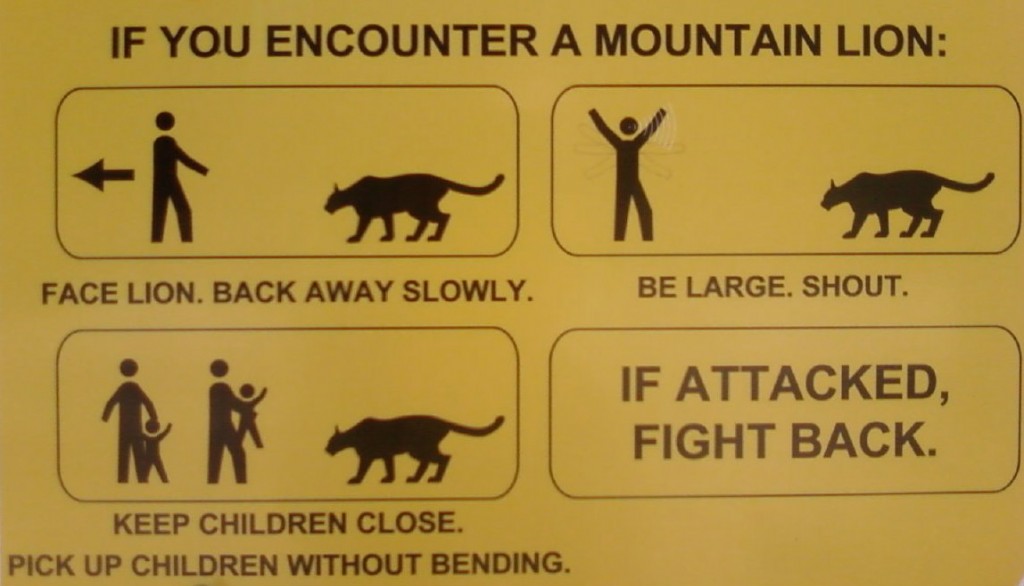
    confrontation-maintain-safetySomeone once told me that if you stare at a cat long enough, they will get angry. Years ago I was at the zoo watching a lion pace forward and backward over and over again. The lion exhibit was packed with people watching him. It was awesome and I was mesmerized.  After a while I remembered what my friend had told me about staring at cats. So I decided to try an experiment. I lined myself up with his pacing so that every time he walked back towards the crowd I was standing directly in front of him. Each time he paced towards me, I made and held eye contact with him. I did this for a couple of minutes. Suddenly, the lion stopped in mid-stride, stared me in the face and let out a mighty roar. The hair on my neck stood on end. It was loud and scary!

    What’s interesting is the response of everyone around me. They all went crazy. Some screamed, kids cried, most jumped and several took off running. This despite the fact that we were all completely safe. The lion was behind two sets of bars. He wasn’t going to hurt us. And yet, for a few moments, we all totally freaked out. I learned a valuable lesson from that experience. 

    When people feel threatened, they don’t think reasonably. It doesn’t matter how smart you are. When we’re scared our bodies go into defense mode. We have a natural desire to either fight or flee. In a sense, our reasoning shuts down and our God-given instincts take over. 

    Danny Silk explains this in his book, ‘Culture of Honor‘. Check it out.

    “God put this little gland inside our brain called the Amygdala. It is an almond-shaped mass of nuclei located deep within the temporal lobes of the brain. This gland is important for determining emotional responses, especially those associated with fear. When somebody does something threatening or unexpected in your environment, when somebody is not safe, your Amygdala kicks on and begins to flood your body with these messages: react, defend, disappear, fight, or flee.

    These are some of the responses in which we show our worst. It doesn’t take a rocket scientist to discover that people who are scared are not at their creative best. If you’ve ever been near a person who is drowning and scared that he or she is going to die, then you know it would be a good idea to keep your distance. Throw a rope or extend a pole, but do not let that person get a hold of you or you will become a buoy. Oh sure, the person will apologize later, if you lived.

    But scared people are not thinking about the team, family, church, or anyone else beside themselves. Fear is a dangerous element for humans to navigate through. Most do not manage it well.”

    So what does all of this say about how we should communicate with others, especially during a confrontation?

    Hopefully, it’s blindingly obvious. In any confrontation, we must find and maintain safety. We need to help the other person know the conversation is going to be ‘safe’. That is, that we will honor them during the conversation; that we care about and respect them. People feel unsafe when they believe one of two things:

    • You do not respect them.
    • You do not care about their goals (or what’s important to them).

    If you want to experience transformative conversations with others, learn how to maintain safety. Be sure the other person knows you are for and with them. You can do this by reading through ‘Three Keys to Effective Confrontation‘. But you will also do it by checking to be sure the other party still feels safe throughout the conversation. At any time, if you sense they are becoming defensive, it’s time to stop talking and begin working at reestablishing safety.

    The fact of the matter is, if you or I feel unsafe in a conversation we will quite naturally get defensive and will emotionally fight or flee. There’s no point in talking when we get to that point, at least not until we’ve calmed down again.

    Proverbs 15:1 says, “A gentle answer turns away wrath, but a harsh word stirs up anger.” Colossians 4:6 reminds us to, “Let your conversation be always full of grace, seasoned with salt, so that you may know how to answer everyone.”

    Confession time – I still struggle with this. Especially with my spouse and kids. The people I most want to feel safe will sometimes feel the complete opposite when I’m around. I’ve got a long way to go, but I’m committed to getting there. Are you?

    How safe do others feel around you?

    photo credit: ekai via photopin cc

  • Three Keys to Effective Confrontation

    confrontationIt takes courage to confront others . . . well, let me qualify that. It takes courage to confront others right! Anybody can blow up, say something mean or hasty or brush through a confrontation without giving thought to others’ feelings. But it takes a lot of intentional thought, courage and patience to successfully confront people properly.

    Let me share just a few pointers I’ve learned about confrontation that might help you next time you find yourself preparing for this super intimidating experience.

    1. Remember the Goals of Confrontation
    Contrary to popular opinion, the goals of confrontation are not to be right or get back at someone who hurt you. If that is truly why you want to talk, it’s better to simply keep your mouth shut. When your goals include the following, then you’re almost ready to begin.

    • A Better Understanding
      Your goal is to gain understanding where it is lacking. There is almost always something you don’t know about the situation. You may lack context which drove the offense. There is often emotions, motives & outside circumstances that you were completely unaware of. Confrontation should be a truth-seeking venture to help you understand others’ perspective better.
    • A Positive Change
      Your goal should include a positive change. In other words, whether the offense is rooted in something you did or said or not, you should wholeheartedly desire to help others learn and grow through the confrontation. It should seem more like a learning or coaching experience than a hand-slapping experience.
    • A Growing Relationship
      If strengthening and growing your relationship with the other party is not a goal, then again, it may be better to just leave well enough alone. Your goals will drive your behavior and what you say. If you genuinely want a stronger relationship after the confrontation, you will naturally ensure that happens throughout it. If you think there is a good chance the confrontation may burn bridges or destroy the relationship, you will take stock and make sure the confrontation is truly worth it before proceeding.

    2. Begin With Three Fingers Pointed at Yourself
    It’s an old illustration, but it works well. Whenever you point your finger at someone, there will always be three other fingers pointing back at yourself. Before you begin any confrontation, the wise person will evaluate their own motivations, feelings and thoughts first. Each finger is asking one of the following questions:

    • Am I Part of the Problem?
      Is it possible that the conflict in question was somehow impacted by your actions? Did you not communicate something clearly? Is there a chance your lack of participation discouraged others? Is there anything at all that you might have done that could have helped prevent the conflict from taking place? Be open & honest with yourself before you sit down to talk with others.
    • Am I Telling Myself Ugly Stories?
      Some of us have a tendency to assume the offending party was intentional about hurting us. We make up stories by patching together random events from the past and by attributing motivations to the person that he or she may never have had. We label them in our minds with words like, “mean” or “rude”. Or we imagine things like, “they hate me” or “they are so cocky”. If you enter into a confrontation with stories like these in your brain, the whole conversation will be seen through that filter and you won’t find the healthy resolution you are seeking.
    • Am I Being Defensive In My Approach?
      If you are feeling defensive before or during the confrontation, your chance of success has been neatly cut in half, if not ruined from the start. Most people can read a defensive stance from miles away – and what it usually means is that they need to take up the same stance as well. If you look like you’re ready for a fight, I guess I better get ready too. That’s how we emotionally respond. Resolution will never be made if our goal is to protect ourselves. 

    3. Move To One Finger Pointed At God’s Servant
    Just this morning I heard a story about a woman who has been able to experience a restored relationship that you and I would probably have thought impossible. When asked how she was able to put up with all of the pain and disappointment she experienced while trying, she simply pointed out, “if God loves them so much, who am I not to”. A great reminder to us all. We should be asking ourselves:

    • Am I Treating Him/Her with Honor?
      We dishonor God when we dishonor His people. We should approach every conversation with a holy reverence, as approaching one of God’s most fascinating and beautiful creations. 
    • Am I Assuming the Best?
      Rather than telling ourselves bad stories, we should do the opposite. Why not make up stories of why the conflict may have happened that believes the best of the person, rather than the worst? Taking this approach will help you relax, it will honor the person you are confronting, and it will empower them to confess wrong motives if they are there – because they won’t have to be defensive.
    • Am I Taking Our Differences Into Account?
      It would be very presumptuous to assume that others think the same way as you. We all process life differently, we make choices differently, we view life through a different filter of expectations, experiences & values. This is often even more true if you are working with individuals from other ethnicity’s or cultures. I will bring value to the conversation by removing my assumptions and expectations and seeking to understand the frame of reference others come from.

    These aren’t academic points to me. I work hard to honor them during confrontations. And when I don’t I always regret it. Ironically, it gets harder and harder to successfully confront the people we care about and love the most. Which is why it’s so important we work at it together.

    Which of these three points do you forget to do most often?

    photo credit: gabaus via photopin cc

  • Christmas Music Video’s

    Christmas Music Video’s

    Following are some of my favorite Christmas Music Video’s. These videos would be great to show PRESERVICE or POSTSERVICE sometime this month of December or for your Christmas Eve service. Perhaps you might even find a way to sneak one into your service plan too! You might also appreciate more links to help you in your service planning right here. Enjoy!


  • Billy Graham’s New Suit

    A friend sent me this story in an email this morning. I see the story is already around a lot, but I really enjoyed reading it and thought I’d share it with my readers this week. Enjoy.


    graham's suit

    Billy Graham is now 92 years-old, and has Parkinson’s disease.

    In January, leaders in Charlotte, North Carolina, invited their favorite son, Billy Graham, to a luncheon in his honor.

    Billy initially hesitated to accept the invitation because he struggles with Parkinson’s disease. But the Charlotte leaders said, ‘We don’t expect a major address. Just come and let us honor you.’ So he agreed.

    After wonderful things were said about him, Dr. Graham stepped to the rostrum, looked at the crowd, and said: “I’m reminded today of Albert Einstein, the great physicist who this month has been honored by Time magazine as the Man of the Century. Einstein was once traveling from Princeton on a train, when the conductor came down the aisle, punching the tickets of every passenger. When he came to Einstein, Einstein reached in his vest pocket. He couldn’t find his ticket, so he reached in his trouser pockets. It wasn’t there. He looked in his briefcase but couldn’t find it. Then he looked in the seat beside him. He still couldn’t find it.

    “The conductor said, ‘Dr. Einstein, I know who you are. We all know who you are. I’m sure you bought a ticket. Don’t worry about it.’

    “Einstein nodded appreciatively. The conductor continued down the aisle punching tickets. As he was ready to move to the next car, he turned around and saw the great physicist down on his hands and knees looking under his seat for his ticket.

    “The conductor rushed back and said, ‘Dr. Einstein, Dr. Einstein, don’t worry, I know who you are; no problem. You don’t need a ticket. I’m sure you bought one.’

    Einstein looked at him and said, “Young man, I too, know who I am. What I don’t know is where I’m going.”

    Having said that Billy Graham continued, “See the suit I’m wearing? It’s a brand new suit. My children, and my grandchildren are telling me I’ve gotten a little slovenly in my old age. I used to be a bit more fastidious. So I went out and bought a new suit for this luncheon and one more occasion. You know what that occasion is? This is the suit in which I’ll be buried. But when you hear I’m dead, I don’t want you to immediately remember the suit I’m wearing. I want you to remember this:

    “I not only know who I am. I also know where I’m going.”

    May your troubles be less, your blessings more, and may nothing but happiness, come through your door.

    “Life without God is like an unsharpened pencil – it has no point.”

    Amen & Peace My Friends

  • Don’t Expect What You Don’t Inspect

    expect-inspectIf you truly want to be a leader, delegate. However, if you’re going to delegate, perhaps the worst thing you can do is make assumptions, especially if the person you are delegating to is someone you haven’t worked with regularly over time.
    Often, we assume that since a person has great character, is competent and passionate about your project that you can simply hand them the reins and expect to see amazing results. Many times, that just isn’t the case.

    There are many reasons why someone may not produce the results you expect. Here are just a few:

    • You haven’t clearly communicated your expectations.
      example: You ask a secretary to let the elders know the meeting will start 1/2 hour early tomorrow night. She waits until the next morning and finally shoots them all an email mid-morning. Because some elders never saw the email, they ended up being late. You didn’t clarify that you need her to call them or their spouses today to ensure they all know about the change for tomorrow.
    • You haven’t clearly communicated your values.
      example: You ask a couple to host a luncheon for new members this Sunday. You clearly communicated your expectations, but assumed they understood your values. The luncheon went fine, but the quality of the food and the excellence of the event was way below your standards. You didn’t clarify that details and excellence were important to you.
    • You haven’t clearly communicated why it’s important.
      example: You ask a volunteer to update a section of the website that’s designed to communicate a special event online. The volunteer finishes the website, but you notice the content has an ‘insider’ orientation with a lot of churchy lingo. You had just put an ad in the paper about the event hoping to drive a lot of unchurched people to that page of the website. You didn’t communicate what this task was for and why it was important. Had you done so, the volunteer may have been more sensitive to how it was worded.
    • You haven’t given them the resources they need (time, money, people, etc.) to properly accomplish the task.
      example: You ask a young adult to be in charge of a children’s fun night at the church. When you drop off your own children at the event you discover that there are no decorations at the event, only two volunteers, and not very many kids. As you began to probe your leader, you discover that she only had a week and a half to pull the event together, she didn’t know many of the people in the church so didn’t know who to ask to volunteer and she had no understanding that money was available to purchase decorations. More importantly, she didn’t understand that she could have connected with the church secretary to help promote the event. She was greatly under-resourced right from the beginning, but didn’t necessarily have to be.
    • You assume everyone you delegate to will know what and how to communicate to you when there are problems.
      example: You ask an elder to run the morning service a week the pastor will be away. Last minute, the worship leader turns up sick and unable to lead worship. He tries to recruit someone else to fill-in who you would have known should not have been asked to do so. You’re assumption was that the elder would notify you if there was a problem. The fact is, more often than not, people tend to try to figure things out themselves rather than connect with their direct report, especially if they feel an obligation to truly lead the event to relieve you from the responsibility of it.

    I could go on.

    Please note the pronoun at the beginning of each of the above points (you). The fact is, when things don’t go as planned, most of the time there is nobody to blame but yourself. Years ago one of my mentors shared the following axiom with me that I have always remembered. I often find myself quoting it to myself when I discover someone hasn’t followed through the way I had hoped. Here’s that axiom:

    Don’t expect what you don’t inspect.

    This is especially important (1) when you’re working with people you aren’t used to working with OR (2) if the task/project you’ve assigned them is something they have never done before.

    In both of those cases, you need to regularly inspect their progress and work. Not micromanage. Inspect. Get regular updates. Ask detailed questions about various aspects of the task/project. Ask them to repeat back to you what you’re expecting, what you’re hoping for, and why it’s important. Ensure they know to tell you the moment a problem arises or they have a need.

    Whatever you do, don’t make assumptions. They aren’t fair to you or your leaders.

    What have you recently delegated that you should ‘inspect’ today?

  • Announcing New Coaching Focus

    coachingIn recent years I’ve been so honored to have helped several awesome churches, pastors and ministry leaders through personal and team-oriented coaching. My coaching style is very personal and catered to each and every situation. This is why I will begin every coaching relationship with an interview and recommendations before we dig into content, goals, tasks and ongoing accountability.

    Today, I’m proud to announce a brand new lineup of coaching opportunities. If you would like to learn more about connecting up with me for an evaluation and estimate, don’t hesitate to give me a call at 585-582-2790 or by email at whedlund@transformingleader.org. My rates are specifically priced to accommodate small to mid-sized churches. Additionally, if your church is part of the Elim Fellowship Network of Affiliated Churches you will receive a special discount.

    Coaching Services Summary


    Church Health & Strategic Coaching
    The most popular coaching I provide to churches has to do with church health and strategic planning. Church Health & Strategic Coaching takes place in three phases and starts with a 6 month commitment. Most churches choose to participate for 12-18 months in the end.

    PHASE 1: Information Gathering
    In this phase I will spend time interviewing the key leader(s) of the organization, will review the website and other materials and attend a Sunday service as a “mystery guest”, if applicable.

    PHASE 2: Church Health Analysis
    In 1-2 sessions I will roll out a general church health analysis of your church, including my recommendations on the primary areas of focus for the duration of the coaching experience. You will make the final call on what areas you would like me to provide strength and support to. I will utilize that information to develop a strategic plan for us to follow together.

    PHASE 3: Ongoing Coaching
    The remaining coaching sessions will focus on the areas identified in Phase 2. I will offer ongoing strategies for each area of focus as well as accountability with the monthly goals we identify. When appropriate, I will also meet with key leaders in the church to offer supportive teachings to supplement the strategic plans.


    Guest Friendly Coaching
    When it comes to church strategies and systems, the area of guest friendliness is one of the most important to me, personally. I believe a guest friendly culture and environment will facilitate outreach and evangelism in your community. People need the Lord and I am hopeful they will find them at your church. The problem is that many guests don’t stay long enough to find Him. I have helped many churches strengthen their Guest Friendly strategy and would be very happy to do so for you as well. Guest Friendly Coaching will require a 6 month minimum commitment. After an initial evaluation, I will give some instructions and assign tasks to strengthen this area in your church. Each month we will meet and evaluate your progress and troubleshoot barriers you face together.


    Hosting Exceptional Services Coaching
    For most churches, the Sunday morning experience is the front door for biblical discipleship for the congregation and community. Supplemental discipleship will take place via classes, small groups, and events, but those will not necessary provide a regular spiritual diet to many of your attendees like the morning service does. So it’s critical that every church hosts exceptional Sunday services every single week. The methods and strategies to prepare for the message, worship, announcements, offering and how to pull it all together will decide whether the services are just ‘good’ or ‘great. My primary responsibility as Executive Pastor at Elim Gospel Church was to strengthen the Sunday morning experience. Since then I have been hired to assist in running conferences and provide coaching to churches who struggle in this area. I believe I can help your church excel in this area as well. Hosting Exceptional Services Coaching will require a 6 month minimum commitment. After an initial evaluation, I will give some instructions and assign tasks to strengthen this area in your church. Each month we will meet and evaluate your progress and troubleshoot barriers you face together.


    Leadership Coaching
    Leadership Coaching is designed specifically for the primary pastor/director of the organization, or for key leaders within the organization. The focus of leadership coaching will be on strengthening the overall leadership orientation of the individual. After an initial evaluation & questionnaire, we will choose 2 or 3 specific leadership characteristics or skills that need to be developed and focus on them for the duration of the coaching experience. The duration and frequency of coaching sessions will be unique to each individual.


    Productivity Coaching
    I’ve received a lot of requests, of late, to provide coaching in the area of time-management and productivity. This is certainly an area of strength for me and I know I can help just about any person become more efficient and productive in their work. If you or someone on your team struggles to get things done, has difficulties with priorities and tasks or simply is overwhelmed a lot with the workload, I recommend you consider letting me help. After an initial evaluation, I will give some basic instruction and assign tasks to strengthen time and project management systems. The duration and frequency of coaching sessions will be unique to each individual.

    Website Coaching
    I believe it’s super important that churches who want to reach the younger generations host a welcoming, good looking website. For most young to middle aged adults, the website represents the first visit to and their first impression of the church . Unfortunately, for many churches, their website is either non-existent or very inadequate for attracting the community. I would be very happy to provide feedback and input regarding what to do with your website. Whether it needs a face-lift, an overhaul or a funeral, I believe I can guide your team towards a final product that you will be proud to send both your church attendees and the community to. Note: I am not offering to create or design your website, though I could potentially do that. I will most likely give your team access to the resources or people they need to get your website up and running effectively. After an initial evaluation, I will give my overall evaluation of your website and recommendations on improving it. The duration and frequency of coaching sessions will likely be limited to two or three sessions, unless you would like more ongoing feedback and accountability along the way.


    Pulpit Feedback
    Communication & presentation are very important to me. I am continually reading and studying about how I might improve in those areas. I should be. There isn’t a week that goes by that I am not speaking to individuals and groups of people. One of the most effective ways I have grown in this area is through honest feedback from other leaders I trust. Unfortunately, many pastors don’t have access to people who know what and how to evaluate a Sunday morning sermon. I believe I can help. Pulpit Feedback will begin with an initial evaluation, followed by the delivery of either video or audio of a Sunday message of your choice (video is preferred). I will then listen/watch your presentation and provide a written critical evaluation of the content and delivery of the message. Subsequent coaching or feedback will be available afterwards as needed.

  • The Responsibility Summary

    Should you be overwhelmed? That’s an interesting question. Of course, if you aren’t overwhelmed then it’s a no-brainer, probably not. But if you ARE overwhelmed, wouldn’t it be great to know if you should be or not? Years ago I remember a conversation with my boss about my workload. Here’s the simple version of what it sounded like:


    Boss. “Here’s something else I’d like you to do.”

    Me. “I’m overwhelmed with the work I already have.”

    Boss. “What work do you already have?”

    Me. {Insert measly & inadequate attempt at describing my workload here.}

    Boss. “I think you need to work on your time management skills. Here’s something else I’d like you to do.”

    Me. “OK” {Walk away overwhelmed.}

    The problem is, neither he nor I really knew if I had too much on my plate or not. We didn’t know what my capacity was and we didn’t have a clear understanding of what I was doing. I see this happen a lot. People are overwhelmed with work and since they don’t know if the problem is them (time management skills) or the job (they have too much work), they assume it’s the former and try to get by. This doesn’t have to be.

    A couple years ago I found myself in this predicament and developed a one page summary of all my responsibilities. It has been, without doubt, one of the most meaningful and effective documents I’ve ever made. It is NOT a Job Description and it is NOT a Task List. It is a Responsibility Summary. I love it, my boss loves it, and everyone I know who has successfully made one loves it.

    BENEFITS
    First, let me outline some of the benefits of this one page document, once it’s been developed.

    • It brings clarity to you.
      The primary benefit is simply the fact that you have clarity about what you do (or should be doing). You’ll never have to wonder what you have on your plate that your forgetting. 
      The Responsibility Summary is a big picture snapshot of everything you’re working on.
    • It brings clarity to your boss.
      If it’s clear to you, then it should also be clear for your employer. When I first showed this document to my boss they loved it. It allowed us to have a very clear conversation about my job and the projects I was working on. What I really liked was that I didn’t have to convince my boss that I had a lot on my plate, it was right there in front of him. And when he told me to add something to my plate, it was real easy to ask, ‘What needs to change in my responsibilities so I can do that for you?’
    • It clarifies priorities.
      It’s a lot easier to see what’s important and what’s not important when looking at a Responsibility Summary. At one point I saw something that was on my “Future Projects” list and something else on my “Current Projects” list that needed to be switched. I didn’t know it at the time, but I was working on the wrong thing.
    • It reveals dead weight.
      Similar to the priorities benefit, the Responsibility Summary shows you what you shouldn’t be doing. Recently I was working with an Executive Pastor at a local church and when we finished his Responsibility Summary we saw that he spent a lot of time fixing computers. This wasn’t a good use of his time. So we built a strategic plan to train and delegate that to someone else.
    • It highlights problems.
      With the same pastor mentioned above, we also noticed that there were a lot of important projects in the “Future Projects” listing and almost no projects in the “Current Projects” listing. The reason was easy to see, he had so many “Ongoing Responsibilities” that he had no time to work on projects. This needed to change and we used the Responsibility Summary to develop a plan to change that.
    • It confirms suspicions.
      Most of the time, a wise person will be able to look at a Responsibility Summary and be able to determine if that individual simply needs to strengthen his time management skills or if he does, in fact, just have too much on his plate. There’s little room to wonder anymore.
    • and more…
      The more I help people develop their Responsibility Summary, the more I’m finding it useful in different ways. For me, it’s a ‘must do’ for any organization or person.


    HOW TO BUILD IT
    The structure of a Responsibility Summary is simple. The hard part is sitting down and figuring out what needs to go into each section. For most of us, that can be stressful and overwhelming all by itself. I’m going to outline what to do here, but I will also provide a download link to a simplified version for you to use. Don’t download and build it until you’ve read the ‘rules’ below!

    • Determine Your Job
      Someone once asked me if he could make a Responsibliity Summary that showed his whole life. I don’t suggest this. Make one summary for your work. If you want, you can make another one for your ‘other job’, your ‘personal life’, your ‘church leadership’ or whatever else you want. Just don’t try to combine them into one sheet.
    • Determine Your Columns
      You probably don’t want to list your responsibilities in one big list. In the end, it will still seem overwhelming and hard to read. Think of what you do and ask, “Are there 3 or 4 categories that I can use to separate my responsibilities?” As you work on this, you might change this around over time. IMPORTANT: If you find you have one column that’s really full and two others that are really empty, you probably need to re-think your categories. Here are a couple of examples to help get you started:
      • A pastor might use: Executive / Ministry Oversight / Active Ministry
      • A secretary might use: Event Planning / Follow-Up / Office Management
      • A facility staffer might use: Winter / Spring / Summer / Fall OR Grounds / Facility / Staff
      • An associate might use: Youth Dept / Care Dept / Active Ministry
    • List Ongoing Responsibilities
      The first row in each column should list your Ongoing Responsibilities. This should include ANYTHING you do on a regular basis that takes an hour or more of your time. It could be daily, weekly, monthly, quarterly or annual responsibilities. Remember, in general these should not be tasks. They are responsibilities. You might also consider putting a note under or beside them clarifying the frequency and the amount of time you spend on them. Do not include vague things like ’email’ or ‘phone calls’. Those are not responsibilities – they are tasks that help you complete responsibilities. Here are a couple of examples:
      • Lead Staff Meetings (W/3)  – the ‘W’ means weekly & the ‘3’ means 3 hours
      • Create/Propose Budget (A/15)
      • Counseling (W/5)
      • HVAC Maintenance (Q/5)
      • Ongoing Website Maintenance (M/4)
      • Easter Service Planning (A/12)
    • List Current Projects
      The second row in each column should list projects you’re working on right now. A Current Project is NOT an Ongoing Responsibility. It has a definite end in mind and it’s not something you will probably do again – at least within the year. You may not know when the project will get done, but you do know that it will or should eventually be completed at some point. Also, Current Responsibilities MUST be projects you are ACTUALLY working on. Just because it’s on your list of things you SHOULD be working on, doesn’t mean you are working on it. If it’s not in your schedule to work on it in the next few days/weeks, it probably shouldn’t be listed as a Current Project, but as a Future Project. Honesty is important here. You don’t want to lie to yourself by making it look like you’re doing something that you actually aren’t. Another important thing to remember here is that eventually a Current Project may turn into an Ongoing Responsibility. For example, ‘create a blog’ might one day turn into ‘post to the blog’, Here are some examples of what a Current Project might be:
      • Interview/Hire Secretary
      • Research how to do a Capital Campaign
      • Propose new system to track attendance
      • Upgrade all computers to Windows 7
      • Create a blog for Youth Dept
    • List Future Projects
      You don’t want to forget this last row. These are the projects that you either SHOULD be working on, but aren’t, or that you eventually want to work on. Over time, you may see that a particular Future Project just never seems to make it to the ‘Current Project’ category. This begs the question, ‘Is it really that important?’ and if so, should someone else be doing it or should something change so that I can do it. Here are a few more examples, although they can/will potentially look just like those in the Current Projects list, depending on if they’re getting worked on:
      • Develop online store
      • Write new Welcome class content
      • Create policies for advertising events
      • Research new database options


    FINAL THOUGHTS
    Here are a few final thoughts about this that you might want to keep in mind.

    • It’s not easy.
      I’ve already said this, but it’s worth pointing out. Building your first Responsibility Summary might be difficult and painful, especially for certain personalities. In the end, it’s worth it, if it’s done right and used regularly. Hang in there and don’t give up until it’s complete.
    • It may take several drafts.
      Like any new venture, it may take several drafts before it turns into something useful. You’re building something from scratch and it’s OK if you don’t get it right the first time, or even the second time. Keep at it, try new ways of organizing columns and you’ll eventually end up with something you like.
    • Update it monthly or quarterly.
      This is a working document, but it’s not meant to replace your task list. Update it monthly or quarterly, but don’t wait any longer than that. If you have a quarterly review with an employer, then get into the habit of updating it before your meeting and bringing a copy in with you. If not, then put in your task list to update it regularly throughout the year.
    • Look at it.
      The goal isn’t to make a cool document that summarizes your job. The goal is to use the information on that document to help you be more productive and effective in what you do. Analyze your Responsibility Summary every once in a while and ask questions like, “Should I be doing that?”, “How can I move that to a Current Project?”, “Why do I spend so much time on something that’s not my main job?”, etc.
    • Tell me how it goes.
      I’m not kidding. I need some stories of how the Responsibility Summary has helped people in my coaching. In fact, if you’re willing, send me a copy so I can use it in further teaching as I coach people in the area of productivity. Thanks!


    DOWNLOAD THE TEMPLATE
    Don’t just download this and start using it until you’ve read through this page. You won’t fully understand what to do. It’s too easy to put things in the wrong categories/columns otherwise. Note: This download is in Microsoft Word format. Enjoy!

  • Everybody Say ‘asana’!

    I sort of consider myself a productivity nut, meaning I like to learn about and find new/better ways to be more productive. Last year I discovered an online task management system that was helping me manage my to do’s, projects, etc. (www.nozbe.com) It had been working well for me, but there’s also a decent learning curve, making it hard for someone who’s not a nut like me to figure it out – this is especially true because for it to be truly useful you had to understand how to use tags properly.

    Well, a few weeks ago, my friend, Bob Kniley (another nut), told me he thought he had found a new online task management system (with a great price – FREE) and suggested I check it out. I fell in love with it within 10 minutes of reviewing it. I have now transferred all of my tasks to asana.

    What makes it a very effective system is the fact that:

    • It’s very user friendly (easy to learn for the non-nuts).
    • It allows for layered tasks (nut language for, ‘it lets you have a big category of tasks, with a ton of projects in that category, and a ton of tasks for each project, with as many steps as needed for each task’).
    • It emails you your upcoming, due, or overdue tasks if you want it to.
    • It lets you email tasks into your task list from your mail client without going to the site.
    • It allows you to collaborate by assigning tasks to other people – and it’ll keep you informed of their progress if you want it to.
    • Did I mention it’s free (note – it’s free if you have less than 30 people included in any given workspace).

    I recommend you check it out! You’ve got nothing to lose and perhaps a lot to gain!

  • Forget Everything

    Here’s a sign of an UNPRODUCTIVE person – they forget some things. Not everything. Just some things. They forgot to send an email. Forgot to show up for a meeting. Forgot to send the proposal. Forgot to prepare for the devotional. They remembered a lot of things too. Everyone was glad they remembered those things. But mostly, people were frustrated about the things they forgot.

    ** paradox **

    Here’s a sign of a PRODUCTIVE person – they forget everything. Really. Everything. If you were to ask them what they are doing next week, they would smile and say, “I don’t remember.” If you asked them what tasks they will be working on tomorrow, they would reply, “I don’t know.” If you saw them in the mall and suggested that perhaps they are forgetting something, they could suggest back with confidence, “Yes, I have forgotten everything.”

    You have to admit. You’re a little curious how this works.

    The difference between these two people isn’t really about what they forget. It’s about how they remember. A productive person chooses to empty his mind of the details of his day, week, month, even year. He doesn’t try to remember what’s going on next week. He doesn’t have to remember to go to a meeting or prepare for a devotional. He just does.

    He does because he has created systems to remember all of those things for him.

    For example:

    • He maintains a responsibility summary (one page) which informs him of all of his major responsibilities, current projects, and future projects.
    • He uses his calendar to keep track of his appointments, meetings AND to schedule time to work on his most important projects/tasks on any given week (and he schedules an hour each week to prepare/plan out the upcoming weeks).
    • He utilizes an information management system which keeps all the important information about his life and ministry organized and accessible.
    • He has two or three in-baskets which funnel information, tasks, activities, and ideas to the most appropriate place and in a timely fashion.
    • He regularly checks his to-do lists to ensure he’s working on the right things at the right times.

    With those five systems developed and in place, a productive person can go home from work every day and forget everything. He can empty his mind of all the clutter of the day and the worries of tomorrow and enjoy his family & free time (which was on his calendar anyway).

    How much do you forget?

    photo credit: Flооd via photopin cc

  • The Formula for United Change

    united-changeRecently I was talking to one of my mentors, Mike Cavanaugh, and we were discussing the overwhelmingly successful transition our church experienced when he resigned as the founding and senior pastor for more than 20 years and handed it off to a young eagle, Joshua Finley. During that year of transition, our church of about 800 fully embraced every step of the transition. When we finally got together to vote in Pastor Josh, we were mildly shocked to receive a unanimous vote. Now, if you’ve been around the church world for any length of time, you’ll know that’s a veritable miracle all by itself.

    During our discussion, Pastor Mike shared with me a formula that I’ve heard for a few years and which he has consistently used as a guiding principle whenever he has had to initiate change with his congregation. It’s a formula that will help facilitate united change.

    Here’s the formula: Communication + Time = United Change

    That’s it. Lots of communication, combined with lots of time, maximizes your chances for united change. Check out this excerpt from a book I read recently by Tim Stevens, called Vision: Lost and Found. He outlines how his church implemented a vision for a huge change, note how this formula so perfectly fits their strategy.

    I started by identifying four groups that we believed we had to have represented if our vision process was going to be complete and inclusive.

    Influencers – This included our entire staff and every volunteer leader in the church….

    Participants – Additionally, we wanted to hear from all the volunteers and those in small groups, Bible studies, etc….

    Attendees – We then wanted to catch everyone else who attended the weekend service….

    Community – And, if possible, we wanted to hear from people in the community who did not attend our church….

    I then recommended breaking our process into four distinct phases:

    Listening – it would take us a few months, but we wanted to make sure we had enough time to hear from everyone who wanted to participate. This required enough focus so people knew we were serious when we asked the questions.

    Drafting – It was going to be daunting, but we wanted to consolidate the dreams and visions of thousands of people and write an initial vision document that capture the heart of the {whole} church.

    Finalizing – Then, we would have a few cycles where we would send the written draft back out to gain feedback. This would help us refine the next version so it was more concise and clear.

    Communicating – And finally, we would agree on a final vision that would become our guiding document for years to come. We would then begin to communicate that vision to everyone who would listen.

    With these four groups and four phases as our guiding template, we began a process that would result in bringing energy and momentum back to the church like we hadn’t felt in years.

    How might this formula, and Tim Steven’s strategic plan, serve you in the new initiatives you are working on this year?