Author: Wayne Hedlund

  • Prophetic Planning

    This article was originally posted on Transforming Leader on December 6, 2010. Enjoy!

    John Wesley Preaching

    It’s Saturday afternoon and the pastor arrives home from the office, sermon in hand. He just spent the last two days poring over the Scriptures, praying, and writing a message he really believes in. His wife sees him walk through the door and asks, “So are you ready for tomorrow’s message?” He looks down at the manila envelope in his hand, lifting it up as he says, “Ready as I can ever be. I think this will be really good stuff. This series is perfect for what our people are going through right now.”

    Fast forward 24 hours. The service is over and the pastor and his wife are driving home from church. “So what did you think of the service?” she asks.  After a very brief moment to gather a deep breath, allowing greater sustenance in his passionate reply, the pastor says, “Amazing! God really showed up! Did you see the people at the alter? Did you notice how powerful the ministry time was? What is overwhelming to me is that I changed the whole order of the service AND my message during worship. It was all very spontaneous and Spirit led. I would love it if that happened every week!”

    I’m going to open a can of worms, just for fun.

    What happened here? When did the Lord show up? On Sunday morning only? Was He not present on Friday and Saturday? Was this pastor meant to spend hours seeking God for a Spirit-led message only to throw it out so God can do what He really had planned the next day? Is it possible the pastor just wasn’t in tune with God until Sunday morning?  Was he just wasting his time in preservice planning and God decided to bail him out?

    Let me stop for just a brief moment and ease your mind (in case I just read your mail from this weekend’s service); been there and done that. There have been several occasions over the years when I set my message aside to follow through with something that I felt led to do during the service. Often the service ended powerfully. Sometimes the message was so anointed I had to backtrack and just marvel in the wisdom and discernment it represented – which obviously did not originate from me.

    Actually, I don’t think we can answer the question. The Bible is full of all sorts of events where man was surprised by a spontaneous move of God. Of course, we know none of it really was spontaneous on God’s part – at least not humanly speaking. He knew what was going on long before we ever found out.

    It leads me to another question though.

    When do we really believe God shows up?
    I think as pastors and leaders we often fall into the trap of thinking that the Sunday service is where God shows up and our weekly planning and preparation is our measly attempt to throw a dart at a moving target and hope we at least get close to the bullseye. Of course, we won’t know where we “hit” until Sunday morning.

    We get excited when we experience God’s sovereign Presence and power on a Sunday morning. It’s so obvious that God was there with us. Rarely do we experience that same excitement mid-week when we’re in the middle of our preparations. We almost never stop and marvel at God’s sovereign Presence while we make phone call after phone call recruiting volunteers to usher or be on the worship team. It’s like those moments don’t really count. God’s off in the back room getting ready for His Sunday appearance and we’re just pulling everything together in hopes that we get everything right.

    What If?
    What if God was actually just as present, perhaps more if that’s possible, all week long with you? What if He was the one that led you to the people you talked to on the phone, the random Scripture passage that ended up being your key verse, and that song you decided to close the service with? What if God places a spiritual mantle on every pastor and leader throughout the week that is prophetic in nature? What if He speaks to you in advance of the Sunday service about what He is planning later in the week or even month?

    We always think of the prophetic as being a person standing up and making a timely, relevant, and powerful message for a group of people or singular person. It’s often spontaneous. The prophet hears from God “right there”. She speaks it out. Everyone lets out a holy ‘gasp’ of appreciation (hopefully). Wow. That was God!

    May I submit that many pastors and leaders function in the same role, but perhaps on an even higher level of influence and relevance? Is it not true that the message you speak on Sunday is also meant to be timely, relevant and powerful? It’s not spontaneous. It’s planned. It’s not ‘heard’ and ‘delivered’ on the spot. It’s discussed, contemplated, prayed through, and developed; then it’s delivered.

    You may not receive the holy ‘gasp’ of appreciation. But you know what? Wow. That was God!
  • Thursday Quote: What Drives Your Church?

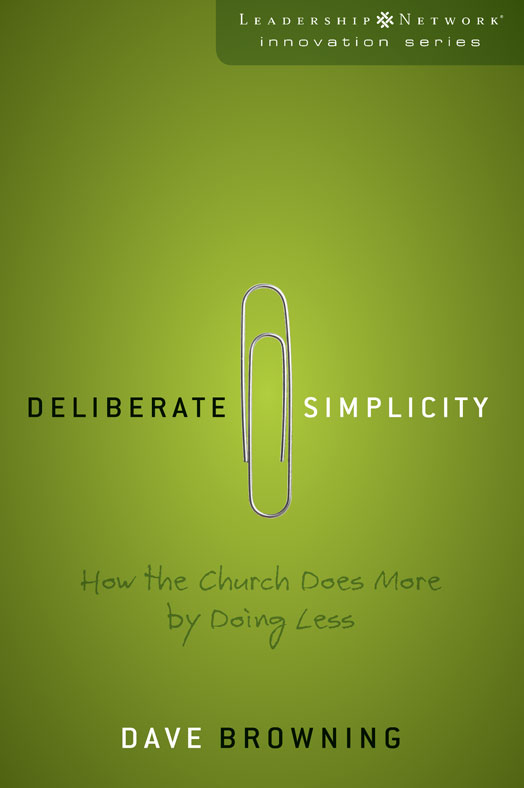
    I’m reading a great book by Dave Browning called Deliberate Simplicity. In one section of the book, Dave challenges us to ask the question, ‘What Drives Our Local Church?” Here’s what he says:

    You cannot do work that matters until you define what matters. A leaders’s job is to clarify and simplify so everyone understands what’s truly important….

    President Calvin Coolidge believed that ‘no enterprise can exist for itself alone. It ministers to some great need, it performs some great service, not for itself, but for others; or failing therein it ceases to be profitable and ceases to exist.’ Perhaps that statement summarizes the reason why many churches are sick and dying….

    Some of the organizing principles that churches adopt (maybe unknowingly) include:


    • Tradition. A church driven by tradition finds itself looking to the past for guidance for the future….
    • Personality. A church driven by personality finds itself directed by a key figure or figures….
    • Finances. A church driven by finances finds itself looking at the budget for direction. If it’s in the budget, we can do it. If it’s not, we can’t….
    • Programs. A church driven by programs defines itself by the programs it offers….
    • Buildings. A church driven by buildings finds itself in constant pursuit of bigger and better facilities….
    • Events. A church driven by events finds itself regularly gearing up for its next concert or pageant or bazaar. While events can be an effective part of any church’s strategy, left unchecked, events can grow to be the ministry….
    • Seekers. A church driven by seekers finds itself trying to get into the mind of ‘the customer.’ Surveys are taken. The results are evaluated. The church’s ministry is driven by polling data. The energy of the body goes into being culturally relevant and seeker friendly….
    • Purpose. A church driven by purpose finds itself evaluating what it does in relation to its sense of purpose. It has a philosophy of ministry that begins with the question, what is the church supposed to do? The church’s goals and objectives become the ruler by which efforts are measured.

    What is the driving force behind your church?

     
    Disclosure of Material Connection: Some of the links in the post above are “affiliate links.” This means if you click on the link and purchase the item, I will receive an affiliate commission. Regardless, I only recommend products or services I use personally and believe will add value to my readers. I am disclosing this in accordance with the Federal Trade Commission’s 16 CFR, Part 255: “Guides Concerning the Use of Endorsements and Testimonials in Advertising.”
  • What to Read

    Following are some more great articles I recently read and recommend to help your church succeed in fulfilling it’s mission. Enjoy. 

    what to read

    What Do We Do With Church Announcements by Gary Molander
    When I was a creative arts pastor, we’d have this ongoing weekly discussion about service announcements. We’d talk about the best delivery method, the best location in the service, and the best people for the job. During that time, I admit that I had quite the adversarial relationship with church announcements. They felt, to me, a bit like an exploratory colonoscopy. I knew how important the procedure was, but I’d rather not endure it. And while that’s too much information about me, you get the idea. Love. Hate. I did both. You’re probably like me. In my latter years, I’ve discovered that the foundational issue has nothing to do with the best delivery method, the best location, or the best people. The foundational answer has to do with David. Read More…


    The Epic-Fail of Church Announcements by Adam Stadtmiller
    Picture this scene. You’re in your pew. The worship is amazing, almost transcendent. The song ends in a moment of awe-filled silence. It’s just you and God. And then—train wreck; you are catapulted from a state of ethereal wonder to an awkward announcement about the church cookie bake-off or a video that never seems to have the sound start until seven seconds after it begins. Nothing in the history of Christendom, save perhaps the Second Crusade, rivals the ineffectiveness of the church’s ability to accomplish an intended purpose more than the medium of in-service announcements. Read More…


    Sunday Morning Announcements by Wayne Hedlund
    Remember our friend, Charlie Brown from the Peanuts comic strips and cartoons? You probably do, and you probably remember how realistic the sound of the school teacher was during those old fashioned episodes . . . “Wah, wa, wha, wha, wah, waah, wa, wah, whaa, wha, whah, wah.” Wow. Just quoting it reminds me of Jr. High History Class all over again. Question. Is that what your congregation hears during the Sunday Morning Announcements? I hope not. The announcements usually get a bum rap. Just for kicks, check off how many of the following are true at your church. Read More…


    Preventing Slips & Falls In Your Place Of Worship by Church Mutual
    Slips and falls occur regularly at worship centers across the country and follow the national trend of adults over the age of 65 accounting for the majority of those injured or killed. Preventing slips and falls is a serious issue for all worship centers and a concern that should be addressed for employees, members and guests of all ages and abilities. Read More…


    3 Steps To A Godly Church Tech Attitude by Phil Schneider
    If I’ve learned anything about being a “church techie,” it’s that the biggest tech-related problem in the Church just might be the tech guys’ attitudes. We see Church from behind the curtain, and sometimes that means that we look at our worship services, our graphics, our (insert your tech-related pet peeve here) with a bit of cynicism that the average congregant doesn’t have. Read More…


    A New Kind of Gospel Tract by Brian Alexander
    I dislike the traditional Church tract. I have never been a fan of handing out tracts, fake million dollar bills or funny little mind games as a statement of the gospel of Jesus Christ. In fact, these little papers, booklets, etc have made me less motivated to actually witness to strangers because the way that these tracts have been poorly thought out. Would somebody really want to listen to you explain the gospel on a fake dollar bill? The answer, more often than not is, “No” – they could care less! However, I have recently discovered a new type of tract called The Story from Spread Truth Ministries. Read More…


    Getting People from Point A to Point B by Tony Morgan
    A few months ago, I was the visitor. Being on leadership at a church myself, I wasn’t seeking regular attendance there. I was simply attending an event they hosted so my 3 year old could have a new, fun summer experience. Unfortunately, an obvious lack of organization made the event awkward and uncomfortable. I didn’t know where to take him in the building. It was chaotic and…I didn’t feel welcomed. Read More…


    Church Tech for Mortals by Eric Dye
    (Note: You have to subscribe to the ChurchMag newsletter to get this e-book. It’s easy to unsubscribe afterwards if you don’t want the newsletter, but the e-book is worth getting.)

    The goal of ChurchMag is to resource the Church through the most effective technology available. Many churches are already understaffed, especially when it comes to developing a well-conceived I.T. strategy. As a result, some may feel uncertain about what technology options are available, or nervous about investing money in products that may not prove useful. We’ve compiled this guide as a resource for the mortals among us who don’t have an exhaustive knowledge of the market. If you find yourself answering questions about Church Tech on a regular basis, we hope that this will serve as a valuable resource for you and your team. This book contains an overview of a variety of related topics across four themes: web, hardware, software, and networking. The appendix includes a list of recommendations found in the text to serve as a quick reference guide. Enjoy. Read More…

    photo credit: oskay via photopin cc

  • Strategy Kickstart – Asking the Question, ‘Why?’

    strategy kickstart logo3A Strategy Kickstart is a short 3-5 minute video clip which can be used to ‘kickstart’ a strategic discussion in your church or ministry. Simply show the video clip to your team and use the ideas and question posed to stimulate a valuable and hopefully relevant discussion on how you can better fulfill your ministry mission.

    In this Strategy Kickstart, Wayne Hedlund challenges us to identify events and activities in our church and challenge them as a team by asking the question, “Why do we do this?”


  • Skype Tips

    Skype LogoI use Skype several times a week to communicate with the various pastors/leaders I provide ongoing coaching to. Once we work out the logistics it is almost always a great way to meet together without the expense and extra time necessary for travel, food and lodging. I highly recommend it. In fact, in the past year I have successfully utilized Skype not only for 1 on 1 coaching, but also for team coaching (2-10 individuals) and workshops for as many as 15 people.

    That said, I’ve also discovered a few things that new Skype users should consider and look into before setting up Skype appointments. Feel free to email me with any further questions you may have.

    Skype Tips:

    • Make sure you have the latest version of Skype.
      This is important. Skype works hard at fixing call difficulties with every upgrade. If you’re running an older version of Skype, you risk having more difficulties during your call. To check your version, select Help/Check for Update.
    • If possible, don’t use a laptop webcam.
      Laptop webcam’s are traditionally difficult to use for a myriad of reasons. The main reason I don’t recommend laptop webcam’s is the mobility issue. It can be difficult to get your image centered properly for the other skype caller as well as have the picture on the screen where you want it so you can see well. Also, often the microphone on laptop’s can be difficult to work with and will sometimes create feedback for the other user.Webcams are pretty cheap now ($30-$50) and it’s well worth the cost for even just a couple of Skype calls. Your standard webcam will come bundled with a microphone so you’re getting a quality upgrade for both audio and video at the same time.
    • Check Audio/Video settings before your Skype call.
      Go into Tools/Options before each Skype session and ensure your Audio Settings and Video Settings are set to the right webcam.
    • Make sure your computer isn’t doing stuff or using the internet during your call.
      Often, the reason a Skype call is interrupted is because your computer is trying to use the internet or doing other tasks in the background. Make sure these background tasks have been paused during the call. For example, I have both Dropbox and Carbonite backup on my computer. I make sure they are both either paused or closed so they don’t try to sync during the Skype call. Common background tasks to look for include virus scans, Microsoft Security Essentials scans, security update downloads, online backups, and synchronization services like Dropbox, Outlook sync, etc.Finally, close unnecessary programs and browser windows during your phone call. I use Microsoft Outlook a lot and will often close it down during the call so it doesn’t start looking for mail and downloading attachments during the call – taking up internet bandwidth and computer capacity.
    • If possible, don’t use wireless internet during the call.
      You won’t always have this as an option, but if it’s easy to plug in a wired internet connection during your Skype call, do so. 
    • Check your internet plan.
      If you consistently have problems with Skype calls it could be that your internet plan with your service provider needs to be upgraded. Call your Internet provider and find out what your upload/download speeds are and ensure they are fast enough for video calls.
    • If you have echo problems, check the speaker settings.
      Sometimes I’ll experience a problem with echo’s, where I can hear myself through the other user’s speakers or they can hear themselves through my speakers. Often, this is because there are several options for speakers and you must select the appropriate one for Skype to work. For instance, if you have laptop speakers but are also using separate speakers plugged into your laptop or connected to an external monitor. In these scenario’s go into Tools/Options and check Speakers in the Audio Settings.Also, sound problems can be dealt with by ensuring you are in a quiet location. Additionally, the closer your microphone is to your mouth and the further your microphone is from the speakers the better.
    • Spend the first two minutes of your call checking voice/video.
      When you first start the call, ask your caller if the can hear you and see you well. Check the quality on your end as well. If there are problems, check some of your settings on each end. You may want to quickly exchange phone numbers if there seems to be difficulties so you can call each other if the call gets dropped. On occasion, call problems can be fixed by dropping the call and making the call again.
    • Check out the short troubleshooting video’s on the Skype website.
      Skype is committed to helping it’s customers have a positive experience. Check out this page on their website to see if you can learn other tips to ensure your Skype calls work well.
    Hope that helps. Happy Skyping!


  • What to Read

    Following are some great articles I recently read and recommend to you for your continued growth as a leader. Enjoy.

    what-to-read

    5 Ways to Stop Procrastinating and Get Things Done by Allen Schowengerdt
    We all do it. We put off that dreaded task for five more minutes, then for thirty minutes, then for another hour, until it doesn’t get done at all. And the worst part is we still weren’t able to enjoy our day. We spend so much time stressing over that looming task that it deprives us from actually being able to focus on other tasks. Read More.


    Good Versus Great Leader (10 Things To Consider) by Perry Noble
    A good leader makes assumptions…A GREAT leader asks questions! A good leader waits for feedback…A GREAT leader solicits feedback! Read More


    Tattoo Thinking by Seth Godin

    A tattoo is basically forever. You should think pretty hard before you get one, because it’s largely an irreversible decision. Just about every choice you make with your project and your career, though, doesn’t last forever. Read More. 


    Developing a Reading Strategy by Loren Pinilis

    We’ve looked at how to find time to read. But that’s only part of the battle. It’s good to read more, but we also want to read well. We want to think about what we read and how we read it. And a reading strategy is an invaluable tool to maximizing the benefit we receive from reading. Read More.


    5 Ways to Think Like a Champion by Jon Gordon

    I meet and learn from Champions every day. Not just in locker rooms but in classrooms, hospitals, homeless shelters, homes and office buildings. I’ve learned that to be a champion you must Think Like a Champion. Champions think differently than everyone else. They approach their life and work with a different mindset and belief system that separates them from the pack. Read More.


    photo credit: mccun934 via photopin cc

  • Critical Thinking Series – Introduction

    The articles in this series are from my e-book, “Thinking for a Change: a fresh look at critical thinking”. The e-book is available for download at a price of $2.99 at the Transforming Leader Online Store.

    critical-thinkingYears ago I heard a story about a man who tried to steal an ATM machine. His plan was to rip the ATM out of the wall of a store-front by chaining it to the back bumper of his pick-up truck. After securing the chain, the incompetent thief got in his truck and hit the gas. A few seconds later, he heard a terribly loud noise and the truck suddenly lurched ahead. Frantic and scared he would soon be caught, he quickly hit the brakes and ran around to claim his prize. Appalled, he discovered the ATM machine was still secured to the building. Lying on the ground in front of him was the truck’s back bumper which had been ripped off. Scared and frustrated, the man got in the truck and went home. Hours later, the police showed up at his door and arrested him for attempted robbery. He was easy to find. The police just checked the license plate on the bumper left chained to the ATM. I don’t know how true the story is, but it makes me chuckle and I wouldn’t be surprised if it actually happened.
    It is incredibly easy to make daily choices without a good and proper dose of critical thinking. Something happens to us and we either react (which can barely be define as thinking at all) or we do the first thing that comes to mind that seems halfway reasonable. Often, it’s a shot in the dark whether our half-baked decision will come back and bite us or not. In fact, the old saying “When you find yourself in a hole, stop digging” has its roots in Scriptures. Psalm 7:15 says, “He who digs a hole and scoops it out falls into the pit he has made.” Humanity has made a lot of holes throughout history and, unfortunately, we don’t always learn from our mistakes! Check out some of these quotes that so aptly capture our propensity for doing or saying something prematurely.

    • “Nothing in the world is more dangerous than sincere ignorance and conscientious stupidity.” -Martin Luther King, Jr.
    • “Only two things are infinite, the universe and human stupidity, and I’m not sure about the former.” -Albert Einstein
    • “I like to think of my behavior in the sixties as a ‘learning experience.’ Then again, I like to think of anything stupid I’ve done as a ‘learning experience.’ It makes me feel less stupid.” -P.J. O’Rourke
    • If you don’t do stupid things while you’re young, you’ll have nothing to smile about when you’re old. –Author Unknown
    • When you’re thirsty, it’s too late to begin thinking about digging a well. –Japanese Proverb
    • Some mistakes are too much fun to only make once. –Author Unknown

    Consider the Children’s Ministry Director who is faced with a dilemma. A Sunday School volunteer calls to explain that she won’t be able to teach her preschool class (which is starting in 15 minutes!). The director is now in a quandary. There will be several families showing up in a matter of minutes and something needs to be done quickly. He may react and grab the first warm body he sees to fill in; or perhaps he quickly decides to let the teen assistant teach the class alone. Either way, with an extra minute or two, he could have come up with more viable options. Of course, the old saying “Hind sight is 20/20.” is only quoted when we discover our hasty decision created bigger problems. In this example, what if the ‘last minute’ sub ended up yelling at the children and left them alone for several minutes for a bathroom break. The quick decision might end up with new families who are angry and unsure if they want to continue attending church or not.

    One reason we are OK with this way of thinking is that it usually gets us by. Anyone with a head on their shoulders, a little experience, and some common sense can make a halfway decent decision that saves the day . . . most of the time. So this way of thinking becomes the standard simply because it often works!

    In the above example, the quick thinking of that director could have saved the day if nothing went wrong. In hind-sight he might also wished he had thought things through more thoroughly. An extra 4 minutes would have sufficed!

    There’s a better way. I believe we can learn to think with perspective. It’s my personal goal to be a ‘critical thinker’ (not a critical person!) as often as possible; and I’m beginning to see that my goal can and is being realized in my day to day life.

    To read more, check out the next article in this series or purchase the e-book at my online store today!

    photo credit: steven n fettig via photopin cc

  • The Power of Criticism in Meetings

    meetingsHere’s the deal. If all you have are a bunch of head nodding people in your team meetings, you will have a hard time coming up with new and fresh ideas. I know. I’ve been there. There have been times when it’s been really important for my team to find a creative solution to a problem, but when we tried to discuss it, nothing happened. Often, I would end up standing up and pacing around while people talked until I was able to come up with a viable solution myself for us to consider. After watching this video, I’m realizing the problem was probably related to how willing my team was in pushing and prodding one another’s ideas.

    The main problem with this comes back to the first dysfunction of teams found in Patrick Lencioni’s book, “The Five Dysfunctions of a Team” – Lack of Trust. If you haven’t read that yet, put it up high on your list of books to get and read.

    So check out this short (2 1/2 minute) RSA video with Journalist & author Jonah Lehrer talking about this problem. 

    [su_youtube url=”https://youtu.be/RgPIkx2JyQU” width=”320″ height=”200″]

    Application: Why not show this video at your next team meeting and ask the question, “Do we trust one another enough to engage in this kind of constructive criticism when we brainstorm together?”

    Image by Caitlin Applegate.

  • Kindness Boomerang by Life Vest Inside

    Adam McCain spoke at our church this Sunday and showed this awesome 5 minute clip during his message about the power of doing small acts of kindness for those around us. What a great illustration to remind us of Christ’s command to “Love your neighbor as yourself.”  If we all did this every day, imagine how our world and community would be different! (Note: the construction worker at the beginning of the video is the same one at the end.) Enjoy.

    [youtube http://youtu.be/nwAYpLVyeFU]

    If you can’t see this video, try clicking this link.

    You Might Also Like These Videos:

  • How To Draft Your Core Values

    draft-core-valuesI’m a firm believer in core values for your church or organization. So in today’s post I’d like to outline some ideas on how your strategic team might go about drafting your ministry Core Values.


    HOW TO DRAFT YOUR CORE VALUES
     
     
    • Set Your Expectations
      In my experience, the process of defining and clarifying your core values is both time consuming AND rewarding as a team. It is definitely a team sport though. Don’t go about drafting your core values alone. It’s meant to be accomplished in a team environment. So make sure you have set aside several hours to work on this project. You may want to consider two or three 3-hour sessions right away. Side-Note: Be sure to keep your meetings close together on the calendar. The more days/weeks between meetings, the less momentum you will build towards completing the project successfully.
       
    • Get On The Same Page
      It’s important that everyone on your team has a basic understanding of why developing your core values is important as well as what core values are and are not. The aforementioned articles (above) would be a great place to begin. Be sure you spend time talking about these things as a foundation first, so you don’t end up doing so half-way through the process.
       
    • Assign Homework
      Next, I recommend you ask each person on the team to take an hour by themselves to personally brainstorm what they believe the core values of your organization are. Be sure they are armed with the “What Core Values Aren’t” document when they do so! I suggest they either keep their list until you return together as a team or submit the list to one individual on your team. I don’t recommend each team member sending out emails to the rest of the team with their list. You want to have conversation about this stuff, but live, not digitally.
       
    • Combine, Discuss, and Condense
      Now is when the rubber meets the road, so to speak. Be sure you have a good chunk of uninterrupted time to talk and have each team member share each value on their list as well as “why” they believe it’s a value that should be considered. As each team member shares, write the list down on a white board so everyone can see the list developing. This one meeting is probably one of the most important. If you don’t have a good degree of trust and openness on your team, people may find it difficult to challenge or question some of the thoughts and ideas being presented – which is an important part of the process.After everyone has shared and the list is developed, begin working on condensing the list down to as few primary core values as possible. Resist the temptation to have a ton of values. You’ll find that, with some effort, many of the values can be combined into a bigger category. For example, “caring” and “responsive to needs” can both potentially fall under the umbrella of ‘caring’. You’ll also want to test each value against my list of what a core value is NOT. Keep in mind, as well, that choosing to not keep a value doesn’t necessarily mean it’s not important to you or the ministry – but that it doesn’t fall into the primary DNA listing of values for your church. Ideally, you’ll be left with a handful of values – preferably less than ten.
       
    • Rephrase Your Values For This Culture
      Unless you’re target audience is boomers on up, you probably don’t want to keep your list of values as is. I recommend you engage in another strategy session or two and rephrase each value in such a way that it will capture the attention of your ministry guests and attendeesFor example, at Elevation Church they hold a value that in it’s simplest form could be phrased: ‘Teachable’. However, the way they explain it on their website is much more interesting, catches my attention, and draws me in. They say: ‘We eat the fish and leave the bones’. Or in Granger Community Church’s recently revamped core values they define ‘Team’ this way: ‘We Value Team: We is Better than Me’.
       
    • Share Them and Live Them
      Finally, you need to discover ways to regularly communicate your values to your congregation, leaders, and even your guests. I suggest you post them on your website and literature about your church, preach a series about them and package it up and give it away to everyone who takes your members class, add them to your strategic dipstick list (the list of things you check on strategically on an annual or semi-annual basis), blog about them, talk about them, and do so regularly.Most importantly, make your values so important that they are non-negotiable. A negotiable value isn’t really a value, it’s an idea. If you have a value of integrity, make sure you and your team consistently think up ways to lead your ministry with integrity. If it’s about teamwork, don’t just talk about teams, build in your very structure standards that prevent people from running ministry all by themselves.
     

    photo credit: Venessa Miemis via photopin cc