Tag: Team

  • Strategy Kickstart: Team Meetings


    A Strategy Kickstart is a short 3-5 minute video clip which can be used to ‘kickstart’ a strategic discussion in your church or ministry. Simply show the video clip to your team and use the ideas and question posed in the video to stimulate a valuable and hopefully relevant discussion on how you can better fulfill your ministry mission.

    In today’s Strategy Kickstart I challenge your team to consider separating Strategic Discussions from Tactical Discussions.

  • The Tunnel of Chaos

     
    “When you did that, it really hurt me. I’ve been mad at you ever since.” That sentence is the culmination of a conversation a friend had with me a while back. It was over breakfast – one that he initiated. I was totally floored. I had no idea that I had said something that hurt my friend. I’m embarrassed to say I didn’t even know he was mad at me.

    That conversation marked an important point in our friendship. I could have chosen to make a joke and take the event lightly. I could have gotten defensive and attacked my friend – pointing out that it was really his fault, not mine. I could have gotten mad back at him. OR, I could have spent time understanding what happened, acknowledging my mistake, and working towards building a deeper understanding about how I could ensure I don’t hurt my friend again.

    To his credit, my friend took the first, more difficult step. He chose to talk to me about it. I am so thankful for that. I know many would have just pushed it under the rug, leaving a big bulge, and spent weeks, months, or even years walking over it every day.

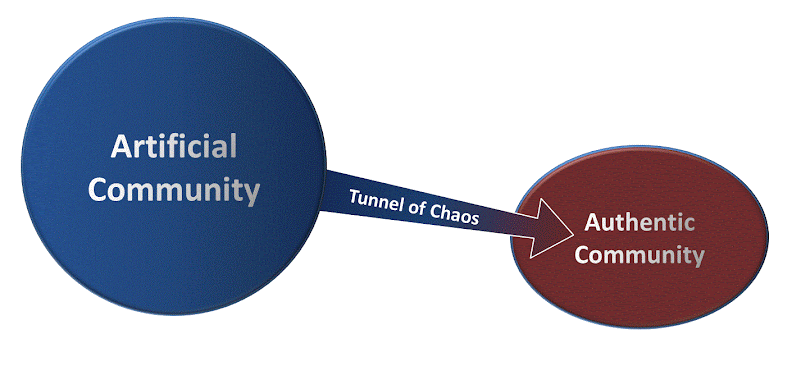
    The Tunnel of Chaos is that tunnel that leads from artificial to authentic relationships. It is a key to building trust with your family, friends, and coworkers. It is a critical component to your leadership team’s success and health. It is a foundational element of fostering and keeping a culture of trust.

    You enter the tunnel when you choose to engage in crucial confrontations with a solid commitment to hold steady until you’ve reached a positive resolution and a deeper friendship.

    Bill Hybels coined this phrase in his book, Axiom: Powerful Leadership Proverbs – a book I highly recommend. You can read this very short excerpt from the book from the Willow Creek Global Summit website right here.

    When was the last time you entered the tunnel with an individual or your team?

    Disclosure of Material Connection: Some of the links in the post above are “affiliate links.” This means if you click on the link and purchase the item, I will receive an affiliate commission. Regardless, I only recommend products or services I use personally and believe will add value to my readers. I am disclosing this in accordance with the Federal Trade Commission’s 16 CFR, Part 255: “Guides Concerning the Use of Endorsements and Testimonials in Advertising.”

  • 6 Things to Consider Before Hiring


    I enjoy hiring people just a little bit more than I do firing people. That is to say – not at all. It is stressful, time consuming, and just plain scary. After years of both successfully and unsuccessfully ‘hiring’ at Elim Gospel Church and the YWCA in York, PA, I’ve landed on a few key principles that I now take into account before I make the final plunge. Over time, these ideas have eased the pressure and anxiety surrounding hiring. I hope you find them helpful as well.

    • Take Your Time.
      I’ve heard both sides of the argument about whether you should hire quickly or slowly. I’ve landed on ‘slowly’. It’s much better to take your time to find the right person for the job than it is to hire a bad apple and go through the pains of figuring out how to let them go. Waiting can really be difficult in the interim while you are short-staffed, but in the long run, it’s worth it. If it’s any help at all, both Jim Collins in his book Good to Great and Bossidy/Charan in their book Execution encourage doing what it takes to get the right people on the bus as well.
    • Use the ‘Four C’ Filter
      Evaluate and interview each candidate based on what we (at Elim Gospel Church) call the four “C’s”. You may have heard Bill Hybels use similar language – though we’ve modified it slightly. Each word reflects one key area by which we will evaluate job applicants. We also let the applicant know about these criteria during the interview. If one of these four C’s don’t line up, we are very reticent to move forward with the hire. The four C’s are:
    • Character:
      Obviously, their faith in God and Christian values should be unquestionable. There should not be any area that we know of in their character that is in question – things like honesty, integrity, respect for authority, etc.
    • Competency:
      It’s important that the person being hired have the skills necessary for the job. You have to sometimes ask uncomfortable questions to dig below the “glossy surface” people tend to paint on their resume’s. In an administrative role, I would suggest asking them to complete some task or another to see how they handle it. Even just having them write up a letter for you at a computer can be very insightful. I have wished in previous hires that I spent more time evaluating this area.
    • Chemistry:
      It is extremely important to us that the potential hire will ‘connect’ with our values and culture in the office and church. This has a lot to do with how well we will work together, how closely aligned the candidate is to our vision for the church, office, department, or whatever area it is. Sometimes a person can NOT have the right chemistry, but be a mighty man of God. This probably means the position just isn’t the right fit – but that the person can still fulfill his calling somewhere else in the church or in the body of Christ. I know of a couple of examples where I ended up letting someone go because the chemistry wasn’t a good fit.
    • Calling:
      We really want to make sure the person isn’t feeling pressured into the role by us or being manipulated by us. We may let the candidate know that we want them for the job, but ultimately it’s up to them to pray to the Lord and seek His advice on whether He is calling them to function in this role right now. We don’t want someone serving on staff who doesn’t believe he is called to – otherwise, their motivation may be for money, prestige, or something else that doesn’t really fit.
    • Don’t Hire Alone.
      I’ve come to the realization that it’s wise to have two or three others involved in this decision as well as the interview process. Often, one of us may have insights about the person the other doesn’t that helps move things along. In fact, sometimes having others in the process protects the church from me. I might have in my mind that this is who I want to hire and end up disregarding important ‘red flags’ as a result. Others will help catch those ‘blind spots’ as well. Also, it’s a great feeling to hire someone when several of you were able to confirm that it’s a fit.
    • Hire from Within.
      It’s almost always safer to hire someone who meets the above criteria who is already part of your church and/or leadership. Among other reasons, they will likely tend to be more loyal to you and the mission of the church than someone from the outside. That’s not to say you can’t hire from outside the organization. Sometimes it’s very appropriate and necessary. Just err on the side of hiring from within whenever you can.
    • The Three Month Trial
      In other words, give them and you an easy “out” if it’s not working. We usually let them know we will evaluate how things are going in 3 – 6 months and decide if we will continue on from there. This provides a natural safety net for you if the hire is going sour. It also gives the new hire an easy out if they can’t seem to get motivated to continue.
    • Ask for a Two Year Commitment.
      Note: this suggestion primarily applies to leadership or highly administrative roles. It takes the average person a good year just to learn their new position, even if they are very experienced and competent. This is because they aren’t just learning the trade, but also the culture, communication, vision of the church, etc. Asking for a two year commitment means you get at least one good year of their full capabilities and production after they have been fully trained and acclimated to their new role.

    Disclosure of Material Connection: Some of the links in the post above are “affiliate links.” This means if you click on the link and purchase the item, I will receive an affiliate commission. Regardless, I only recommend products or services I use personally and believe will add value to my readers. I am disclosing this in accordance with the Federal Trade Commission’s 16 CFR, Part 255: “Guides Concerning the Use of Endorsements and Testimonials in Advertising.”

  • Teamwork and Trust

    I’m convinced that great teams are impossible to build and keep without trust. Trust is not something you can purchase, manufacture, or demand. It is a value that is modeled and built over time. You already know this . . . at least in your head, but do you understand what it takes to get there? I can give you a suggestion on where to begin. Patrick Lencioni’s book, “The Five Dysfunctions of a Team” and the associated field guide, “Overcoming the Five Dysfunctions of a Team“. If you lead any team at all, these books should be in your bookcase and on your mind.

    Consider this team of young men and what they have accomplished together. I can’t even begin to imagine the number of hours they spent together. It seems clear that there certainly is a high degree of trust – at least in relationship to this presentation! (Note: I recommend you watch in full screen.) Enjoy!

    Disclosure of Material Connection: Some of the links in the post above are “affiliate links.” This means if you click on the link and purchase the item, I will receive an affiliate commission. Regardless, I only recommend products or services I use personally and believe will add value to my readers. I am disclosing this in accordance with the Federal Trade Commission’s 16 CFR, Part 255: “Guides Concerning the Use of Endorsements and Testimonials in Advertising.”
  • Creating a Trust Culture

    Have you ever had a volunteer, employee, or friend tell you she would do something, and then totally bomb out and not do it – even to the point of not TELLING you she wasn’t going to do it? Have you ever done that yourself? When that happens, trust is broken. Trust should be an extremely important and well-guarded part of your church and ministry. If you don’t have it, then I respectfully submit that your ministry is in a very dangerous place.

    Jesus highlighted how important it is that we be in honest and open communication when he said in Matthew 5, “Therefore, if you are offering your gift at the altar and there remember that your brother has something against you, leave your gift there in front of the altar. First go and be reconciled to your brother; then come and offer your gift.” Jesus is expressing here that the broken trust in this relationship is critical to fix, right away. Stop what you are doing (even worship) and go reconcile.

    I listened to Andy Stanley talk about this yesterday and felt the need to encourage you to listen to it as well. Please consider taking 25 minutes out of your day today (before you forget and get too busy) to listen to this podcast by Andy entitled, “Trust vs Suspicion”.

    Click Here to Listen to “Trust vs Suspicion” by Andy Stanley.

    If you are interested in subscribing to Andy Stanley’s Leadership podcast you may do so right here.

  • The Meeting Professional

    Photo courtesy of ©iStockphoto.com

    The last few weeks I’ve explored the idea of teams; specifically getting the right people on them. But what about leading teams? What would happen if hired a professional to lead your meetings. How would it look compared to how YOU lead them?

    Seth Godin wrote a blog about this recently entitled “Making Meetings More Expensive“. He didn’t suggest hiring a professional though. He recommended a meeting fairie.

    Click this link to see what he had to say. You’ll be stretched.

  • The Strategic Personality

    This month I’ve been talking about the importance of getting the right people on the right seats in your bus:

    • In ‘The Chicken or the Egg‘ I asked the question, “Which should come first, your strategic team or your vision?”
    • In ‘The Seats of the Bus‘ I explored who should sit where on the bus.
    • In ‘What’s the Big Deal About a Wrong Seat?‘ I showed you what it might look like having the wrong person in the wrong seat – especially on your Strategic Team.
    • Finally, in ‘The Four C’s‘ I gave you permission to evaluate your team selection through the lens of four specific criteria.
    I want to zero in on one of those “Four C’s” a little more today; specifically in the area of Competency. Let me ask you a question. How do you know if a person has the right personality to serve on a Strategic Team? You may not think it’s a very important question. I can assure you that it is. I’ve learned through the school of ‘hard knocks’ that certain personalities generally just don’t fit on a Strategic Team. He may have great character, awesome chemistry with you and your church, and feel called to serve in leadership. He may even be one of your leaders or elders.
    If you were looking for someone to manage the finances in your organization, I think it’s safe to say that an area of competence for that role would include someone with an analytical personality. If you decided to recruit someone to teach a class you would hope the individual was good with people – another personality trait. In the same way, people who serve on the Strategic Team should lean in a particular direction regarding their personality. This is an area of competence which is very easy for us to overlook.
    I’ve already shown you what it might look like if you have the wrong person in the back of the bus right here. Now I’ll show you what personality best fits in those seats. Check out this chart.


    The upper right quadrant will tend to be your leaders and visionaries.
    The upper left quadrant will often be your thinkers and analytically inclined.
    The lower right quadrant will likely be your communicators and your fun people.
    The lower left quadrant will usually be your faithful and loyal workers who just want to use their gifts to serve.
    The closer to the outer edge, the stronger their personality in that quadrant. The closer to the center the more ‘well-rounded’ they tend to be in all of those quadrants. I recommend you try out the online personality profile at www.leadingfromyourstrengths.com/purchase-lfys-profiles.php. You’ll have to pay a $25 fee to take the test, but in the end you will have a 25+ page summary of your strengths & weaknesses. On the very last page you will find a chart similar to the one above with an indicator of where you fit.
    Does this mean that people who tend toward the bottom left shouldn’t be on your team? Not necessarily. What it does mean is that certain strategic discussions will likely be more of a stretch for them to engage in. You will probably see them struggling or need to give them more time to process or catch up than you would those whose personalities lean towards the upper right. Some of these people may contribute very little to the conversation as well. I happen to know that those with a strong bottom/left personality also have a very difficult time with confrontation and conflict. Two important elements in strategic discussions.

    What if you find yourself in one of that bottom left quadrant? In that scenario I would recommend that you work extra hard to ensure you don’t fill your Strategic Team with others of the same personality. In other words, be sure to recruit team members who lean to the upper right. You may also want to consider asking someone else to lead the team meetings. You should definitely be present and have a voice in the discussion, but it would probably be easier for you if someone else focused on leading so that you can give more of your energy towards processing the discussions in the room.

  • The Four C’s


    In my last two blog entries I have been talking about the importance of getting the right people on your bus and also making sure you have the right people in the right seats.

    In particular, it is very important that every team member is aligned with you in four different areas. At Elim Gospel Church, we simply call these “The Four C’s”. Three of these “C’s” Bill Hybels talks about in his Leadership Book, “Axiom: Powerful Leadership Proverbs”. Whether you are looking for someone for your Strategic Team, for your board of directors, for the director of your men’s ministry or for your newest secretarial hire, these four criteria should be evaluated as part of the recruitment process.

    Character: It goes without saying that character is critical when recruiting someone to an influential position. What is often NOT said, or thought about, is just what “character” traits you are looking for. We tend to see people as “good” and have a hard time labeling them as someone lacking in character.

    You should identify your own list, but here are a few things we deem very important:

    • Team Player
    • Teachable
    • Honest
    • Attends Regularly
    • Serves Regularly
    • Gives Regularly
    • Submitted to Leadership
    • Growing Christian
    • Positive Example in Life

    Competency: The business world has this one figured out. They’ve got resume’s, job applications, and interviews down pat. The Christian world? Not so good. Again, it seems like we somehow think it’s “unchristian-like” to evaluate whether someone actually has the right skills for the job. Classic example: the lady who played the organ when growing up in church during my teen years. Was I the only one that noticed she didn’t have any rhythm and constantly got the wrong notes? Oh yeah, and she couldn’t really sing either.

    When recruiting, for anything, figure out in advance what competencies are required for that role; then you can begin the process of deciding who best meets those criteria (along with the other 3 “C’s”.)

    Chemistry: Again, this area is one many leaders are afraid to discuss or consider. This is the arena where you determine if the person in question is going to be a good fit in your culture as well as with you as their leader. Chemistry is not to be confused with character. It is strictly about whether this person carries the key aspects of your ministry DNA or not. This is why nearly every great leader in both the marketplace and ministry will tell you that it’s much better to hire from within – because those people will be much more likely to be DNA carriers and score high in chemistry with you as their leader.

    Here is what I have discovered about how chemistry impacts your team and ministry. When you have a team player that is high in chemistry with you and your organization, you will very likely have little relational conflict. Conversely, when chemistry is low, conflict will likely abound. I’m not talking about the constructive conflict that should be in every relationship and team. I’m talking about the conflict that continually rises up because two different worlds/mindsets/standards keep colliding. This is also why it is becoming more and more popular for organizations to hire competent but young and less experienced people as opposed to those who have a ton of experience. The more experienced professionals also tend to have a lot of opinions and mindsets on what should be done and how to do it.

    Calling: The final “C” we look for when hiring or recruiting is also critical to us. We actually walk all new hires through these four C’s and end with this one. This is our reminder that God has an interest in this decision. Jesus told us to “Seek first the kingdom of God and His righteousness…” God told Jeremiah, “I know the plans I have for you…” So we remind the candidate to seek God for His purposes for them and we do the same. It is quite possible that the person would be a great match in every other way, but that God is directing them towards something else in your organization or in the world.


    We take these criteria very seriously. If even just one of them doesn’t seem to be lining up, we slow everything down and re-evaluate. Better to struggle through a leadership void for a season of time than to get the wrong person on the bus and find out 6 or 9 months down the line that they aren’t going to work out.

    Disclosure of Material Connection: Some of the links in the post above are “affiliate links.” This means if you click on the link and purchase the item, I will receive an affiliate commission. Regardless, I only recommend products or services I use personally and believe will add value to my readers. I am disclosing this in accordance with the Federal Trade Commission’s 16 CFR, Part 255: “Guides Concerning the Use of Endorsements and Testimonials in Advertising.”

  • What’s the Big Deal About a Wrong Seat?

    OK. So we have acknowledged that there are different kinds of seats on the bus. Why is this so important? Would it really be that big of a deal if team members picked their seats? What if someone who sits in the middle of the bus decides they would really like to hang out in the back of the bus? Shouldn’t we let them?

    Do you remember where you sat on the bus when you were a grade-schooler or teenager? It’s pretty likely that, although you perhaps thought you would enjoy sitting somewhere else, if you did you would have felt really out of place. Or perhaps your parents made you sit in the front and you couldn’t wait for the ride to get over?

    The point is, team members should be placed on the RIGHT team for their OWN benefit as well as the benefit of your organization. This is especially true when it comes to identifying who should be on your strategic team. It’s not for everyone to sit in the back of the bus. The conversations taking place in healthy strategy meetings will include honest and open assessments of current ministry, big picture brainstorming, and plans to make both small and large shifts and changes in your organization. Some of those conversations are enough to send your average “tactically-minded” team member to counselling for weeks.

    Here are some signs you may have the wrong person in the wrong seat in Strategic Meetings:

    • He rarely speaks during the meeting.
    • She often fidgets or is disengaged from the conversations.
    • When he does share, his comments seem to reflect a misunderstanding of the general direction of the discussion.
    • She seems distressed during the meeting most of the time.
    • He constantly brings up reasons why ideas won’t work.
    • She regularly resents or defends ministry evaluations.
    • He is emotionally exhausted after each of the meetings.
    • She gets overwhelmed and excessively emotional during or after the meeting.
    • He keeps turning the conversation towards the details – “Who is going to do that?”, “Where will we get the money?”, “How will we ever be able to recruit people to get involved?”, etc.
    Do your ministry a favor. Be careful in who you choose to be on your Strategic Team. Over the next few entries I will share more ideas on how to pick the right people for your Strategic Team.
  • The Chicken or the Egg?

    Philosophical Dilemma: Which came first, the chicken or the egg?

    Evidently the age-old question has finally been solved. Ironically, the solution British scientists have come up with supports creation pretty well! If you are into poultry philosophy, fell free to check out the article here.

    Leadership Dilemma: Which came first, the strategic plan or the strategic team?

    Most of the business and ministry world would likely have answered this question with, ‘the strategic plan’. After all, doesn’t it make sense that we determine where we want to go, what our vision is, and THEN pull together a team of people to implement that vision? I would have thought so myself until I read the book, “Good to Great” by Jim Collins (I recommend this book!). Listen to what Jim had to say about great leaders:

    “We expected that good-to-great leaders would begin by setting a new vision and strategy. We found instead that they first got the right people on the bus, the wrong people off the bus, and the right people in the right seats – and then they figured out where to drive it. The old adage, ‘People are your most important asset’ turns out to be wrong. People are not your most important asset. The right people are.”


    Disclosure of Material Connection: Some of the links in the post above are “affiliate links.” This means if you click on the link and purchase the item, I will receive an affiliate commission. Regardless, I only recommend products or services I use personally and believe will add value to my readers. I am disclosing this in accordance with the Federal Trade Commission’s 16 CFR, Part 255: “Guides Concerning the Use of Endorsements and Testimonials in Advertising.”