Tag: Growth Barriers

  • Pastor Jack Oats

    image compliments of Matthew Stumphy

    I know you have a given name and title at your church. I’m sure you are proud when you hear them spoken (most of the time at least). However, is it possible that you could also go by the name Pastor Jack Oats. If so, you are very likely ignorant of the fact. If you aren’t ignorant of the fact, then perhaps you need therapy.

    OK. That wasn’t very helpful. You are free to go by the name “Pastor Jack Oats” if all or most of the following is true:

    • You preach every Sunday of the year.  Bonus: you lead worship each week too.
    • You teach every Wednesday of the year.
    • You also teach a Sunday School class almost every week.
    • You create the bulletin and/or sermon note-taking guide each week. Bonus: you make the PowerPoint too.
    • You run sound on Sunday mornings.
    • You count the offering each week (with or without someone else present).
    • You are available 24/7 to your congregation in case someone needs to talk.
    • You order and organize the Sunday School curriculum. 
    • You provide ongoing counselling to several people each week.
    • You lead the youth ministry on Friday nights.
    • You created and maintain the church website.
    • You organize and run VBS every summer.
    • You do a lot of the cleaning and mowing around the church. Bonus: shoveling too.
    What do you think? Does that hit pretty close to the mark? Does this describe a good chunk of your weekly activities? If so, then I hereby dub you, Pastor Jack Oats. How did I know? Just check out the first word of every bullet above. You.
    Andy Stanley has said, “Devoting a little of yourself to everything means committing a great deal of yourself to nothing.” 
    Here’s the deal, YOU can’t do everything Pastor Jack Oats! (aka: Pastor Jack Of All TradeS)

    “WAIT! You don’t understand! I serve in a small church and have to do all of those things!”

    I know there’s a chance I may have just offended a few of my readers. Please understand that I’m not trying to offend. I am trying to challenge. I know you have a lot of responsibility and there are a lot of things you need to do. I know that often you are the ONLY person who can or will do them.

    However, sometimes it’s easy to get into a rut in thinking that you are the only one. The fact is, if you have a congregation of 12 people, it’s possible to ‘spread the responsibility’ of ministry around. (I didn’t pick the number randomly . . .) I’ve come across a few pastors over the years who:

    • Have gifted people in their church, but don’t think to ask them to serve.
    • Assume everyone is too busy to do some of the things they do.
    • Are afraid to ask others to get involved.
    • Enjoy doing lots of things and are unwilling to give them up to others.
    • Want to be in control and prefer to do things themselves.
    • Don’t trust others to do things the way they want them done.
    • Believe they don’t have time to recruit and train others to do things. It’s easier to do it themselves.
    • Believe they don’t have anyone in their church who can do the necessary tasks.
    Friend, if this is you then I urge you to reconsider. There are gems sitting in your pews and in your communities who God has called and gifted to serve His body alongside you. It is His plan that you equip your people to do the ministry. That is what you are called to do. It is a holy and biblical mandate from God himself (remember Ephesians 4:11-13)
  • The Big Road Block


    Road-ClosedI’ve heard it said that there are two seasons in Upstate New York: Winter and Construction. We’re feeling it right now in the small suburban town that I live in. Every day several handfuls of construction workers magically appear to repave our roads and rebuild the local bridges.

    The bridge construction, in particular, has been quite frustrating. An entire section of road will be shut down for 3 weeks to a couple of months. Ugh. The first local bridge they worked on required a long, convoluted detour. I even discovered that the construction crew went on some sort of strike for a couple of weeks. I don’t know the details, I just remember thinking, “This is really ridiculous! We have a well traveled road that can get me to my destination in great time that is not being fixed and has been road-blocked indefinitely!”

    That said, here’s what I discovered: I GOT USED TO IT. It was a mild annoyance, but eventually I adjusted my expectations and plans and just used the detour all the time. I had no idea when the road would reopen so it became pretty irrelevant as I adjusted to the new pathway. A new pathway that was long, tedious, and not very productive.

    I’ve discovered that many of us have a road block like this that needs to be overcome before we see any meaningful changes in our ministry and at our church. It’s a road block that we don’t think about very much. We just bypass it, deal with it, live with it, adjust to it, even forget about it. We’ve gotten used to doing ministry the long, tedious, and not so productive way. This road block can be a major key to launching change. You get this particular road opened and you may discover a brand new path to effective and powerful ministry.

    The road block is YOU. Think about it. If you are the primary or even secondary influencer in your church or ministry, who is really stopping you from fulfilling the calling of God for your church and on your life? It’s so easy to blame the conditions around you, to describe all the reasons or excuses that stand in the way, to determine that the solution is beyond your control and external. In fact, it’s easy because it means you don’t have to take responsibility. You just convince yourself that there are good reasons why certain things can’t happen, and you just have to live with them.

    But what if the real problem was a wrong mindset that you believe? What if the road block is your way of viewing your ministry and situation? Perhaps the bridge is out and you’ve gone on strike…indefinitely. While on strike you’ve adjusted how things work so that the ministry continues – but it’s entirely ineffective. What if your predecessor is the one who created the detoured path you are on because his thinking was on strike and you’re now following the same path?

    I’m not saying that there aren’t limitations and natural barriers to the fulfillment of your God-ordained vision. I’m just saying that ONE of those barriers may very well be your perceptions and internal dialog about how you can reach that vision.

    I’d like to propose that it IS possible to see God’s purposes and vision fulfilled. After all, if it’s a God-ordained vision, then He’s interested in seeing it fulfilled even more than you are! It’s not your responsibility to MAKE that vision happen, it’s your responsibility to fulfill your part of that vision and let the Holy Spirit breathe life, prosperity, and blessing into it.

    Maybe I’m missing all the ingredients, but it seems to me that at least three primary ones would be:

    1. FAITH. You need to believe it’s from God and live and act like it will happen. I think it’s OK to have doubts. We see plenty of that in the Bible. What’s not OK is forgetting that God is the overseer of your ministry, not you.
    2. A PLAN. We would all love it if God would just step in and make it all happen. Alas and alack, he wants us to do the planning part, with His leading, instead. Nehemiah made plans to build a wall. David made plans to conquer a nation. Joseph made plans to overcome a God-revealed famine. The disciples made plans about where they would go, when they would leave, and often what they would do while they were there. And of course, Jesus lived out a God-sized strategic plan for the salvation of the world.
    3. COMMITMENT. That means you are willing to press through the dips, the valleys, the rough times. It means you’re willing to work hard, to read a lot, to ask for help, and to make changes that will require a level of self-sacrifice that will be uncomfortable. It means you’ll take risks and fail sometimes and then get up and try again. It means you won’t give up.

    HOW DO YOU KNOW IF YOU’RE IN THE WAY? How about starting by asking three questions:

    1. Do I have faith that God can and will lead me to where I believe this ministry is supposed to go?
    2. Do I have a plan to get there?
    3. Am I willing to make sacrifices on the way?
  • Overcoming Barriers to Church Growth

    Several years ago we read a book as a team that really started us on the path of strategic planning at Elim Gospel Church. It was called, “Leadership Transitions for Growth” by Michael Fletcher. The book has now been re-released by the title, “Overcoming Barriers to Church Growth“. It’s a short and easy read, and played a big role in helping us to change our mindset as a leadership team for growth.

    Among other things, the book discusses how to build a leadership structure for the NEXT stage of growth you are believing God for in your church/ministry. He said it best on page 43:

    “To cross over into a new stage, leaders must understand what lies ahead and make the necessary realignments before they expect to move to a new level of growth.”

    He explores three questions for small size churches (under 200), medium size churches (200-700), and large churches (over 800):

    1. How do the Elders relate to ministry?
    2. Who does the ministry?
    3. How are decisions made?
    If you have been struggling getting your footing in church growth, I would recommend this book as a resource, especially in the area of how your church leadership is currently structured.

    Disclosure of Material Connection: Some of the links in the post above are “affiliate links.” This means if you click on the link and purchase the item, I will receive an affiliate commission. Regardless, I only recommend products or services I use personally and believe will add value to my readers. I am disclosing this in accordance with the Federal Trade Commission’s 16 CFR, Part 255: “Guides Concerning the Use of Endorsements and Testimonials in Advertising.”
  • Attributes of a Church in Decline

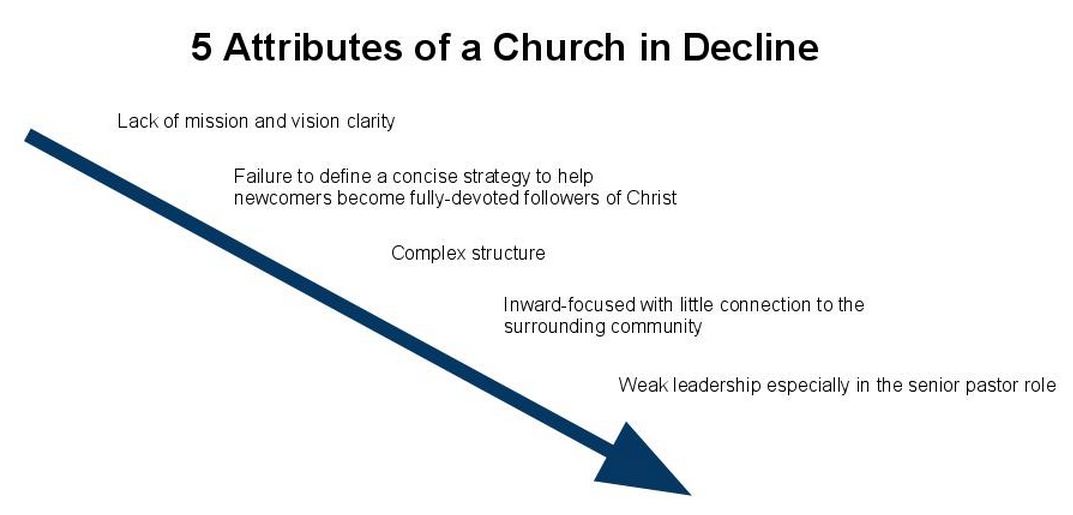
    Tony Morgan grabbed my attention again this week in his blog entitled, “5 Attributes of a Church in Decline”. He shared what he and a fellow blogger felt could be five key attributes of a church in decline. What strikes me as so interesting is simply that all five attributes are indicative of a church that isn’t led by someone who thinks strategically for the future. For instance, as I’ll share in a future entry, a clear mission and vision is a very basic and key first step in strategic planning. What do you think?

    In case you have a difficult time reading this chart, the five attributes are:

    • Lack of mission and vision clarity.
    • Failure to define a concise strategy to help newcomers become fully-devoted followers of Christ.
    • Complex structure.
    • Inward-focused with little connection to the surrounding community.
    • Weak leadership especially in the senior pastor role.