Category: Evaluation and Feedback

  • Knowledge Empowers Leaders To Make Wise Choices

    knowledge-empowers-leaders

    A wise man has great power, and a man of knowledge increases strength; for waging war you need guidance, and for victory many advisers. Proverbs 24:5-6

    There is very little that will frustrate a true leader more than lack of knowledge. Knowledge, when wielded by the right individual, is like a sharp sword that is capable of cutting through confusion to find truth and wisdom. Lack of knowledge leaves us whacking away at ghosts in the darkness, hoping we will stumble upon the right path. Empires have fallen because of lack of knowledge. Relationships have come to ruin. Bank accounts have run dry. Employment opportunities have passed people by. All because someone didn’t have the information needed to make a wise choice.

    The church world is not exempt from this truth. When leaders have access to the right information, it empowers them to make wise choices. Those wise choices ultimately lead to transformation in the lives of the broken and hurting people in that community.

    Proverbs 24 (quoted above), reminds us that leaders can have ‘great power’ and ‘increased strength’, which can lead to ‘guidance’ when facing battles. In other words, we have a greater chance of victory than we did without them (wisdom & knowledge); we are ’empowered.’

    If wisdom were a fire keeping us warm and giving us light, knowledge would be the wood and fuel feeding that fire. Of course, knowledge must be given to the right person, a wise person, in order for it to make a difference. Otherwise, it is simply wood sitting in a pile on the floor. 

    Charles Spurgeon said it this way: “Wisdom is the right use of knowledge. To know is not to be wise. Many men know a great deal, and are all the greater fools for it. There is no fool so great a fool as a knowing fool. But to know how to use knowledge is to have wisdom.”

    Knowledge is not our ONLY source of wisdom. There are other sources as well, the most important Source being God Himself, who promises to give wisdom to all who ask it (James 1:5.) But I suspect that knowledge is one of the primary tools God gives us to make wise choices.

    How does this apply to you today? What area of your life or ministry are you struggling with? What challenge are you facing that seems overwhelming and insurmountable? I recommend you start with prayer and then begin asking lots of questions. Go on a treasure hunt. Look for answers and don’t stop until you’ve found them. 

    Image from istockphoto.com.

  • The Art of Inviting Feedback

    feedbackI’m a big fan of feedback. Not the kind you get on Sunday mornings when the microphone goes haywire and everybody goes deaf. The kind you get when people share their thoughts & opinions regarding something you’re trying to do with excellence.


    Inviting feedback is a bittersweet activity. But when I swallow my pride and listen closely to other’s thoughts, it increases my effectiveness and impact in ministry.

    Yesterday I listened to this two-part podcast from the Andy Stanley Leadership Podcast series entitled, “The Art of Inviting Feedback“. One of the big takeaways was learning how to ask your leaders, co-workers and team-mates this one question:

    “If you were me, what would you do differently?”

     I strongly urge you to ask your entire team to listen to these two podcasts. They have the potential to, over time, make a big difference in your ministry’s leadership culture.

    The Art of Inviting Feedback – Part 1 (Andy Stanley Leadership Podcast)

    The Art of Inviting Feedback – Part 2 (Andy Stanley Leadership Podcast)

    photo credit: woodleywonderworks via photopin cc

  • Thursday Quote: Who – The A Method for Hiring

    This is a guest post by Pastor Doug Cowburn II. Pastor Doug serves as the Executive Pastor at Elim Gospel Church in Lima, NY. Recently, while sharing lunch together, Doug told me about this book and readily agreed to writing this Thursday Quote about it for your benefit. Enjoy.


    Recently, two different people I know recommended that I read, Who: The A Method to Hiring. I found that this book was not only a great resource for when you need to hire someone, but also a great way to look at writing your own job description. If you’re like me, you want to know when you are being successful at your job. The problem is that many who are in ministry are either working without a job description or the one they have is all activity based. Activity based job descriptions say things like:
    • Connects with volunteers
    • Teaches on a regular basis
    • Leads the deacon team

    Someone could follow an activity based job description for years and never actually move the needle on the church’s mission. I want to be an “A Player” who delivers his best and contributes toward the church’s vision and mission. In order to do this I need a job description, or as this book suggests, I need a scorecard that gives me some targets to hit.

    Here are some of my favorite quotes from the book:

    “We define an ‘A Player’ this way: a candidate who has at least a 90 percent chance of achieving a set of outcomes that only the top 10 percent of possible candidates could achieve.”

    “The scorecard is composed of three parts: the job’s mission, outcomes and competencies. Together, these three pieces describe ‘A’ performance in the role—what a person must accomplish and how. They provide a clear linkage between the people you hire and your strategy.”

    “While typical job descriptions break down because they focus on activities, or a list of things a person will be doing (calling on customers, selling), scorecards succeed because they focus on outcomes, or what a person must get done (grow revenue from $25 million to $50 million by the end of year three). Do you see the distinction?”

    “Scorecards: • Set expectations with new hires • Monitor employee progress over time • Objectify your annual review system • Allow you to rate your team annually as part of a talent review process.”

    As you can see, this book was written primarily for the business world, but it has huge implications for ministry related job descriptions as well.  What would your scorecard look like?

  • Finding Your Sacred Cow

    This week I suggested that your church may have a ‘sacred cow‘ or two that you’ve been holding onto. I haven’t been entirely fair in my blunt and vague references to the ‘cow’. Today, I will attempt to be more clear and practical.


    Definitions:

    • Wikipedia defines a ‘sacred cow’ as something considered (perhaps unreasonably) immune from question or criticism. 
    • Dictionary.com proclaims it as an individual, organization, institution, etc., considered to be exempt from criticism or questioning. 
    • Miriam Webster’s Learners Dictionary says it best from my perspective though: someone or something that has been accepted or respected for a long time and that people are afraid or unwilling to criticize or question.
    A Real Example:
    Several years ago I was leading a Strategic Meeting at Elim Gospel Church. We were discussing the number of programs, events, and activities that were potentially sideways energy and not centered around our primary mission as a church. The reality was that some of these activities were stealing our best people and resources – and they weren’t strategically helping our church and it’s people grow. We had just read Andy Stanley’s book, Seven Practices for Effective Ministry (required reading at our church) and decided we needed to “Narrow the Focus”.
     
    So far, so good. We all acknowledged that we needed to streamline our church programs to maximize effectiveness and make room for focused growth. Our next step was when the sacred cows stepped into the room (Note: cows don’t mix with elephants very well!). We wrote down on a white board all of the church related activities that could be counted as something that should be evaluated. Once we built our list we systematically began discussing each activity to decide what to do with them. At the end of the meeting we had decided to cut exactly ZERO things.
     
    Here’s what the conversation sort of sounded like, 

    Wayne: “So how about VBS? Is that something we should consider ending?”

    Team Member: “No. We can’t lose that. We have hundreds of children attend that each year and it’s attracting a lot of families from the community.”

    Wayne: “OK. Well, let’s consider the ‘Women’s Community Bible Study’.”

    Team Member: “No, no. I feel we would really be making a big mistake there. A lot of women from the other churches attend that event. It’s a great way to serve those other churches and it’s very well attended.”

    Wayne: “Umm. Our Easter Production?”

    Team Member: “Wow. You really think we should consider doing a normal service? Besides Christmas Eve services that Sunday service is our highest attending service of the year!”

    Suffice it to say, that was not one of our funnest meetings. I left that meeting feeling deflated and as if we had wasted several hours of everybody’s time. What we realized was that although we wanted to do the right thing and cut back, none of us were committed to really questioning these and other events. They had become sacred cows for us. (Note: I specifically used those three examples from our discussion for a reason. We have since successfully ‘killed the cow’ in each of those cases. If you’re interested in how we did it, shoot me an email or post a comment.)
     
    Three Disclaimers:
    1. Before you look at the final section below, please be reminded that IF one of these have become a ‘sacred cow’ it’s possible you either don’t know it or aren’t willing to admit it. I talk about that in my post entitled, “The Smelly Cow“.
    2. I am NOT trying to say that the below examples shouldn’t be happening in your church. It’s quite probable that many of them should. However, what may be very appropriate, strategic, and anointed by God in one church may in fact become the opposite in another.
    3. If you look closely at the above definitions you will note that a sacred cow is NOT NECESSARILY something that you shouldn’t be doing. It can also include something that you should be doing, but that you ARE NOT willing to question. So here it is, “Are you willing to question any or all of the below examples in your church ministry?”
    Sacred Cow Examples:
    Following are a few examples of activities, events, etc. that COULD end up becoming ‘sacred cows’ for your church. I’d love to listen to your internal dialog as you read them. Hopefully, they won’t sound that meeting we had many years ago!
    • A Program or Ministry.
      It is possible your church supports a ministry that happens every week or month that isn’t really an integral part of your church’s mission. This may include a men’s or women’s program, a children’s program, a class, perhaps even your mid-week service {gasp}
    • An Event.
      Of course, there may be many events that you host occasionally or even annually that really need to be questioned and evaluated. Understand, you shouldn’t really be checking to see if the event is successful based on how many people attend or even how effective the event is. Rather, you want to know, “Is it strategic and fulfilling our mission as a church?” An event may include a special service like an Easter or Christmas service, a youth overnight retreat, a seminar or conference that you host, maybe even your Vacation Bible School.
    • A Service Element.
      A service element may include ANYTHING you do immediately before, during, or after a Sunday service. Often, churches get so used to doing the same things every week that they become sacred and untouchable. This is how church services can become ineffective and irrelevant in reaching their communities. Your members who have been around for years don’t even question what happens each week, but your guests sure do! Examples of service elements include your style of worship, how you receive the offering, the volume of the service, the temperature in the room, how you give the announcements, how you host communion, whether Aunt Edith should play the piano and possibly even how you preach every single week! Ouch.
    • Your Language.
      Sometimes the words you use every week are inappropriate and unhelpful to your listeners – and in particular to your guests. This will include the obvious words like “sanctification”, “justification” and what-not. However, it may also include words like “visitor”, “heathens”, and “secular”. (Example: We no longer refer to new people each Sunday as ‘visitors’ – it sounds like they won’t be staying long. We now call them our guests.) Finally, your language will also include the many assumptions you may make from the pulpit about your listeners, like ‘everyone here already knows all the stories/people in the Bible’ and ‘everyone here understands our church’s history and culture’.
    • Your Things.
      What would happen if you walked down the hall and removed that picture of the founding pastor from 50 years ago? What things does your church possess and most often display that have become sacred cows? How about the seats in the sanctuary? The offering baskets? The stained glass windows? I’m not suggesting you clean house this Saturday – if you do so, you may end up with a church split. I AM suggesting that you may have some sacred cow ‘things’ kicking around that should be identified. What to do with them is another topic entirely.
    • Your Building.
      Every pastor and leader understands intellectually that the ‘church’ is the people, not the building. However, we can often be guilty of giving our building more ‘sacred value’ than our people. Nowhere in your mission statement is there a reference to your building (I hope). How have you preferred your building over your people? Additionally, parts of the building can become sacred cows – like the color of the carpet or walls or the wall that divides two rooms which could really serve your church better as one big room.
    • Your People.
      Don’t get me wrong, I’m not calling your people cows. However, sometimes we can have people in positions of influence or ministry in the church and nobody is willing to question whether they are really serving the church well in that role. Just because someone has been on the worship team, an elder, or a greeter for the last 20 years does not mean they should be today and tomorrow.
    • Your Systems.
      You may not realize it, but you have systems. They are the procedures that you either officially or unofficially utilize to get things done. Here’s the deal with systems: rarely do the same systems serve the church forever. In fact, just like the parts of your car, systems can get old and wear-out. A growing church will always be evaluating how decisions are made, how the bulletins are produced, how guests are followed up on, etc. to ensure those systems are still serving the ministry of the church as best as possible. If you ever hear someone respond to the question, ‘Why do you do it this way?’ with ‘Because that’s how we’ve always done it.’ then I submit that you may have a system that has run it’s course.
    Disclosure of Material Connection: Some of the links in the post above are “affiliate links.” This means if you click on the link and purchase the item, I will receive an affiliate commission. Regardless, I only recommend products or services I use personally and believe will add value to my readers. I am disclosing this in accordance with the Federal Trade Commission’s 16 CFR, Part 255: “Guides Concerning the Use of Endorsements and Testimonials in Advertising.”
    Image Source Unknown
  • Thursday Quote: Shutting Down Low Performing Ministries

    Will Mancini

    My Thursday quote this week is from Will Mancini’s blog entitled, “3 Strategic Alternatives to Shutting Down a Low Performing Ministry“. If you’ve been following the thread of this week’s series about ‘The Sacred Cow‘ then you’ll also discover this article particularly helpful.

    Here’s a teaser from Will’s post:

    “Is it time to close a program in your church? Many leaders will tell you, “When the horse is dead, dismount.” But this classic advice rolls of the tongue much easier than it plays in real life.

    As a leader in ministry you have no doubt faced ministries that just ought to go. Like sour milk, they live past their shelf-life. But for various reasons, you just can’t do it. Maybe there is still a group of precious saints being served by the program. Or maybe the decision-making culture of the church just requires more time to process.”

    Want to read more? Check it out RIGHT HERE.


  • The Smelly Cow

    Every once in a while I have the privilege to lead all day meetings at Elim Gospel Church where I serve as Executive Pastor. After a couple hours of intense discussions we’ll take a break. Everyone will stand up, leave the room, go to the bathroom, get a new cup of coffee, etc. Ten minutes later, I’ll walk back in the room and be inundated with an odor I hadn’t noticed before. Ugh. We’ll all notice it. The windows get opened and we valiantly attempt to air it out. All those bodies stuffed into that room add up to some serious BO. Here’s the deal. Most of us didn’t notice it until we left and came back.

     
    Two days ago I told you my sad story about a cow I cared about and then had to kill. I also suggested that some of our churches have cows as well. They are most often referred to and known as sacred cows.
     
    Their not. They are only treated like sacred cows. They are really smelly cows. You know what it’s like to get used to a smell. You’ve been in numerous situations where the odor is mildly unbearable for most people – but surprisingly not to you.
     
    By now you’re wondering what in the world my point is. Simply this. The ‘cows’ in your church aren’t very obvious to you and your members. They may be staring you in the face. You just might be gently patting one on the back while reading this article.

    However, sacred cows are usually quite obvious to your guests. Ouch. Is it possible that’s one of the reason some of them don’t come back?

     
    Do you have any sacred cows at your church? Not sure? I have a suggestion for you. Try sniffing them out. Here are a few ideas on how to get started…
    • Draft a few questions that are designed specifically to sniff out sacred (smelly) cows. Here are a couple to consider: 
      Was there anything that made you feel uncomfortable when you first arrived at our church? Was there anything about the Sunday service that was confusing to you or that didn’t seem to have a real point that you could tell? Is there anything anyone did or said that made you feel like an outsider? Is there anything about the facility that seems out of place? What can you think of about this church that has always been confusing to you? If you have attended other churches before, what would you say is really different compared to your other church experiences – good or bad?
    • Ask key people who might have some measure of authority to answer these questions. This could include:
      Any new members of your church within the past year. First time guests within the past 2 months (give them a call). First time guests each Sunday (make a feedback card or form). Guest speakers who have spoken in the past year. Trusted family members of attendees who visited from out of town.
    • Select four people who you trust know how to think critically to spend two weeks asking the question, “why?” to anything and everything. 
      I recommend you give them a notebook and have them journal all of their ‘why’ questions in the notebook. I also suggest they not share their ‘why’ questions with you or anyone else until the two weeks are over. Anytime they have a ‘why’ question that they can’t reasonably answer themselves, have them highlight them for further consideration after the two weeks are over.
    • Hire a mystery guest to come to your church. 
      Check out my post about mystery guests right here. 
    If you find some cows, I’d love it if you’d let me know.
     
  • Attributes of a Church in Decline

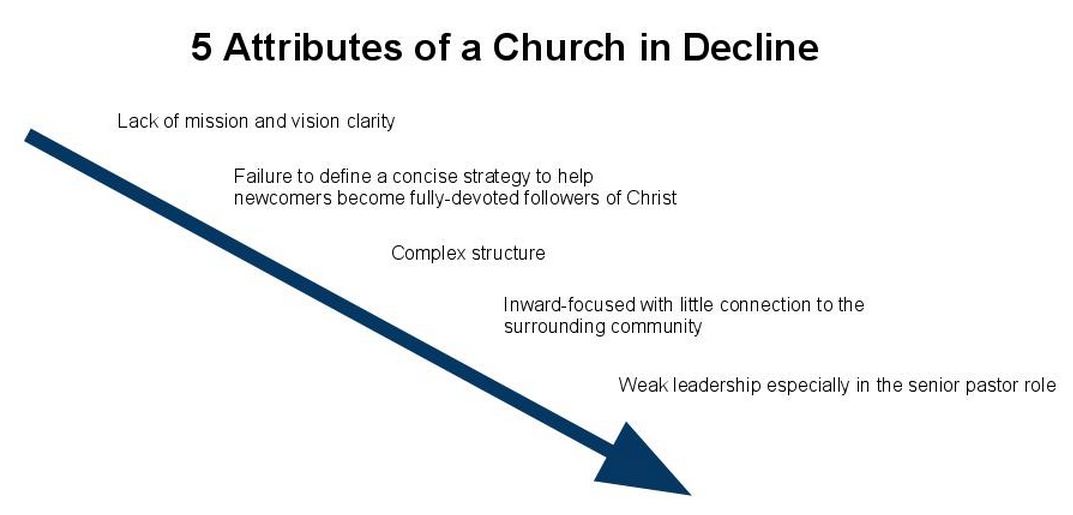
    Tony Morgan grabbed my attention again this week in his blog entitled, “5 Attributes of a Church in Decline”. He shared what he and a fellow blogger felt could be five key attributes of a church in decline. What strikes me as so interesting is simply that all five attributes are indicative of a church that isn’t led by someone who thinks strategically for the future. For instance, as I’ll share in a future entry, a clear mission and vision is a very basic and key first step in strategic planning. What do you think?

    In case you have a difficult time reading this chart, the five attributes are:

    • Lack of mission and vision clarity.
    • Failure to define a concise strategy to help newcomers become fully-devoted followers of Christ.
    • Complex structure.
    • Inward-focused with little connection to the surrounding community.
    • Weak leadership especially in the senior pastor role.