In his book, Good to Great
He hit the nail on the head. Ministry is not just all about having people around doing things; it’s also about paying attention to what they are doing as well. Unfortunately, I think this ideas sort of locks many of us up. We think, “How am I supposed to find the exact right seat for everyone?” Ugh. Some of us can hardly figure out where WE fit in, much less trying to figure out which seats on the bus everyone else is supposed to fit.
MY RECOMMENDATION: START WITH SECTIONS.
What if we just started by getting people in the right section of the bus instead? Generally, we have three kinds of people in our church: Creatives, Doers & Leaders. Yes, I know. Sometimes people can be a mixture of one or more of those. But generally speaking, if we know what kind of people we’re dealing with, we can seat them where they fit best and worry about finding their exact seat as time goes on.
The back of the bus – Creatives
Everyone knows that the troublemakers like to sit in the back. If you’re sitting back there, you probably want to be far away from what’s really going on. You aren’t interested in where the bus is going right now. You just want to utilize your creativity to dream, talk, and get into just enough trouble that the bus driver doesn’t notice.
This is where strategic thinkers and creatives sit. They are big-picture people. They like to try new things. They are sometimes critical thinkers (I didn’t say critical people!) They are the ones you want in the room when you’re dreaming about the future, evaluating how things are going and discussing creative, new things to do or ways to do them.
These people don’t need a lot of authority to make choices, they just need a platform for their thoughts and ideas to be heard. Great leaders will gather them together to hear them out and learn from them. They also tend to be early adopters, ready to jump in with both feet when it’s time for change.
The front of the bus – Leaders
If you’re sitting at the front of the bus it’s likely because you want to be close to the action. You want to see who’s coming in and out the door. You want to talk to the bus driver. You want to see where the bus is going next and you want to play a part in how you will get there.
This is where the the leaders sit; the ones who make decisions. These are the people in your organization who will actually decide the future and direction of the church. Sometimes the Creatives & the Leaders are the same people. However, often it’s wise to have them sit in a separate section of the bus. Of course, if you’re driving a small bus (a small church/ministry) you don’t always have that luxury.
In a perfect world, the Creatives come up with some great ideas, feedback and insights and the Leaders can then determine which one’s will work best for the bus based on it’s mission and where it’s going.
The middle of the bus – Doers
If you’re sitting in the middle of the bus you are likely in your own world. You’ve got your iPod in or your just hanging with everyone else in that section. Sometimes you like to listen in on the talk in the back of the bus and sometimes you like to sit near the front to get a feel for the action, without having to be involved. You aren’t cut out for the intensity of the back of the bus and you aren’t really super interested in where the bus is going. You just like being IN the bus.
This is where the doers sit. These are the people who will do whatever is necessary to keep the bus moving and support the vision of the leaders. They are the ones who will dig their heels in and grind out the plans you have made. Your doers don’t make a lot of decisions, and they don’t want to. They do the work based on the decisions that have already been made, and they do it well.
About Your Bus
Here are a few closing observations about how these sections work (or don’t work) in different ‘buses’ or ministries.
- In my experience, the middle of the bus (Doers) is where the vast majority of people sit, like 90%. There are usually only a few seats in the front and a few seats in the back dedicated to Creatives and Leaders.
- If a bus has too FEW Doers, it end up coming up with a lot of ideas/plans that never get done. Innovative ideas & new paths don’t get built. The bus doesn’t stop when it should to take on new passengers. It sometimes doesn’t get cleaned properly and needs a fresh coat of paint. You get the idea.
- If a bus has too FEW Leaders, the bus tends to take loopy circles and gets distracted going places it doesn’t need to go. It also runs inefficiently and needs to spend a lot of time in the shop with repairs. Often, the bus looks great but is going nowhere important.
- If a bus has too FEW Creatives it takes the path it’s always known, even when there are better paths to take. The bus stays old and eventually becomes uninteresting to prospective new passengers.
- The smaller the church, the more Creatives and Leaders have to double up and also be Doers. There is less of a clear demarcation between the different seats.


 I’m a big fan of feedback. Not the kind you get on Sunday mornings when the microphone goes haywire and everybody goes deaf. The kind you get when people share their thoughts & opinions regarding something you’re trying to do with excellence.
 I’m a firm believer that defining your core values is a foundational strategic necessity for any church or organization. I’ve already discussed this in-depth in my Core Value series. That said, I thought it’d be cool to share the core values that
  A
A  Years ago I heard a story about a man who tried to steal an ATM machine. His plan was to rip the ATM out of the wall of a store-front by chaining it to the back bumper of his pick-up truck. After securing the chain, the incompetent thief got in his truck and hit the gas. A few seconds later, he heard a terribly loud noise and the truck suddenly lurched ahead. Frantic and scared he would soon be caught, he quickly hit the brakes and ran around to claim his prize. Appalled, he discovered the ATM machine was still secured to the building. Lying on the ground in front of him was the truck’s back bumper which had been ripped off. Scared and frustrated, the man got in the truck and went home. Hours later, the police showed up at his door and arrested him for attempted robbery. He was easy to find. The police just checked the license plate on the bumper left chained to the ATM. I don’t know how true the story is, but it makes me chuckle and I wouldn’t be surprised if it actually happened.
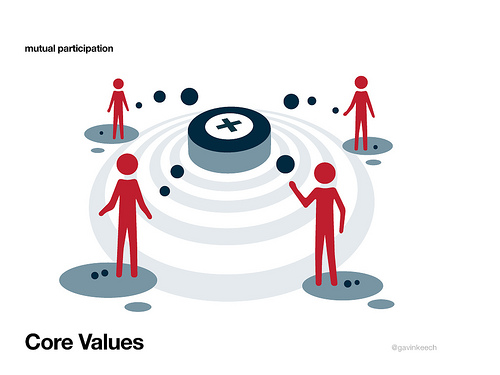 I’m a firm believer in core values for your church or organization. So in today’s post I’d like to outline some ideas on how your strategic team might go about drafting your ministry Core Values.