Author: Wayne Hedlund

  • Get with YouVersion Today!

    YouVersion

    Hopefully, you’ve heard of this great website by now. I’ve blogged about it before but feel it’s worth bringing up again. www.youversion.com is a free website that offers a myriad of tools to help you and your congregation integrate the Word of God into daily life.

    It’s not just a Bible Website! It’s much, much more. It’s a place for people to gather to talk about Scripture – and what it means to them. It’s a place for accountability and encouragement. It’s a place to journal & remember what you are learning.  YouVersion is fast becoming the primary means by which this generation interfaces with God’s Word.

    FOR YOUR CHURCH
    First, let me give you some examples of how this website can serve your church. With a little focused attention on your part and regular attention each week, you may discover that your congregation reads the Bible more than ever! Let me show you how:

    • Read a Bible plan together.YouVersion has over 150 different reading plans. Some are devotional plans from well known leaders like Rick Warren. Most are Bible reading plans that range from 7 day plans to year long plans. Some of the plans are even topical in nature and would go perfectly with a sermon series. Individual’s can subscribe to plans via many different methods. We encouraged our congregation to join the “New Thru 30” plan last year when we did a series on the New Testament. Check out the Bible Reading plans here.
    • Create a Group & Live Events
      You can create a group just for your church and encourage your congregation to join. Once your group has been created, it can be used for encouragement and unified activities. As an example, click on THIS LINK to see a Live Event I created for a group I created for my blog readers. Note: This Live Event is simply one example of what you might consider doing with your congregation. 
    • Encourage Accountability
      YouVersion recently released a new feature that allows individual users to pick another YouVersion user as an accountability partner with a Bible Reading Plan. YouVersion will send email updates to the accountability partner on the individual’s progress in the plan, including whether or not they are getting behind in their reading. You might consider challenging your congregation, Sunday School classes or small groups to partner together.
    • Advertise YouVersion RegularlyThis website is free to everyone, compliments of the people at lifechurch.tv. Your congregation can only benefit from it’s use. Find ways to regularly advertise the website to your church. Put links on your website, make announcements, place ads in your bulletin, maybe even add a link to the site on your email signature.


    FOR INDIVIDUALS
    There are many other great features in YouVersion that will help you and your congregation stay rooted in the Word. Here are a few of them.
    • My Notes & Community Notes
      You can attach as many personal or private notes to individual Scriptures as you want. This takes ‘writing in the margin of your Bible’ to a whole new level. Notes can be kept private so that only the user sees them, or they can be made public for everyone to view when they browse to that particular passage. 
    • Bookmarks & Labels
      You can bookmark as many verses as you want to allow for easy access later on. Additionally, YouVersion has announced a new feature that should be rolled out very soon. The new feature will allow you to create labels for each individual bookmark. So for instance, you will be able to bookmark James 1:19 and then create labels like ‘anger’, ‘listening’, ‘patience’. Over time, those labels will come in real handy when your trying to look up passages you’ve bookmarked as relating to ‘anger’!
    • Pick Your Version & Parallel Bibles
      YouVersion boasts more than 100 different versions of the Bible in multiple languages. Pretty much, it’s highly likely your favorite version exists. Additionally, the ‘Parallel’ button will let you view a particular passage in two different versions at the same time.
    • Audio Bible
      Have a few moments to spare while driving to work, taking a shower, or mowing the lawn? Listen to the Bible, again in several versions. You can even listen to your daily Bible reading plan! Personally, this feature alone has increased my diet of the Word of God.
    • Go Mobile
      YouVersion is available for just about every mobile option out there. I have YouVersion installed on my phone and enjoy almost all of the functionality of the website at the touch of my finger. You can create widgets for the verse of the day or even your Bible reading plan.
    • Twitter & FaceBook
      YouVersion makes it real easy to post a Scripture to Twitter or FaceBook. Did you read something profound? Let all your friends read it too!
    There’s more. Signup for YouVersion today and fall in love with God’s Word all over again!
  • A ‘Thankful’ Thought

    I have been overwhelmed this week how often the Bible exhorts us to be thankful. It seems like every time I flip (or swipe) a page in my Bible the Lord is prompting me to give thanks to Him. For example:

    Speak to one another with psalms, hymns and spiritual songs. Sing and make music in your heart to the Lord, always giving thanks to God the Father for everything, in the name of our Lord Jesus Christ. Ephesians 5:19-20

    In this passage, Paul is saying that we should always give thanks. Taken literally, always means, well always. That’s a lot of times that we are supposed to be thankful. And then he also says to be thankful for everything. Well, it would have been easier if he had said “most things” or “some things”. Everything doesn’t give us very much wiggle room.

    So I’m being personally challenged to apply this in my life, always and in everything. How about you. Are your words, actions, attitudes ones that reflect a thankful heart?

  • Ten Church Strategies: The Ministry Partner Strategy (Volunteers)


    Check out this quote from Bill Hybels from his book, ‘Volunteer Revolution‘:

    “It’s as if God has work gloves on. And he calls us to roll up our sleeves and join him with our talents, our money, our time, and our passion. He wants his mission to become ours. ‘If you’re chasing the wind,’ he tells us, ‘you can keep right on doing that. Or you can hook up with me, and together we’ll transform this hurting planet.’”

    The Ministry Partner System is the local church’s answer to God’s call for everyone to ‘roll up their sleeves’ and partner with Him. The problem is that individuals often view the local church as an organization meant to serve him or herself instead of seeing themselves as being a vital part of a body of believers. Ephesians 4 clearly defines a key role of the pastor (among others): “…to prepare God’s people for works of service, so that the body of Christ may be built up…” In this installment of ‘The Ten Church Systems‘ I will outline how the church can identify, equip, and release people to ‘partner’ together in fulfilling your church’s mission. If you haven’t already, I recommend you first read my ‘Getting Started Thoughts and Disclaimers’, written in three parts: Part 1Part 2Part 3.

    Key Sub-Systems of The Ministry Partner System (Volunteers)
    Following are the key sub-systems needed to develop and sustain this system. Please note that the term “Ministry Partner” and “Volunteer” are interchangeable throughout this article.

    • Ministry Identification System
      It can be very frustrating to potential volunteers when they actually want to serve somewhere in the church, but have no information about what volunteer positions are available and what the commitment is for each one. This system will identify every ministry position in the church as well as clarify each one’s basic job description, ministry expectations and requirements. 
    • Ministry On-Ramp System
      It seems the traditional method for filling volunteer positions in the church is through direct recruitment. Although this method can be very effective if done properly, it can become grossly inadequate, plus it means potential volunteers won’t find a place to serve until they get that phone call or email. The ‘Ministry On-Ramp System’ will develop simple ways for church attendees to get plugged into each person’s best possible position. On ramps may include web based solutions, signup tables, ministry fairs, ministry partner classes, sermon series and more. Depending on your church’s Ministry Partner strategy, it may also include a volunteer apprenticeship program.
    • Ministry Partner Resource System
      As the Systems/People Matrix so aptly illustrates, putting great people into bad systems leads to frustration, resentment, and often a high turnover of some of your best people. This system is a critical part to your church’s health and growth. It will include volunteer training (helping them understand how to do the job as well as allowing them to develop and grow in it), resourcing (making sure they have everything they need to be a success), and encouragement (providing meaningful and regular feedback).
    • Ministry Partner Communication System
      Although communication could really fall within the above mentioned ‘Ministry Partner Resource System’, it deserves it’s own mention since it is so critical to a healthy volunteer system. The fact is, good communication breeds loyalty, trust, and commitment while bad communication develops the exact opposite. This system will ensure your volunteers are on the same page with you regarding schedules, expectations and potential problems.
    • Ministry Partner Celebration System
      It’s OK that we have volunteers who serve ‘behind the scenes’. It’s not OK that they are so incognito that weeks, months, even years go by without a ‘thanks’, ‘we are so proud to have you on this team’ and ‘your contribution makes a difference’! This system will ensure everyone is honored and cared for during their tenure as volunteers (instead of just at the end of their tenure!) This system may include simple ‘thank you cards‘, emails, phone calls, and perhaps even an event like a ‘Volunteer Appreciation Banquet’. It is recommended that the celebration system also utilizes the occasional gift certificate and acknowledges milestones (5, 10, 15+ years of service).
     

    Note: Inspiration for the Ten Church Systems comes from Nelson Searcy and the Eight Systems of the Local Church he proposed in his free e-book entitled, ‘Healthy Systems, Healthy Church‘.

    Photo from mangostock on istockphoto.com

    Disclosure of Material Connection: Some of the links in the post above are “affiliate links.” This means if you click on the link and purchase the item, I will receive an affiliate commission. Regardless, I only recommend products or services I use personally and believe will add value to my readers. I am disclosing this in accordance with the Federal Trade Commission’s 16 CFR, Part 255: “Guides Concerning the Use of Endorsements and Testimonials in Advertising.”

  • The Tunnel of Chaos

     
    “When you did that, it really hurt me. I’ve been mad at you ever since.” That sentence is the culmination of a conversation a friend had with me a while back. It was over breakfast – one that he initiated. I was totally floored. I had no idea that I had said something that hurt my friend. I’m embarrassed to say I didn’t even know he was mad at me.

    That conversation marked an important point in our friendship. I could have chosen to make a joke and take the event lightly. I could have gotten defensive and attacked my friend – pointing out that it was really his fault, not mine. I could have gotten mad back at him. OR, I could have spent time understanding what happened, acknowledging my mistake, and working towards building a deeper understanding about how I could ensure I don’t hurt my friend again.

    To his credit, my friend took the first, more difficult step. He chose to talk to me about it. I am so thankful for that. I know many would have just pushed it under the rug, leaving a big bulge, and spent weeks, months, or even years walking over it every day.

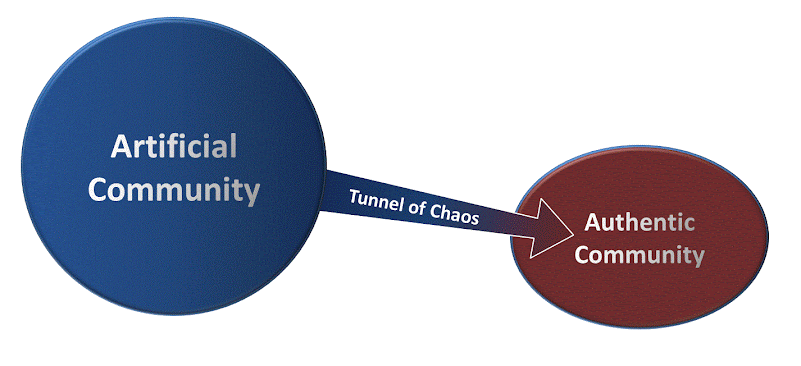
    The Tunnel of Chaos is that tunnel that leads from artificial to authentic relationships. It is a key to building trust with your family, friends, and coworkers. It is a critical component to your leadership team’s success and health. It is a foundational element of fostering and keeping a culture of trust.

    You enter the tunnel when you choose to engage in crucial confrontations with a solid commitment to hold steady until you’ve reached a positive resolution and a deeper friendship.

    Bill Hybels coined this phrase in his book, Axiom: Powerful Leadership Proverbs – a book I highly recommend. You can read this very short excerpt from the book from the Willow Creek Global Summit website right here.

    When was the last time you entered the tunnel with an individual or your team?

    Disclosure of Material Connection: Some of the links in the post above are “affiliate links.” This means if you click on the link and purchase the item, I will receive an affiliate commission. Regardless, I only recommend products or services I use personally and believe will add value to my readers. I am disclosing this in accordance with the Federal Trade Commission’s 16 CFR, Part 255: “Guides Concerning the Use of Endorsements and Testimonials in Advertising.”

  • Do Something Different

     
    This past Sunday our church did something unique. It got people talking, created some buzz, added value to the message, and created a memory for our congregation. It was something different.

    We held a ‘No-Show’ Sunday. We removed all of the volunteers from the schedule and replaced them with cardboard silhouettes. We trimmed down the service to almost nothing. No projection, videos, lights, or worship team. Our worship leader led from a guitar. The words to the songs were in the  bulletin – which people picked up themselves because there were no greeters or ushers. Everyone left right after the service because there was no cafe. Staff and key elders ran the preschool – there was no programming for gradeschoolers. I could go on, but you get the idea. Our series title is ‘Me to We’ – we’re talking about partnering together in ministry through service in the church. It was awesome.

    When was the last time you did something unique, different and memorable?

    I ran across this video clip at churchm.ag today. It’s about a store called ‘The Limited’ that did something different. What could you do in your church or community this winter that people would always remember (in a good way)?

    Can’t see this video? Click this link.

  • Tactical Tip: Internet Passwords

    A while back I had been getting nervous about all the websites where I had to enter passwords. What I was nervous about was the fact that I was using the same password on almost all of them. This always bothered me but I never did anything about it.

     
    Then one day when I was talking to a friend who is a security guru at RIT, I realized how easy it would be for someone to hack into a sensitive account and totally break the bank. For instance, I might give my password to a small time business who then has access to that password in their database. How easy would it be for someone on staff there to snag that password and try it out on my eBay, Paypal, or Amazon accounts. For that matter, any online store that has my credit card information saved would be fair game!
     
    Thankfully, I decided to learn my lesson the EASY way, instead of the HARD way. I instituted a new system for passwords that is working well for me and doesn’t require me to memorize more than one password. I recommend you try it out too. 
     
    Note: it will sound somewhat complicated at first. However, I guarantee that once you’ve learned how to do it, you’ll remember it AND be safe.
     
    Tactical Tip: Internet Passwords
     
    Here’s what you do:
    The following suggestion will be applicable to probably 95% of the passwords that you use. Most secure passwords require at least 8 characters and must also include letters, numbers, upper case, lower case, and a special character.
    • Define a Core Password:Define a password that you can easily memorize that is six characters long and includes at least one number and one special character like a question mark, hyphen, or period.  Now, for every website you go to these six characters will be six of 8 characters in the password. Just memorize them and the next step and you’ll be all set. Example: You might pick r7.ite as your core password.
    • Define a Special Rule:Next, create a rule that only you know that incorporates the site name into your password. For example, you may choose to use the first two letters of the site name or site web address – or the first and third letters, etc. and add them to the beginning, middle, or end of your predefined password. Example: Let’s say you choose to use the first two characters of a website and you will place it at the beginning of your core password. So you’re Google password (www.google.com) might look like this: gor7.ite
    • Capitalize a Character in the Special Rule:Finally, capitalize one letter in your special rule. This will add additional security to your overall password. Example: Now I will choose to capitalize the second letter in the website I am visiting. Here is what it would look like: gOr7.ite.
    • More Examples: Here are a few more examples using this rule: (1) www.amazon.com = aMr7.ite. (2) www.paypal.com = pAr7.ite. (3) www.twitter.com = tWr7.ite.
    Password Resets:
    Now, every once in a while you’ll run across a website that requires you to change your password every 6 – 12 months. For example, your financial institution may require this. One goal of this Tactical Tip is that you don’t have to rely on your memory anymore. So you’ll need an additional rule that you can use in these unique cases. Unfortunately, you will need to find a way to remind yourself that this particular website password will be different than the rest. I recommend you put the year of the reset into the password. Example: Let’s say it’s the year 2012 and the website is www.hsbc.com. Your password might be hSr7.ite12.
     
    The Three Time Reset Rule:
    Any website worth going to will give you the option of recovering your password if you’ve forgotten it. I strongly recommend you click the button to reset or recover your password after your SECOND failed attempt. Many websites will lock you out and require a phone call after three failed attempts.
     
    The Behind the Times Website:
    Finally, some websites just won’t stick to the standards. They ask for some odd rule that doesn’t fit the national standards. The other day I ran across a website that wouldn’t allow a special character in the password. After a few choice words, I decided to go back to my ‘old’ password that I used for all my other websites before I instituted this much more secure method. It’s not foolproof, but it sometimes works.

    Image compliments of Salvatore Vuono at freedigitalphotos.net

     
  • Top Ten Posts of October 2011

    Here are the most viewed posts in October on Transforming Leader.

    1. Sunday Morning Announcements
    2. The Ten Systems of the Local Church
    3. Ten Church Systems: The Weekend Service System
    4. Ten Church Systems: Getting Started p.1
    5. Ten Church Systems: The Assimilation System
    6. Ten Church Systems: The Care System
    7. Ten Church Systems – Getting Started p.2
    8. Ten Church Systems – Getting Started p.3
    9. The Rhythm of Failure (with Craig Groeschel)
    10. Tactical Tip: Say ‘Thanks’ in Your Email
    I have been fascinated to see the interest generated by the Ten Church Systems series. Usually, the top posts of a month might include maybe 3 or 4 recent articles and a lot of older entries that are still getting a lot of traffic. This month was a 7 out of 10! But July’s ‘Sunday Morning Announcements‘ is still getting more than twice the traffic than any other post! Maybe it’s because everyone loves Charlie Brown or something!
  • How You Can Get Smarter This Year


    Watch this 4 minute interview with Seth Godin. Chik-Fil-A CEO, Dan Cathy, asks Seth just a few simple questions. As always, Seth comes back with some profound and helpful insights. I’ve highlighted my favorite quote below.

    I began blogging more than a year and a half ago. What I’ve discovered is that writing has forced me to think harder and be smarter. Just the act of putting thoughts, values, and beliefs into print stimulates the brain and clarifies thinking. Seth Godin put it this way:

    “Having to say intelligent things about what you notice in the world makes you smarter.” Seth Godin

    I wonder. Is it time for you to begin writing? Should you start a blog or a journal? Perhaps you don’t consider yourself much of a writer. That’s OK. Nobody said you have to publish. Just write it down. Get those thoughts, musings and ideas out of the ethereal and untouchable recesses of your mind and down on paper or your computer. Give it a try! What have you got to lose?

    Image compliments of graur razvan ionut at freedigitalphotos.net

  • Ten Church Strategies: The Small Groups Strategy

    The local church can make a lot of mistakes, and people won’t leave if it can get one thing right: relationships. I’ve seen this happen many times. People will learn to deal with leadership weaknesses and minor inconveniences in a church setting when they have developed authentic relationships. You have probably heard the terms ‘front door’ and ‘back door’ in terms of people joining or leaving a church. Developing a relevant and effective small groups ministry will make a huge impact on closing that ‘back door’.

    In this installment of ‘The Ten Church Systems‘ I’ll talk about creating a means by which church attendees can grow, express care, and ultimately ‘be the church’ through small group environments. If you haven’t already, I recommend you first read my ‘Getting Started Thoughts and Disclaimers’, written in three parts: Part 1Part 2Part 3.

    Key Sub-Systems of the Small Group System
    Following are the key sub-systems related to small groups. These systems have been left somewhat vague to allow room for various small group strategies a church might adopt. That said, each system will be fairly complex and time consuming to maintain. A special thanks goes to Pastor Doug Cowburn at Elim Gospel Church for his help in refining these thoughts.

    • Group Leader System
      You can’t have good groups without leaders (facilitators) and hosts (hospitality). This system will oversee the recruitment, training, care and ongoing development of group leaders, hosts, and apprentices. 
    • Group Connection System
      This system will provide opportunities for attendees to get connected into an appropriate small group (whether a new group or existing group) with ease. It will service both longstanding attendees as well as guests. The group connection system may include group campaigns, events, website sign-ups, and more.
    • Group Content System
      This system will ensure the approved group content is communicated, purchased (if applicable), created (if applicable), distributed, and implemented. This system will also include a feedback element to ensure the content is remaining relevant to group members.
    Note: As in all of the Ten Church Systems, church leaders will need to determine their group strategy. This will include asking questions like, “How long will groups last?”; “What will we choose to study within our small groups?”; “Will we ask all groups to study the same thing (full alignment) at different times?”; “How many groups/participants are we shooting for?”; “What requirements do we have of groups (if any)?; etc.


  • Ten Church Strategies: The Marketing Strategy

    Here’s another one of those words that make some pastors and christian leaders cringe when associated with the church: marketing. I contemplated just calling this the ‘Outreach’ system since it is primarily about encouraging the community to visit the church. The problem is that we also associate Outreach to much more than that (like missions, and ministry to the poor/needy). So I’m keeping ‘Marketing’ as the word to describe this system.

    Despite the uncomfortable connotations of the word, nearly every pastor believes in marketing the church. If a church has a website, ads in local papers, info in the white pages, or a sign on the front lawn, then that church is into marketing. In fact, I recommend you check out this page located at, interestingly enough: www.churchmarketingsucks.com.

    In this installment of ‘The Ten Church Systems‘ I will outline several areas every church should develop in order to effectively attract the unchurched, overchurched, and dechurched (been there, done that) in their communities. If you haven’t already, I recommend you first read my ‘Getting Started Thoughts and Disclaimers’, written in three parts: Part 1Part 2Part 3.

    Key Sub-Systems of The Marketing System:
    Following are the key Sub-Systems related to The Marketing System. You’ll notice that a core value of marketing is effective and relevant communication.

    • Website System
      The church website is a vital part of The Marketing System. This system will include the development of a powerful website that is both attractive and easy to navigate. The best website will serve both prospective guests as well as longstanding members. The Website System will also ensure that content is consistently updated and relevant. (Check out ‘Guest Friendly Website’.)
    • Traditional Advertisement System
      This system will include a clear analysis and implementation of the most appropriate forms of traditional advertising. It may include things like newspaper ads, TV or radio ads, and telephone book ads.
    • Social Media System
      Unless the church is reaching a very narrow group in the community, social media is and will continue to become a very important part of church promotions. This system will include determining the best types of social media to engage with and will keep each one relevant and up to date. Social media systems may include Facebook, Twitter, LinkedIn, Google+ and more.
    • Special Event Promotion System
      This system will focus on the effective promotion of special church events that may draw the community. Church productions, Christmas programs, unique outreaches, upcoming message series, and key classes are just a few examples of possible events to promote outside the church. The Special Event Promotion System will get the word out to the community in the most effective ways possible. It may include touchcards, posters, billboards, radio ads, and more.
    • Word of Mouth System
      The best marketing happens informally through attendees who are excited about the church. The Word of Mouth System will equip attendees to ‘talk it up’ through effective communication and hands-on materials they can use to supplement their invitations. Pastors and church leaders will intentionally tell church attendees about upcoming exciting events or services so they can get the word out. The best system will also put something in their hands to use as an invitation – like posters, flyers, or touchcards. Obviously, an updated and exciting website and social media should support and supplement this system as well.
    • Church Communications System
      Church communications is probably one of the most challenging systems to develop for pastors and church leaders. This system will ensure all church activities get promoted appropriately. It will prevent some events from getting over-promoted while others are under-promoted. The Church Communications System will provide a simple way for church leaders to submit communications requests. Those requests will eventually be approved after consideration has been made as to what methods of promotions they will receive – for example, verbal promo, newsletter, e-blasts, bulletin inserts, website page, etc.
    • Branding & Graphic Arts System
      This system will determine what needs to have a specific brand within the church. Of course the church itself should have a relevant logo, but sometimes specific ministries or events should be branded as well. Often, individual message series, sermons, or special events will have a unique brand too. This system will develop brands and graphics and distribute them to the other Marketing sub-systems.

    Note: Inspiration for the Ten Church Systems comes from Nelson Searcy and the Eight Systems of the Local Church he proposed in his free e-book entitled, ‘Healthy Systems, Healthy Church‘.