Category: Confrontation

  • Don’t Hit ‘Send’ When It’s Personal

    dont-hit-send

    I made a leadership mistake last week. I sent an email prematurely. I actually remember pretty vividly having my finger over the ‘Send’ button on my Kindle. I paused a minute and the thought flitted through my mind, “Should I really send this email?”; then I pushed it aside and hit ‘Send’.

    It felt good too. I was able to communicate my frustration and disappointment about something someone did that I disagreed with. I set them straight. Told it like it was. That sort of thing. 

    It’s not that sending the email, in and of itself, was wrong – and being a writer, it’s not that it wasn’t written well. In fact, in other scenarios I could probably have written something very similar to what I wrote and it would have been totally appropriate. In this case, I messed up. Why?

    I shouldn’t have done it because it was personal.

    It’s Leadership 101, but it’s also easier said than done. When you’re reacting (via email) to something someone has done or said that is personal, don’t hit ‘Send’ on that email. At least, don’t hit it right away. In my case, I realized after the fact that I was rude and defensive. Ugh.

    I’ve often quoted Ambrose Bierce who once said, “Speak when you are angry and you will make the best speech you will ever regret.” This is even more true in emails. Once you hit ‘Send’ it’s gone for good and there’s no taking it back. The problem for many of us leaders is, we don’t always know when we’re angry. We confuse anger with our desire to ‘fix’ or ‘help’ others. That’s what I did.

    Here are a few pointers I was reminded of while backpedaling and revisiting this experience.

    When you should wait to hit ‘Send’.

    • If it hurts you.
      If it hurt you, in any way, you should wait. None of us are immune to pain, and none of us are at our best when dealing with pain. That means we’re probably not saying what we really should say, if we should say anything at all.
    • If you’re mad.
      Similarly, when you are in a state of anger, your brain is quite naturally on the defense. Whatever you communicate in your email (or verbally for that matter) will very likely be defensive. People, in general respond to defensive behavior from others by defending themselves. Now everybody has got their dukes up. Not helpful.
    • If it hurts them.
      It goes without saying that, as leaders and believers, we are above hurting others. It’s the antithesis of what it means to be a Christ-follower and following His great command to love others.
    • If you don’t know them.
      If you have never met, or spoken with, the other party, you need to pause when sending that email. As leaders, we have a certain degree of ‘permission’ to influence and correct those who have given us permission to do so. But if you’re trying to correct someone else on their words or behaviors, and they haven’t given you permission to do so, you’re very likely overstepping your bounds.
    • If it’s long.
      Some of us can be real wordy and get preachy in our emails. Uh, like me at times. If it’s a corrective email and it’s really long, forget it. Don’t hit send. Pick up the phone or schedule a meeting instead.
    • If it’s a big deal.
      If the content of the email is a big deal to someone – either you or them – you need to pause over the ‘Send’ button. The likelihood is real high that if what’s being discussed in the email has a personal bearing on either party or is potentially wrought with emotion, it shouldn’t be said over email.
    • If it’s complicated.
      By complicated, I’m not referring to the issue, I’m referring to the relationship. If the relationship has a history of confusion, misunderstandings, hurt feelings, etc. it’s not really good to do a lot of email communication – at least regarding personal issues.

    What to do while you wait.

    • Pray.
      There’s nothing better than asking the All-Knowing God for wisdom and discernment. It goes without saying that He can and likely will shed light on how you should respond and if you should send that email.
    • Get A Second Opinion.
      I’m not talking about counselling. I’m just talking about another opinion, preferably from someone you trust and shares the same values you do about loving others in leadership.
    • Wait.
      This seems redundant to say, but I’m going to say it anyway. Wait for a while. I’m not talking about waiting for an hour or a couple of hours. Usually, it’s good to wait 2 or 3 days minimum. Give yourself time to get some perspective and cool down, if necessary. I wouldn’t be surprised if 3/4 of those emails never get sent simply because you waited long enough to realize it’s not worth it.
    • Ask For Time & To Talk Live
      Sometimes it’s not appropriate to leave people hanging. So ask for permission to wait a while, and maybe meet to talk it out live. Keep it down to about 4 sentences that might sound something like this: “I’m going to need some time to think this through first and I’m wondering if email is, perhaps, not the best means of communication for us to use on this topic. Is it possible we could schedule a time to meet over coffee, on Skype or over the phone later this week?”
    • Send A Different Email
      Once you’ve exhausted the above ideas, you may discover that starting from scratch and sending another email will work just fine. Now that you’ve had time to clear your head, you can keep the communication simple and leave out the defensive tone that was in your first email.
    • Drop It
      Sometimes the right thing to do is to just drop it. There are many reasons why this may be the best solution. It could be that the issue is relatively small in the bigger picture and not worth making a big deal about. Often, we may realize that the person wasn’t trying to be mean or hurtful, and we can just let it go. Sometimes it’s plain that there are much bigger issues connected with the situation that should really be addressed before this issue can properly be dealt with. 

    What to do if you hit ‘Send’ prematurely.

    I think there’s really only one thing to do when you realize you’ve said things that were best left unsaid. Find a way to apologize and ask for forgiveness. This means you:

    • Humbly confess what you did.
      “I sent that email when I was still processing what was said, and I wasn’t really thinking straight.”
    • Acknowledge what you said that was inappropriate.
      “I said some things in that email that were inappropriate, defensive and disrespectful.” 
    • Sometimes you might even point out specific things said as well.
      “…like when I told you ‘That was stupid.’”
    • Ask for forgiveness.
      Would you be willing to forgive me for my hasty words and bad attitude?

    And of course, when you are asking forgiveness of the other party, it’s usually not wise to begin defending or explaining yourself – and certainly you shouldn’t start expounding on what the other person(s) did wrong. That should be left for another time.

    Check out my other posts regarding confrontation. I particularly recommend: “Four Steps in Healthy Confrontations

  • Confrontation 101: Maintain Safety At All Times

    confrontation-maintain-safetySomeone once told me that if you stare at a cat long enough, they will get angry. Years ago I was at the zoo watching a lion pace forward and backward over and over again. The lion exhibit was packed with people watching him. It was awesome and I was mesmerized.  After a while I remembered what my friend had told me about staring at cats. So I decided to try an experiment. I lined myself up with his pacing so that every time he walked back towards the crowd I was standing directly in front of him. Each time he paced towards me, I made and held eye contact with him. I did this for a couple of minutes. Suddenly, the lion stopped in mid-stride, stared me in the face and let out a mighty roar. The hair on my neck stood on end. It was loud and scary!

    What’s interesting is the response of everyone around me. They all went crazy. Some screamed, kids cried, most jumped and several took off running. This despite the fact that we were all completely safe. The lion was behind two sets of bars. He wasn’t going to hurt us. And yet, for a few moments, we all totally freaked out. I learned a valuable lesson from that experience. 

    When people feel threatened, they don’t think reasonably. It doesn’t matter how smart you are. When we’re scared our bodies go into defense mode. We have a natural desire to either fight or flee. In a sense, our reasoning shuts down and our God-given instincts take over. 

    Danny Silk explains this in his book, ‘Culture of Honor‘. Check it out.

    “God put this little gland inside our brain called the Amygdala. It is an almond-shaped mass of nuclei located deep within the temporal lobes of the brain. This gland is important for determining emotional responses, especially those associated with fear. When somebody does something threatening or unexpected in your environment, when somebody is not safe, your Amygdala kicks on and begins to flood your body with these messages: react, defend, disappear, fight, or flee.

    These are some of the responses in which we show our worst. It doesn’t take a rocket scientist to discover that people who are scared are not at their creative best. If you’ve ever been near a person who is drowning and scared that he or she is going to die, then you know it would be a good idea to keep your distance. Throw a rope or extend a pole, but do not let that person get a hold of you or you will become a buoy. Oh sure, the person will apologize later, if you lived.

    But scared people are not thinking about the team, family, church, or anyone else beside themselves. Fear is a dangerous element for humans to navigate through. Most do not manage it well.”

    So what does all of this say about how we should communicate with others, especially during a confrontation?

    Hopefully, it’s blindingly obvious. In any confrontation, we must find and maintain safety. We need to help the other person know the conversation is going to be ‘safe’. That is, that we will honor them during the conversation; that we care about and respect them. People feel unsafe when they believe one of two things:

    • You do not respect them.
    • You do not care about their goals (or what’s important to them).

    If you want to experience transformative conversations with others, learn how to maintain safety. Be sure the other person knows you are for and with them. You can do this by reading through ‘Three Keys to Effective Confrontation‘. But you will also do it by checking to be sure the other party still feels safe throughout the conversation. At any time, if you sense they are becoming defensive, it’s time to stop talking and begin working at reestablishing safety.

    The fact of the matter is, if you or I feel unsafe in a conversation we will quite naturally get defensive and will emotionally fight or flee. There’s no point in talking when we get to that point, at least not until we’ve calmed down again.

    Proverbs 15:1 says, “A gentle answer turns away wrath, but a harsh word stirs up anger.” Colossians 4:6 reminds us to, “Let your conversation be always full of grace, seasoned with salt, so that you may know how to answer everyone.”

    Confession time – I still struggle with this. Especially with my spouse and kids. The people I most want to feel safe will sometimes feel the complete opposite when I’m around. I’ve got a long way to go, but I’m committed to getting there. Are you?

    How safe do others feel around you?

    photo credit: ekai via photopin cc

  • Three Keys to Effective Confrontation

    confrontationIt takes courage to confront others . . . well, let me qualify that. It takes courage to confront others right! Anybody can blow up, say something mean or hasty or brush through a confrontation without giving thought to others’ feelings. But it takes a lot of intentional thought, courage and patience to successfully confront people properly.

    Let me share just a few pointers I’ve learned about confrontation that might help you next time you find yourself preparing for this super intimidating experience.

    1. Remember the Goals of Confrontation
    Contrary to popular opinion, the goals of confrontation are not to be right or get back at someone who hurt you. If that is truly why you want to talk, it’s better to simply keep your mouth shut. When your goals include the following, then you’re almost ready to begin.

    • A Better Understanding
      Your goal is to gain understanding where it is lacking. There is almost always something you don’t know about the situation. You may lack context which drove the offense. There is often emotions, motives & outside circumstances that you were completely unaware of. Confrontation should be a truth-seeking venture to help you understand others’ perspective better.
    • A Positive Change
      Your goal should include a positive change. In other words, whether the offense is rooted in something you did or said or not, you should wholeheartedly desire to help others learn and grow through the confrontation. It should seem more like a learning or coaching experience than a hand-slapping experience.
    • A Growing Relationship
      If strengthening and growing your relationship with the other party is not a goal, then again, it may be better to just leave well enough alone. Your goals will drive your behavior and what you say. If you genuinely want a stronger relationship after the confrontation, you will naturally ensure that happens throughout it. If you think there is a good chance the confrontation may burn bridges or destroy the relationship, you will take stock and make sure the confrontation is truly worth it before proceeding.

    2. Begin With Three Fingers Pointed at Yourself
    It’s an old illustration, but it works well. Whenever you point your finger at someone, there will always be three other fingers pointing back at yourself. Before you begin any confrontation, the wise person will evaluate their own motivations, feelings and thoughts first. Each finger is asking one of the following questions:

    • Am I Part of the Problem?
      Is it possible that the conflict in question was somehow impacted by your actions? Did you not communicate something clearly? Is there a chance your lack of participation discouraged others? Is there anything at all that you might have done that could have helped prevent the conflict from taking place? Be open & honest with yourself before you sit down to talk with others.
    • Am I Telling Myself Ugly Stories?
      Some of us have a tendency to assume the offending party was intentional about hurting us. We make up stories by patching together random events from the past and by attributing motivations to the person that he or she may never have had. We label them in our minds with words like, “mean” or “rude”. Or we imagine things like, “they hate me” or “they are so cocky”. If you enter into a confrontation with stories like these in your brain, the whole conversation will be seen through that filter and you won’t find the healthy resolution you are seeking.
    • Am I Being Defensive In My Approach?
      If you are feeling defensive before or during the confrontation, your chance of success has been neatly cut in half, if not ruined from the start. Most people can read a defensive stance from miles away – and what it usually means is that they need to take up the same stance as well. If you look like you’re ready for a fight, I guess I better get ready too. That’s how we emotionally respond. Resolution will never be made if our goal is to protect ourselves. 

    3. Move To One Finger Pointed At God’s Servant
    Just this morning I heard a story about a woman who has been able to experience a restored relationship that you and I would probably have thought impossible. When asked how she was able to put up with all of the pain and disappointment she experienced while trying, she simply pointed out, “if God loves them so much, who am I not to”. A great reminder to us all. We should be asking ourselves:

    • Am I Treating Him/Her with Honor?
      We dishonor God when we dishonor His people. We should approach every conversation with a holy reverence, as approaching one of God’s most fascinating and beautiful creations. 
    • Am I Assuming the Best?
      Rather than telling ourselves bad stories, we should do the opposite. Why not make up stories of why the conflict may have happened that believes the best of the person, rather than the worst? Taking this approach will help you relax, it will honor the person you are confronting, and it will empower them to confess wrong motives if they are there – because they won’t have to be defensive.
    • Am I Taking Our Differences Into Account?
      It would be very presumptuous to assume that others think the same way as you. We all process life differently, we make choices differently, we view life through a different filter of expectations, experiences & values. This is often even more true if you are working with individuals from other ethnicity’s or cultures. I will bring value to the conversation by removing my assumptions and expectations and seeking to understand the frame of reference others come from.

    These aren’t academic points to me. I work hard to honor them during confrontations. And when I don’t I always regret it. Ironically, it gets harder and harder to successfully confront the people we care about and love the most. Which is why it’s so important we work at it together.

    Which of these three points do you forget to do most often?

    photo credit: gabaus via photopin cc

  • The Power of Criticism in Meetings

    meetingsHere’s the deal. If all you have are a bunch of head nodding people in your team meetings, you will have a hard time coming up with new and fresh ideas. I know. I’ve been there. There have been times when it’s been really important for my team to find a creative solution to a problem, but when we tried to discuss it, nothing happened. Often, I would end up standing up and pacing around while people talked until I was able to come up with a viable solution myself for us to consider. After watching this video, I’m realizing the problem was probably related to how willing my team was in pushing and prodding one another’s ideas.

    The main problem with this comes back to the first dysfunction of teams found in Patrick Lencioni’s book, “The Five Dysfunctions of a Team” – Lack of Trust. If you haven’t read that yet, put it up high on your list of books to get and read.

    So check out this short (2 1/2 minute) RSA video with Journalist & author Jonah Lehrer talking about this problem. 

    [su_youtube url=”https://youtu.be/RgPIkx2JyQU” width=”320″ height=”200″]

    Application: Why not show this video at your next team meeting and ask the question, “Do we trust one another enough to engage in this kind of constructive criticism when we brainstorm together?”

    Image by Caitlin Applegate.

  • Tactfully Speaking: Taming the Tongue


    “With the tongue we praise our Lord and Father, and with it we curse men, who have been made in God’s likeness. Out of the same mouth come praise and cursing. My brothers, this should not be.”

    James* reminds us that what comes out of our mouths makes a difference. In this final installment of the ‘Tactfully Speaking’ series, I’d like to share some my thoughts on how we might tame our tongue. Here they are:

    • Build the ‘5 Steps to a Meaningful Conversation‘ into your life.
      I’ve already discussed the process you might consider using when engaged in a conversation, with anyone, really. I would love to claim I do so all the time – I still have a ways to go myself – but I can say I’ve never regretted utilizing these simple steps when I remember to do so.
    • Be slow to speak.
      It is very hard to ‘dig a hole’ when you are conspicuously silent. That’s not to say our default should be silence. That can backfire too.  James* exhorts us to “be quick to listen, slow to speak and slow to become angry.” Ambrose Bierce once said, “Speak when you are angry and you will make the best speech you will ever regret.” Suffice it to say, the best time to be silent is when you are angry and not thinking straight.
    • Avoid definitives whenever possible.
      “God never moves in our church.”, “The women’s ministry should have been shut down a year ago.”, “The music is going to drive people away.”  These are a few examples of definitive statements. Certainly it is OK to have opinions, even strong opinions. The problem is that we often communicate our opinions as irrefutable and conclusive facts. There really isn’t any place for your listeners to go with that. If they agree with you, then all is well. But if they don’t they may keep silent and secretly disagree or they might possibly get defensive and your conversation could quickly evolve into an unnecessary argument.

    I recommend you get into the habit of prefacing your opinions with a simple disclaimer. Start with the words, “In my opinion…”, “It seems to me…” or “I’m thinking…”. Let’s look at the above examples again with a simple disclaimer like this: “It seems to me that God never moves in our church.”, “In my opinion, the women’s ministry should have been shut down a year ago.”, “I’m thinking the music is going to drive people away.”

    • Be careful talking about others when they aren’t present.
      I suspect every leader needs to occasionally hold discussions about others when they aren’t in the room. I’ve done it, and I’m sure you have as well. But I’d like to submit that, perhaps, we do it more often than is truly necessary, especially if what we have to say about the person isn’t positive. Those conversations should be well guarded and rare. Even the Scriptures lay out a very clear order when it comes to dealing with difficult situations with people*. First you go to the person, and THEN you talk about it with a trusted and mature leader. Even then, it doesn’t stay behind closed doors but eventually makes it’s way back to the person.
    • Add key phrases to your speech.
      There are a few words and phrases that consistently save face for me – especially during a confrontation or difficult conversation. By themselves they don’t seem very effective, but properly used they can be very powerful. I’ve already shared a few important phrases above in avoiding definitives. Here are a few more of my favorites: “I wonder if…”, “Is it possible…”, “I could be wrong, but…”, “Could it be that…”. Let’s look at some examples of how those phrases might be used: “I wonder if we should consider approaching this conversation differently.”, “Do you think it’s possible that you might be too emotionally involved to really make a good decision about this right now?”, “I could be wrong, but my sense is that they didn’t mean to come across that way when they said that.”
    • Increase the use of your vocabulary.
      This might seem like an odd suggestion. What does an increased use of vocabulary have to do with taming the tongue and speaking tactfully. Answer: a LOT. Understand, I’m not talking about opening the dictionary and discovering odd or long words that nobody knows about. No. That’s increasing your vocabulary (also a good idea). I’m talking about increasing the USE of your vocabulary. What I am recommending is that we begin to study how other great communicators say things and intentionally model and integrate them into our daily speech. I’m talking about learning how to phrase things so that our listeners feel understood, don’t get defensive so much, and want to hear more of what you have to say. How many times have you caught yourself saying or thinking, “It’s on the tip of my tongue, I just can’t seem to get it out.” 
    What other ways might we tame our tongue? 
    * The above Scripture references include: James 3:9-10, 2 Timothy 3:16, James 1:22, James 1:19; Matthew 18:15-17 & Matthew 5:23-24.


    Image from Tap10 at istockphoto.com.
  • Tactfully Speaking: According to the Bible


    I’ve heard it said that tactful speech is simply a way to coddle the weak and help them control the strong. Ouch. That hurts. If this were true then I suppose everyone has general permission to be blunt, rude, or insensitive to others. I don’t think so. I think this viewpoint may have more to do with people’s unwillingness to swallow their pride OR with the occasional situation when people attempt to control others by playing the “I’m not listening because you’re so disrespectful.” card. In fact, tactlessness isn’t something that is reserved just for the outgoing, talkative, and/or brutally honest. The quiet and reserved individual is just as prone to say something insensitive.

    When the rubber meets the road, it’s just complicated. You can’t etch a lot of rules in stone and call that tactful speech. Each situation, relational dynamic and personality will play a big role in what people say and how they say it. Context is huge. History is important. Venue makes a big difference. It’s a lost cause to try and put all of these scenario’s in a box.

    So how can we learn to speak tactfully? Thankfully, I think there are many principles and rules of thumb which, when learned and put into practice will help us save face. I’ve already shared one important element of tactful speech in this post. Another tactic for tactful speech is to get in the habit of filtering your comments through Scripture. As mentioned in the aforementioned post, there are many Scriptures that exhort us to be wise with our words. One of my favorites is:

    Do not let any unwholesome talk come out of your mouths, but only what is helpful for building others up according to their needs, that it may benefit those who listen. Ephesians 4:29

    This passage makes a few important assumptions. Let’s look at them:

    • Assumption #1: You can choose to guard what you say.
      I guess this means the old adage, “If you don’t have something nice to say, don’t say it.” can sometimes be true. Maybe we could change the word ‘nice’ to ‘beneficial’?
    • Assumption #2: It’s possible to filter your speech to ONLY.
      It’s a high calling to ONLY speak when you know what’s coming out of your mouth is going to ‘bless’ or ‘help’ others.
    • Assumption #3: You can know what will be ‘helpful for building others up’.
      There’s only one way I can think of to accomplish this – stop thinking of ourselves over those we are with. A good dose of Philippians 2 should keep us on track.
    • Assumption #4: You can speak things based on what you know about their individual needs.
      There is an intentionality in this assumption that is daunting. If I want to say something that will build others up I first need to understand them first. Our words should be an overflow of a caring and growing relationship. 
    • Assumption #5: What you say can benefit the person listening.
      This strikes me as a challenge and a promise. Keep your speech ‘other-centered’ and you may just discover God working through you more than you realize.
    In a nutshell, tactful speech is ‘other-centered’ rather than ‘self-centered’.
     
  • Tactfully Speaking: 5 Steps To A Meaningful Conversation

    Several months back I had a painful conversation with someone for about ten minutes. I knew this man could tend to be abrasive in his speech and personality, so I braced myself emotionally before we started chatting. Despite my greatest efforts, I left the conversation defensive and frustrated. Over the years I know people have talked to him about how he comes across. Yet there we were and I was still having to emotionally recover after just a brief interaction.

    Admittedly, that is a drastic example of someone who has little to no tact; but it takes only ONE sentence to put others on the defensive and end the potential for a meaningful connect.

    The word ‘tactful’ can be defined as “having or showing a sense of what is fitting and considerate in dealing with others”. Here is what I’ve discovered about tactfulness. It is a godly trait than can be learned. Scriptures exhort us to be careful in our speech over and over again. Here are just a few examples:

    • A gentle answer turns away wrath, but a harsh word stirs up anger. Proverbs 15:1
    • Do not let any unwholesome talk come out of your mouths, but only what is helpful for building others up according to their needs, that it may benefit those who listen. Ephesians 4:29
    • Let your conversation be always full of grace, seasoned with salt, so that you may know how to answer everyone. Colossians 4:6
    So in the next few posts I’d like to lay out a few pointers I’ve learned about speaking tactfully. This list isn’t all inclusive, but it certainly is a great place to start. I’ll start with five important parts of a meaningful conversation.
     
    5 Steps To A Meaningful Conversation
    • Listen.
      OK. So that’s not officially a way to talk, but it certainly is an important step in setting the foundation for when you do {talk}. Focus on what the other person is saying and stop your brain from coming up with the reasons why they are wrong or what you will say next.
    • Clarify.
      A tactful response is an informed response. According to Proverbs 29:20, only a fool spouts what he thinks before fully understanding what is at stake. Take the time to understand what’s being said BEFORE you share your own thoughts, ideas, or opinions. Here are two ways you can effectively clarify: (1)Ask clarifying questions. (2)Repeat back what was said in your own words.
    • Think.
      That seems obvious. It’s not. Too often we speak before we think. I have fallen into this trap more times than I can remember. Take the time to think through (a.)what has been said, (b.)what you think, and (c.)what you will say before you open your mouth to talk. Better an awkward silence than the alternative! 
    • Speak.
      Finally, you can have your say and speak your mind. But remember to be tactful in what you say and how you say it. I will talk more about how to be tactful in your response in my next post.
    • Ask.
      And you thought you were finished after saying what you think! Nope. Your final step is to ask a question. This is very important and is your ‘best friend’ in the whole process. By asking the right questions you can ensure that your listener(s) are also following the same process as you. In particular, they are listening, clarifying, and thinking. Here are a couple of examples of questions you can ask:

    “Does what I am saying make sense to you?”

    “Thoughts?”

    “Questions?”

    “What do you think?”

    “Could you repeat back to me what you heard me say? I’m not sure I communicated it well or not.”

    Image from SensorSpot on istockphoto.com

  • Thursday Quote: Crucial Confrontations

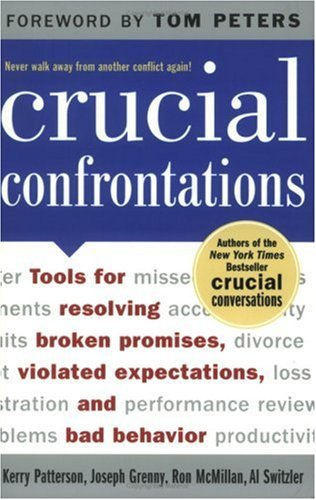
    Today, I’m quoting from the book, Crucial Confrontations: Tools for Resolving broken promises, violated expectations, and bad behavior, by Patterson, Grenny, McMillan, & Switzler. If you ever or even occasionally find yourself in the scenario of having to confront someone – I highly recommend this book.

     Think CPR

    “The first time a problem comes up, talk about the Content, what just happened: ‘You drank too much at the luncheon, became inebriated, started talking too loud, made fun of our clients, and embarrassed the company.’ The content of a problem typically deals with a single event – the here and now.

    The next time the problem occurs, talk Pattern, what has been happening over time: ‘This is the second time this has occurred. You agreed it wouldn’t happen again, and I’m concerned that I can’t count on you to keep a promise.’ Pattern issues acknowledge that problems have histories and that histories make a difference. Frequent and continued violations affect the other person’s predictability and eventually harm respect and trust….

     As the problem continues, talk about Relationship, what’s happening to us. Relationship concerns are far bigger than either the content or the pattern. The issue is not that other people have disappointed you repeatedly; it’s that the string of disappointments has caused you to lose trust in them: You doubt their competency, you don’t respect or trust their promises, and this is affecting the way you treat one another: ‘This is starting to put a strain on how we work together. I feel like I have to nag you to keep you in line, and I don’t like doing that. I guess my fear is that I can’t trust you to keep the agreements you make.’”

    To learn more about this book or order it through my Amazon Affiliate’s bookstore, click this link.

  • The Tunnel of Chaos

     
    “When you did that, it really hurt me. I’ve been mad at you ever since.” That sentence is the culmination of a conversation a friend had with me a while back. It was over breakfast – one that he initiated. I was totally floored. I had no idea that I had said something that hurt my friend. I’m embarrassed to say I didn’t even know he was mad at me.

    That conversation marked an important point in our friendship. I could have chosen to make a joke and take the event lightly. I could have gotten defensive and attacked my friend – pointing out that it was really his fault, not mine. I could have gotten mad back at him. OR, I could have spent time understanding what happened, acknowledging my mistake, and working towards building a deeper understanding about how I could ensure I don’t hurt my friend again.

    To his credit, my friend took the first, more difficult step. He chose to talk to me about it. I am so thankful for that. I know many would have just pushed it under the rug, leaving a big bulge, and spent weeks, months, or even years walking over it every day.

    The Tunnel of Chaos is that tunnel that leads from artificial to authentic relationships. It is a key to building trust with your family, friends, and coworkers. It is a critical component to your leadership team’s success and health. It is a foundational element of fostering and keeping a culture of trust.

    You enter the tunnel when you choose to engage in crucial confrontations with a solid commitment to hold steady until you’ve reached a positive resolution and a deeper friendship.

    Bill Hybels coined this phrase in his book, Axiom: Powerful Leadership Proverbs – a book I highly recommend. You can read this very short excerpt from the book from the Willow Creek Global Summit website right here.

    When was the last time you entered the tunnel with an individual or your team?

    Disclosure of Material Connection: Some of the links in the post above are “affiliate links.” This means if you click on the link and purchase the item, I will receive an affiliate commission. Regardless, I only recommend products or services I use personally and believe will add value to my readers. I am disclosing this in accordance with the Federal Trade Commission’s 16 CFR, Part 255: “Guides Concerning the Use of Endorsements and Testimonials in Advertising.”